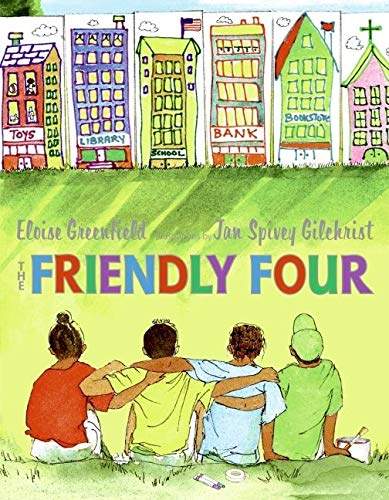
Written by: Eloise Greenfield
Illustrated by: Jan Spivey Gilchrist
Published by: HarperCollins, June 13, 2006
ISBN: 978-0060007591
Plot Summary
Drummond lives on a street where he is the only kid, just him, two teens, and two babies. At the start of the summer, he spends his time wishing that it would end soon so that he can return to school and see his friends. But a new family moves in across the street and he meets and befriends Dorene. Soon, they find out another new boy has been adopted and will be coming to live on their street. Their foursome becomes complete when Dorene and her grandmother fly to retrieve her cousin, Rae, who is coming to stay with them while her mother is sick. The children become fast friends who are always together, and Drummond finds himself wishing the summer would never end.
Critical Analysis
The formatting of the book mimics Drummond's own life on his street where he starts out alone and gradually finds more friends moving in. The poems in the first section of the book are written for just one voice, Drummond's. In each concurrent section, a new friend is introduced and another voice is added to the poems, eventually ending up with poems written in 4 voices, Drummond, Doreen, Louis, and Ray. The reader is able to watch their friendship grow and see Drummond's summer go from a bummer summer to a good summer.
We meet Drummond first, who likes to wrestle and run. Unlike many children, he feels like "summer's a bummer" because he has nobody to play with. In "After the Baby" we find out that he is a big brother. This poem makes great use of wordplay. Many adults use this phrase when a baby is expected, to describe how things will change after the baby is born. However, in this case, Drum is talking about being stuck at home with his brother and the babysitter, constantly being told that they'll go to the playground "after the baby finishes his nap . . . has his diaper changed . . . eats." But "after the baby" always takes too long. You can really hear Drum's voice in this poem- an active and frustrated child who is constantly being asked to wait to do something fun.
Drum's words are all written in red, so the first section of the book, just titled "Drum" is completely comprised of red text. However, at the end of his section, he sees new neighbors moving in, with a little girl around his age. We meet Dorene, and her voice joins Drum's in section two, with blue text to go with his red. Their first poem together, "Drum and Dorene" begins with repetition, which helps to set the rhythm of the poem and makes the reader picture a friendly but somewhat awkward meeting between two new neighbors. Before, the pace of the poems had been slow in Drum's solo section, but it picks up a bit here, mimicking the children's actions of running, chasing, and playing together. This section ends with a poem called "The New Boy." In it, Drum and Dorene learn that Ms. Lynn Bunton has a new son who is 6. Since they are both 7, they have decided that he is perfect for them, as well as for Ms. Bunton. This shows how close the two friends have grown since they are now thinking as a pair instead of individuals.
In section three, we meet Louis, Ms. Bunton's new son. It is immediately apparent how much his new mother really loves him. His voice, in green text, joins Drum's and Dorene's, bringing in more color and life to their story. He says that his new mama's eyes remind him of someone he thinks he knew, maybe his mother. This connects his new mother with his birth mother, linking them together in love and care for him. The first thing they do to celebrate their newfound friendship is have a party. Louis is immediately welcomed to the group, in a spot that has seemingly been waiting for him the entire time. The children's joy is apparent in the words of "The Party": "Now, let's just be silly, and make too much noise, and laugh a lot, because we have a new friend, because I have two new friends. Let's be willy-nilly silly, and laugh. Because we want to." You can hear the excitement and raucous shouts that would be taking place at a party with these three new friends.
Soon the mood turns more somber, in the last poem of section three, titled "Going to Get Rae". Dorene and her grandmother are going to get her so that she can stay with them while her mother is sick. In the next chapter, Rae's voice in purple completes the rainbow of text. In her opening poem, she explains that she doesn't plan to unpack her things because her mother will be better soon and the faster she can pack up, the faster she'll get home to her. This shows her child-like hope that her mother will recover soon and that she'll be able to return home to help her.
Dorene convinces Rae to meet her friends and soon the four are close. Their voices begin to meld into one, represented by black text as the four speak in pairs, trios, and as a whole group. We see their attitudes change, as Drum becomes less and less ready to see the summer come to an end and Rae realizes that she'll miss her new friends when she's able to return home.
The friends make their own town called Goodsummer in Drum's yard and have adventures at the movies, the bank, school, the office building, the library, the pet shop, and the concert hall. In the last section, they say goodbye, with plans to meet again next summer to continue their adventures.
Excerpt
"At the Movies"
Drum: Is the monster still on the screen?
Rae: Yes. He's stomping
I'm looking with one eye closed.
Louis: I'm looking the other way.
Drum: I'm covering my face.
Dorene: My head is in my lap. What's he doing now?
Rae: He's waving his fist.
Drum, Dorene, Louis: Ohhhh!
Louis: What's he doing now?
Rae: He's running . . .
Drum, Dorene, Louis: Oh, no! He's running!
Rae: . . . away. The people are chasing him.
All: Yaaay!
Rae: That was a great movie.
That monster was mean.
Drum, Dorene, Louis: That was the best movie
I have ever not seen.
Use
Students will read the poem aloud in a group of 4. Each one will take the part of one of the characters. They will pantomime the actions like the children are doing in the poem, pretending to watch a scary movie.



No comments:
Post a Comment