Saturday, February 29, 2020

Book Review: The Surrender Tree


Written by: Margarita Engle
Published by: Henry Holt and Company, 2008
ISBN: 978-0-8050-8674-4

Plot Summary

The Surrender Tree follows the story of Rosa, a slave in Cuba in the 1800s who works as a healer for runaways who have been captured. Rosa's life coincides with Cuba's wars for independence. She grows up and continues to be a healer for sick slaves who have been freed by their owners but are still sought out by Spain. She is hunted by Lieutenant Death, a boy she knew from childhood who is still a bounty hunter as an adult.

A girl named Silvia who is sent to a reconcentration camp sets out to find Rosa after her family dies in the camp and learns to be a healer from her. When Cuba's woes with Spain finally end, they are faced with a new foe, the Americans.

Critical Analysis

The story is told through the viewpoints of several different characters. Each one has their own style, with Rosa and Silvia's passages being longer and full of imagery while Lieutenant Death and Jose's are more terse and short.

Language is an important feature in the poems, both the use of Spanish and English intertwined as well as word choice. In Rosa's first poem, she says "Some people call me a child-witch, but I'm just a girl who likes to watch". The use of witch and watch helps to symbolize how the 2 concepts are so similar and yet so different. The words are only 1 letter apart but so separate in meaning, just as they are used to describe the same person, Rosa, through her own perspective and that of other people.

When describing the sounds of the jungle at night, Rosa lists several animals and ends with the song of un sinsonte, a Cuban mockingbird. The word not only infuses the Cuban culture into the poem, but it sounds like "sing-song", giving the reader an idea of how the birds, bugs, and animals must sound.

The emotions that the poems evoke in the reader are very real. Lieutenant Death talks about the time his father took him to be healed by Rosa and tells her that his arm has been injured by wolves. Lieutenant Death says "I grin, not because I have to be healed by a slave-witch, but because it is comforting to know that wild dogs can be called wolves, to make them sound more dangers, making me seem truly brave." This says to the reader that although he is putting on a brave front, he is really a scared boy and helps to emote the fear he feels in the moment, due both to the wolves and perhaps also Rosa herself.

The imagery is strong throughout the book. Rosa's description of the burning of Bayamo evokes not only images but smells and feelings as well. You can close your eyes and almost feel as though you are there walking with her. "I watch the flames, feel the heat, inhale the scent of torched sugar and scorched coffee . . . . I listen to voices, burning a song in the smoky sky." Additionally, the use of torched and scorched brings some rhyme into the writing and really drives home the idea of how destroyed everything is.

There are a few references to cages throughout the book and this may be a nod to the slavery that was present in Cuba's early days. At the beginning of the book, Lieutenant Death mentions that his father cuts apart the bodies of runaways and puts them in separate cages so that their spirit cannot fly away. This implies that the slaves will never truly be free, which foreshadows their fate after they are freed by their owners, only to have Spain stake a claim on them.

Cages reappear near the end of the book when Silvia tells Rosa about her grandparents who kept caged birds. They would carry them up a hill to watch the sunset and she remembers the birds singing and dancing, even while caged. This again symbolizes both the slaves as well as Rosa and Jose's adult lives on the run during the wars. Although they were trapped, they still lived their lives and experienced happiness.

Awards Won

2009- Pura Belpre Medal Winner
2009- Newbery Honor Book

Review Excerpt

From Kirkus Reviews, published March 15, 2008

"The poems offer rich character portraits through concise, heightened language, and their order within the cycle provides suspense.

Connections

Students can read this book alongside a book about the American Revolution and compare the two. Special attention should be paid to how the US changes from their Revolutionary War to the Spanish-American War.

Students can research other instances in which concentration camps were used throughout history. Most people know about their use during the Holocaust but are unaware of other examples.

Book Review: Bow Wow Meow Meow: It's Rhyming Cats and Dogs


Written and Illustrated by: Douglas Florian
Published by: Hartcourt, Inc., 2003
ISBN: 0-15-216395-6


Plot Summary

Bow Wow Meow Meow is a collection of poems about cats and dogs. Florian divides the poems up by breed, covering such popular ones as the Bloodhound, Poodle, Dalmatian, panther, and lion. Each poem is accompanied by an illustration of the animal.

Critical Analysis

The first thing one notices about this book is its bright pink cover. This is a book that will stand out on the shelves and is sure to delight those that seek it out or just happen to grab it based on the pop of color it provides. The cover illustration is an interesting one that turns the tables on the old story of dogs chasing cats. It features a cat with its mouth wide open and a dog inside, holding a bone in its jaw.

The illustrations throughout the book are fairly simple line drawings, but many contain fun details. The illustration for Dog Log shows inside a dog's brain and all the thoughts he is contemplating. These include fetch, smells, roll over, wag and other dog-related thoughts.

The illustration for The Siamese is another that will delight the reader. It shows a large Siamese cat holding a man in its paw. Any cat owner will know that the cat is really the one running the show. The drawing reflects the poem's assertion that states "And I'm the boss, you know, Not you!"

Florian seems to almost play with the words in the poems, using funny and punny sayings in his works. In The Whippet, he cleverly uses the dog's name since it sounds similar to "whip it": "The whipper speeds with ease and grace. Few dogs can whippet in a race."

Onomatopoeia is used to great effect in The Chihuahua. He plays off the small dog's reputation of excessive barking and uses its name to mimic its sound. "But it can bark a brouhaha: ¡Chi-hua! ¡hua! ¡hua! ¡hua! ¡hua! ¡hua! ¡hua!"

Florian also makes use of the typography to add extra flair to a few poems. In The Dalmatian he uses assonance with the repetition of the short o sound. Each of those o's is a black spot, mimicking the spots on the dalmatian's white coat. In The Poodle, the text is written in curly cues, to match the dog's curly coat, rather than in straight lines.

Review Excerpt

From Publishers Weekly, published February 10, 2003

"While a few paintings may seem over the top (e.g., the bloodhound is surrealistically depicted as having a nose that houses a smaller hound), most are exceedingly clever.

Connections

The short and funny poems in this book really lend themselves to being read out loud. Students can select a poem to read alone or in groups and prepare simple costumes to match the type of dog or cat their poem is about. They could also make puppets and use those to read the poem.

Friday, February 28, 2020

Book Review: Voice of Freedom: Fannie Lou Hamer, Spirit of the Civil Rights Movement


By: Carol Boston Weatherford
Illustrated by: Ekua Holmes
Published by: Candlewick Press, 2015
ISBN: 978-0-7636-6531-9


Plot Summary

Voice of Freedom tells about the life of Fannie Lou Hamer through a series of poems. She was born the youngest of 20 children to sharecroppers in Mississippi. The majority of her childhood was spent working in the cotton fields, only attending school December through March when she wasn't needed in the fields.

As adults, her siblings moved north, but she stayed in Mississippi to care for her mother following her father's death. She married Perry Hamer and adopted two daughters. She was tricked into sterilization surgery and never had biological children of her own.

She attended a meeting about voter registration and went with a group to register, but failed the test. She worked hard, and had to live on the run to protect her family, but went back and passed. She joined the Student Nonviolent Coordinating Committee (SNCC) and became a leader of the movement, singing at rallies.

She was arrested and beaten for eating lunch at a whites-only counter on the way home from attending citizenship school in 1963. She ran for Congress and worked for the Mississippi Democratic Freedom Party, attending several Democratic National Conventions as a representative.

Fannie Lou Hamer worked her entire adult life to ensure that African Americans were able to vote and represent their fellow citizens. Although she herself never won an election, she was instrumental in helping to get legislation passed and getting other black congresspeople elected. She also started a farm project to reduce hunger and helped to start a Head Start preschool program.


Critical Analysis

This book reads as though Fannie Lou Hamer is telling you a story (or actually singing you a song) all about her amazing life. The language is conversational and would lend itself well to an audiobook. The author also used diction in the poems, writing in the way that Hamer herself would have spoken.

The illustrations in the book are done in a collage-style manner, mimicking a quilt with many pieces combined together. They look as though many pieces of different fabric have been combined to create the people and places that were important to Hamer's life.

The cover shows Hamer singing and wearing a yellow dress and hat. In the background, there is a yellow batik print that reappears in several illustrations throughout the book, tying together the moments of Hamer's life. It appears in the illustration for Sunflower Couty, Mississippi, again in the background. It mirrors the sunflowers shown in the photo and is representative of her home of Sunflower County. The pattern reappears in the sky in the next picture for Delta Blues. Then it forms her mother's dress in Spoiled and is mirrored on the next page in her doll's dress, showing the connection between her mother and the sacrifices she made for her. The batik pattern is present in other colors towards the end of the book, representing how she changed and grew throughout her life.

In addition to the batik pattern, there are others that appear numerous times throughout the book, including one that looks like sheet music, a nod to Hamer's musical ability.

The picture that goes with the poem Delta Blues stands out for its composition. At first glance, it looks like people are trailing long white beards or hair behind them. Upon closer inspection, one sees that they are actually bags filled with cotton. This gives the reader a sense of the hard and unending job that working in the cotton fields was.

Much of the book does not have a traditional rhyme scheme, but there are times that it is used with great effect. Delta Blues, about Hamer's time picking cotton ends with the lines "Sharecropping was just slavery by another name. The same folks still had us, had us in chains." The use of the rhyme scheme drives home the point that nothing had really changed for Hamer and her family. The same poem also uses alliteration which enhances the sound of the poem. "Same sorry situation every season."

Awards Won

2016- Caldecott Honor Book
2016- Robert F. Sibert Honor Book
2016- John Steptoe New Talent Illustrator Award Winner


Review Excerpt

From Kirkus Starred Reviews, published April 15, 2015

"Young readers who open this book with just a vague notion of who Fannie Lou Hamer was will wonder no more after absorbing this striking portrait of the singer and activist." 

Connections

There is a video available by the same name that has narration and some animation to go along with the book. Watch it after reading the book aloud to allow students to hear the poems in other voices.

Tuesday, February 11, 2020

Book Review: The Frog Princess: A Tlingit Legend From Alaska


Retold By: Eric A. Kimmel
Illustrated by: Rosanne Litzinger
Published by: Holiday House, 2006
ISBN: 978-0-8234-1618-9


Plot Summary


The village headman's daughter cannot find a suitor who she believes is good enough for her. She says she would rather marry a frog. That night, a stranger comes and asks her if she really meant that she would rather marry a frog than any of the suitors. She confirms that it is true and he leads her to the bottom of the lake and to her new home with the frog people. She marries a frog husband and has many frog children, but her parents miss her and believe her to be dead. One day a traveler tells them he saw a young girl singing surrounded by frogs and describes their daughter. The headsman tells the Chief of the Frog People to return his daughter. The Chief offers gifts instead and says that the daughter is happy where she is. The headsman threatens to start a war if she isn't returned. The daughter is returned but is very sad and will only croak until a shaman makes her into her old self. She explains that she is sad and misses her husband and children. Her parents try to convince her to marry a human but she leaves and is never seen again, nor were any other frogs in the lake. But long after, a traveler was told by a frog to tell the headsman that his daughter was happy with her husband and children. The traveler told the headsman, and as he did, he heard frogs croaking across the lake. But when he shut his eyes, he could hear them speaking in Tlingit.

Critical Analysis

This is a tale of transformation, like other similar tales where a human is turned into an animal. It differs from some in which the transformation is a result of a spell or punishment because, in this story, it is the daughter's choice to become a frog. The story also has similarities to other tales in which a leader's child is being forced to choose a spouse but cannot find anyone suitable (Aladdin or Cinderella).

Since this is a traditional legend of the Tlingit people, there is ample opportunity to display their culture through the illustrations and story. However, as is mentioned in the Kirkus review noted below, the connections are limited and the main characters' robe goes against the traditional clothing of the culture. Tlingit people use natural elements to create their clothing, so the main character's bright yellow cloak does not fit with an accurate portrayal of their culture. The illustrator was trying to show her individualism however, this misses the mark and perhaps is an example of the illustrator putting her own cultural background and ideas into the illustrations rather than honoring those of the Tlingit culture.


The illustrations overall do not fit with the culture, the yellow robe isn't the only example of that. They are watercolors that give the book an almost ethereal, dream-like equality. One could argue that this fits in with the unusual tale. However, traditional Tlingit artwork is generally much bolder in terms of coloring and style.

One illustration that does a good job of tying in the culture is that of the suitor with bulging eyes on page 4. His cloak is a more natural color that could have been made from elements and his headdress evokes the style of the Tlingit totems, for which they are well-known.


Review Excerpt

From Kirkus Reviews, published May 15, 2006

The story is gracefully told and there is limited use of Tlingit imagery in the animal headdresses worn by some male figures. The illustrator explains that the princess’s untraditional yellow robe is a way to show the young woman’s individualism, but the attractive watercolors lack a strong feeling for this unique cultural group.

Connections

Read this book and a version of The Frog Prince to students. Ask them to find similarities and differences between the two.

Delve more deeply into Tlingit tales by sharing other collections of stories, such as Shamans and Kushtakas: North Coast Tales of the Supernatural or Heroes and Heroines in Tlingit-Haida Legend, both by Mary Beck.

Book Review: Joseph Had a Little Overcoat


By: Simms Taback
Published by: The Penguin Group, 1999
ISBN: 0-670-87855-3


Plot Summary


Joseph has an overcoat but it is old and worn he makes a jacket out of it and wears it to the fair. After a time, it continues to get old and worn and he makes a vest, a scarf, and other items out of it, the garments getting smaller and smaller over time. He wears or uses each one for something different. The moral at the end of the story teaches us that you can always make something out of nothing.

Critical Analysis

Taback modeled this book after an old Yiddish song he knew as a child. It is a type of cumulative tale where the action continually repeats itself (the garment becomes worn and Joseph fashions it into something smaller). Children may think all is lost, literally, when the last of the overcoat, a small button, is lost by the main character. But Joseph triumphs by making the book that the reader is now holding, thus proving the lesson at the end of the book, you can always make something from nothing.

The tale is simple and repetitive and allows the illustrations to really shine. The level of detail in the pictures is amazing and you can read it several times and discover something new upon each re-reading. The cut-outs are perfectly hidden in the pages so as not to spoil the next iteration of the coat. The colors used are bright and bold and give a warm and cozy feeling to the book.

The reader is able to tell just how special the coat is to Joseph based on the places he chooses to wear it. Some of them include his nephew's wedding, visiting his sister and singing in the men's chorus. This helps one to understand how sad Joesph must have been when he lost the button, the last part of the coat that he had remaining. The author then inserts himself into the story by showing Joseph creating the book that the reader is now holding in their hand.

The illustration that shows Joseph making the book includes animals that have been shown previously in other pictures throughout the book. This might be because Joseph is using them as models to draw the illustrations in the book or because they are showing an interest in what he is making since they have been there throughout his life as he wore the coat.

Awards Won

National Jewish Book Award for Children's Picture Book, 1999
Caldecott Medal, 2000

Review Excerpt

From Publisher's Weekly, published October 4, 1999

Taback's inventive use of die-cut pages shows off his signature artwork, here newly created for his 1977 adaptation of a Yiddish folk song. This diverting, sequential story unravels as swiftly as the threads of Joseph's well-loved, patch-covered plaid coat. 

Connections

Use this book and Taback's unique style of die-cut pages to introduce an art project to students. Have them create a two-layered picture, with the top page having cutouts in it to reveal part of the bottom page.


Book Review: The Three Little Pigs


Illustrated By: Paul Galdone
Published by: Clarion Books, 1970
ISBN: 0-395-28813-4


Plot Summary


A mother sow does not have money to keep her piglets, so she sends them away from home. The first meets a man with straw and convinces him to give him the straw to build his house. The wolf comes, blows his house in and eats the pig. The second little pig meets a man with sticks who gives him the sticks to build his house. The same routine with the wolf ensues and the pig is eaten. The third little pig meets a man with a load of bricks and gets them to make his home. The wolf tries to blow his house in but is unable to, so he decides to trick the pig. He invites him to a turnip farm, an apple tree, and a fair, in turn, to try to eat him, but the pig outsmarts the wolf and goes before him. At the fair, he buys a butter churn and scares the wolf away by rolling down the hill in the churn. When the wolf sees he's been tricked a third time, he tries to go down the chimney but the pig starts a fire, boils the wolf and eats him for supper.

Critical Analysis

This book tells the classic tale of the three little pigs and their homes. It uses repetition in the language used by both the wolf and the pigs, which makes it easy for small children to follow and memorize.

It is interesting to be able to see the experience coming home from the fair from both the perspective of the third little pig and that of the wolf. We see that the pig's original intent was just to hide in the churn. It is an accident that the churn falls over and since he is rolling inside it, the pig does not realize he has frightened the wolf. Later when the wolf comes to his house, he tells the pig "A great round thing came rolling down the hill right at me" and the pig realizes that it was him and that he scared the wolf away. This makes the wolf angrier than he'd been before when the pig tricked him. Readers may be able to relate to this part of the story because it is likely that the wolf is embarrassed to find out that it was only the pig in a churn that made him so scared.

The illustrations are a treat for the eyes. The front cover pictures the three pigs, each holding an item that the wolf tries to use to trick the third pig, and ensconced in a homey wooden frame that one can imagine the third pig would hang on his sturdy brick wall. The color scheme is kept fairly simple with reliance on heavy black outlining to really enhance the characters and setting.

There is definitely a natural theme in the illustrations throughout the book. The title page features clover. The first page of the book shows a beautiful meadow, although it also evokes sadness with the presence of the mother pig's tears. It is interesting to see the difference in the 3 pigs' reactions to leaving. The first is facing away from his home, down the road, as if looking to the future. The second pig is facing his mother with a sad look on his face, but no tears. The third pig is crying, just as his mother is, and has a hoof raised in a wave goodbye.

The tale begins when the mother pig is unable to keep the piglets because she has no money. This provides detail about the pigs that is lacking from some other versions. Perhaps the reason that the first two pigs make bad decisions in regards to their homes is that they are too young and inexperienced. Other versions of the tale specifically state that the time has come for the pigs to go out into the world to find their own way. The first two pigs' fate is grimmer than some other versions in which they are able to escape the wolf and run to their brother's home for safety. This adds somewhat to the third pig's reasoning behind his treatment of the wolf at the end of the book and allows readers to take away a sense of fairness being returned to the story.


Review Excerpt

From The Horn Book "Some Pigs! What Makes a Good Three Little Pigs?", published March 1, 2009, by Joanna Rudge Long

Paul Galdone’s 1970 The Three Little Pigs, small and lap-friendly, is close to Jacobs but slightly simplified — a boon for newly independent readers. His deftly sketched piglets are starry-eyed innocents in familiar-looking farmland, his wolf just scary enough to serve the story without provoking nightmares.

Connections

Share other versions of The Three Little Pigs with students and have them compare and contrast the stories and illustrations.

Discuss the various ways that the wolf tried to trick the third little pig and how the pig manages to get a leg up on the wolf each time. Have students come up with additional ways the pig could trick the wolf in each situation.

This story lends itself to readers' theater, but take care if sharing with young children who will be sensitive to the fates of the first two pigs.

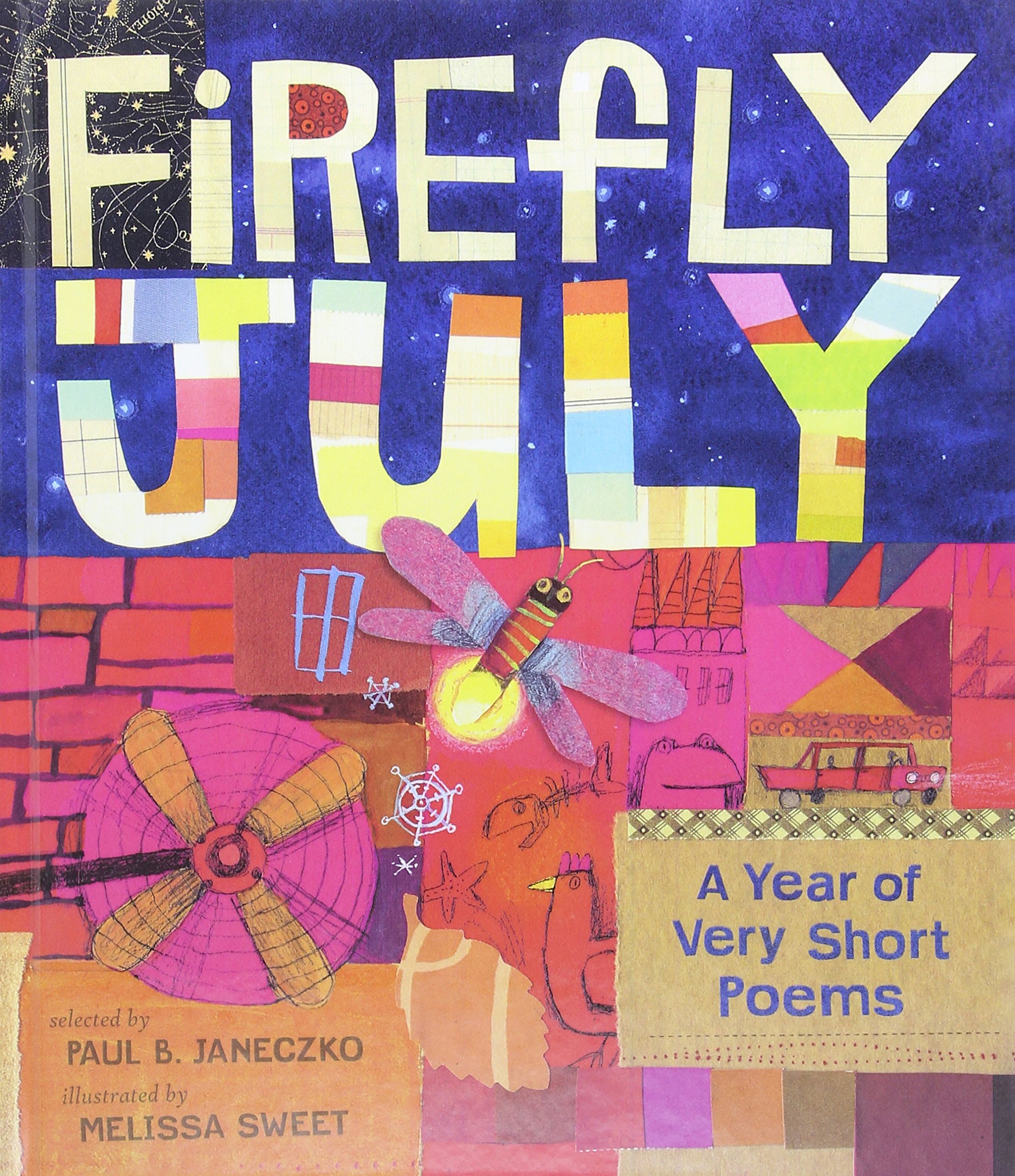
Book review: Firefly July

  Selected by: Paul B. Janeczko Illustrated by: Melissa Sweet Published by: Turtleback Books, April 10, 2018 ISBN: 978-0606409025 Plot Summa...