Monday, January 25, 2021

Book review: Construction People


Title: Construction People

Poems selected by: Lee Bennett Hopkins

Illustrated by: Ellen Shi

Published by: Wordsong, March 17, 2020

ISBN:  978-1684373611

Plot Summary

Construction People is a collection of 14 poems written by various poets and compiled by Lee Bennett Hopkins. They point the spotlight on the people and machines that are used to construct buildings. The book starts with a poem focused on the early stages of a building- when it is just plans and blueprints. It ends with a fully constructed skyscraper and along the way, we get to meet the people and see the processes that work together to complete it. 

Critical Analysis

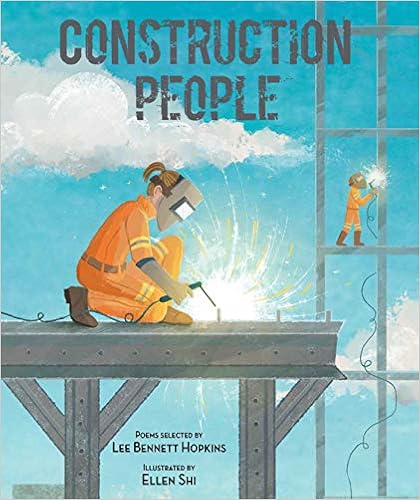
The book opens before the building has even begun. The first poem "What Will I Become", by Rebecca Kai Dotlich, provides an overview of all the work it will take to construct the building. Arranged in verses, this poem doesn't use rhyming but does include other poetic elements. Repetition is present in the poem, which begins with the line "I will rise". We see this line again in the later stanzas of the poem, and it works as a guidepost, leading us through the steps taken to create the masterpiece that the building will become. The accompanying illustration shows the very first tools that will be used for the building- not hammers or cranes, but protractors, rulers, and blueprints. The prints are hazy, perhaps showing the plan isn't yet complete, but this also serves to mirror the clouds that are shown in later images of the building itself. 

"Backhoe Operator", by Georgia Heard, has a rhyming couplet scheme- it is arranged into pairs of lines, each of which rhyme with one another. The simplicity of this style is combined with the more complicated words used, mirroring the job of the backhoe operator. The job itself seems straight-forward: moving dirt. However, there is much careful and detailed work required on the part of the operator behind the scenes to make his work appear easy. The poem uses personification to describe the backhoe, telling of how it sinks its teeth into solid ground. This line helps to paint a picture of the first moment that it begins to dig and will help students to imagine what it looks like as they can think about how it looks for a person to bite into something solid, like an apple. In the picture, the backhoe operator is shown with a dark skin tone, and throughout the book, the illustrations show people from a variety of ethnic backgrounds, as evidenced by their skin, hair, and facial features. This helps students to see themselves in the book and to realize that anyone can do these jobs. 

"Dump Truck Drivers" by Darren Sardelli makes use of several poetic elements. Onomatopoeia is found in the poem and is used to describe the noises that the trucks make: "BEEP BEEP SCREEEEECH HARUUUUMFFFFF FA LUMFFFFF". These are the sounds we hear when the trucks drive and reverse on the site. Those lines are written in all capital letters and are italicized. This serves to make them stand out on the page, much like the sounds they describe stand out among quieter sounds in the city and at the construction site. The mounds of dirt the truck carries are compared to brownie mix. This metaphor helps students to visualize the dirt in terms of something with which they are likely familiar. The poem ends with some wordplay, talking about how dump truck drivers are here to "back up builders". They indeed literally back up to dump materials in their spots, but also help to lend support to the other workers, thus figuratively backing them up as well. The last line says that their "caring contributions help them build a strong foundation." Again, the foundation is literal since they are helping to construct a building's actual foundation, but also refers to the figurative foundation built between the workers cooperating with one another. 

Excerpt

"What I Am " by Rebecca Kai Dotlich

A storied tower
called
            splendid

etched with echoes
of chatter and shouts,
an iron chime of voices,
topped by a slender slant
piercing the bluest of skies.

Majestic with steel spine;

once known

                as blueprint

now part of a
                breathtaking
                spectacular

                skyline.

Use

Read the poem aloud to students twice without showing them the poem in the book. Then show a printed version so students are able to see the layout of the words on the page. Read the poem again, and then discuss how the poem flows the relationship between that and the layout on the page. Discuss all the words in the poem that are used to describe the building and the process that it takes from being a blueprint to becoming a part of the skyline. 

Book Review: Stampede: Poems to Celebrate the Wild Side of School


Title: Stampede: Poems to Celebrate the Wild Side of School

Written by: Laura Purdie Salas

Illustrated by: Steven Salerno

Published by: Clarion Books, April 6, 2009

ISBN:  978-0618914883

Plot Summary

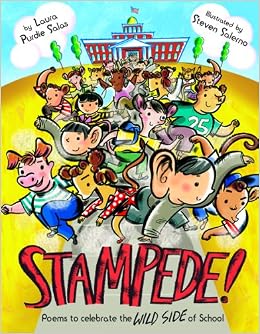
Stampede is a collection of 18 fun poems that begin with students waiting for school to start and then follow the course of their day, ending in dismissal. Each poem uses an animal to describe how students might act during that portion of the school day. The fun and funny poems follow the structure that one might recognize from animals being described in a zoo or on a nature program. 

Critical Analysis

The school day is the focus of the poems in Stampede. Some will inspire readers to laugh out loud, while others are more thoughtful and touch upon the range of emotions that students may experience throughout the day or year. All of the poems utilize rhyme but they do so in many different formats. For instance, "Ducks in a Row" is an acrostic poem, using the first letters of the word "ducklings" to describe how students look as they walk in a line through the halls of the school. The lines are broken up by their first letters so they are not all a uniform length. However, the rhyme scheme follows the same rhythm based on the syllables in the words throughout the poem. "Prickly" has a more traditional alternate rhyme format, but the poet plays with the rhymes,  making them appear throughout the poem and not just on every other line- the first stanza has 3 rhyming lines in a row. The second has a more common every other line rhyming pattern, but the last two words on each of those lines rhyme, giving the poem a more solid rhythmic sound. 

Since all the poems use a different animal to describe the parts of the school day, symbolism and metaphor can be found frequently throughout the book. In "Nesting" the student is a quiet fox with their desk as their den. The clever illustration shows another student peeking at the desk, which is cracked open just about an inch and from which only a pair of eyes can be seen. Flowing out of the crack is a reddish-brown tale- perhaps that of a fox or just a girls' ponytail. It shows the fox actually hiding inside the desk, while a human student would see the desk as their safe spot to hide all their precious treasures without actually having to climb inside themselves. The end of the poem says that their den/desk makes them feel safe when they're not understood. This would be true both of an actual fox, who would seek safety from predators in their den, but also of a student who may feel more protected and sheltered from the class's looks or the teacher when seated in their "safe space". 

Onomatopoeia is used in the poem "Rumble, Grumble Growl" to describe the noises students' stomachs make when they're ready for lunch but it's not quite time to eat. In this poem, a bear is used for comparison, since both bears and stomachs are known to rumble, grumble, and growl. More specifically, the poet says they are "a bear in springtime". This will bring to mind that feeling that students have when they wake up in the morning and are starving for breakfast. Not only is the student in the poem hungry, they're as hungry as a bear that hasn't eaten in months due to hibernation.  The poem has an alternate rhyme scheme, with every other line rhyming. It also uses repetition in the first two lines- "Hear my stomach rumble, hear my stomach roar". The accompanying illustration shows a child dressed in brown whose shoes have fallen off, revealing somewhat paw-like feet. Their hair has gathered up on either side to resemble a bear's ears and they're dreaming about the mentioned chips, fruit, and cake. 

There is an interesting contrast between the poems that describe students at the beginning versus the end of the school day. The book starts off with "Swarm", comparing the gathering children to bumblebees. The reader can picture students hovering around the doors in anticipation, and can almost hear the buzz both of conversation and of the excitement of a new day. The line "we buzz and flitter-tumble" creates a picture similar to the one shown in the illustration with children dressed in black and yellow stripes buzzing, flying, flitting, and tumbling around the yard, eager to find friends, and begin their day. 

The book ends with the titular poem, "Stampede", which compares the students to elephants as they leave school for the day. The anticipation from the beginning of the day and the beginning of the book is gone, but the eagerness remains, although now they are eager to get out of school and stampede home. The students are shown dressed in grey with an arm raised like a trunk, and with slightly larger than normal ears. Rather than individuals buzzing from place to place like they did in "Swarm", they are now all a group with one shared goal, running as one in the same direction (out the school doors). They are now "thundering, fumbling" elephants who "spill outside". In addition to being an apt portrayal of how kids change throughout the school day, being equally excited to leave as they were to arrive, this transformation can be applied to many other parts of life where we are as excited to finish as we were to begin.

Excerpt

"Prickly"

When I'm feeling
porcupine-y,
I get nasty,
I get whiny.

Stay away or
I might stick you.
My sharp words are
quills to prick you.

Use

Introduce the poem by discussing porcupines with students. Show them a picture and ask them to share things that they know about the animal. Then read the poem aloud to students, allowing them to listen to it twice. Discuss why the poem is named "Prickly". Students can do a choral reading of the poem, listening for its sing-songy sound and the rhyme scheme. End the discussion with a chance for students to suggest other emotions they may feel and the animals that could be used to describe them. 


Book Review: The Crossover


Title: The Crossover

Written by: Kwame Alexander

Illustrated by: Dawud Anyabwile

Published by: HMH Books for Young Readers; Illustrated edition September 24, 2019

ISBN:  978-1328575494

Plot Summary

The Crossover tells the story of Josh Bell, a twelve-year-old basketball phenom, as well as his twin brother and their parents. Josh goes through changes as his brother seemingly becomes more interested in "Sweet Tea Girl", as Josh refers to her, than basketball. Josh grows increasingly frustrated with his brother's distraction as well as worried about his father's health issues, until both issues come to a head.

Critical Analysis

The graphic novel version of this novel in verse adds to its rich language with vibrant illustrations and text design that make the words pop off of the page. The basketball theming is present throughout the story. The graphic novel's illustrations are all done in grey tones with only a bold orange, which represents the basketball itself, to add in a pop of color. The book is divided into sections named after the parts of a basketball game- beginning with the warm-up and then moving through Quarters 1-4 before ending in Overtime. There are also pages that are titled "Basketball Rules" and in the graphic novel, they are shown on what looks like a page that has been torn out of a playbook. These "rules" apply both to the game of basketball as well as to what is currently happening in Josh's life. 

The book makes frequent use of metaphors- Josh is "covered in more dirt than a chimney", his friend's girlfriend has "a mouth as big as Vermont", and "the stubble on my head feels like bugs are break-dancing on it." These phrases help to paint a picture and allow the reader to better see and feel Josh's experiences in their own mind. Since the book is written in the first person, you can almost "hear" Josh saying the metaphors aloud while you read. 

The book centers on Josh's close relationship with all of his family members. Of course, he and his twin, JB, share a love of basketball, although they are also different in many ways. Their mother is the assistant principal at their middle school and their father a former professional basketball player in Europe who had to retire due to health reasons. His health conditions are a constant undertone running throughout the book until they take center stage when he suffers a heart attack and has to be rushed to the hospital. Their close family dynamic is a major theme in the book, alongside basketball. 

The book uses rhyme at different points throughout the story. The opening section in the Warm-Up chapter is comprised of rhyming lines that give the text a rhythmic flow, much like the sound of a basketball being dribbled. Many of the rhymes throughout the book come in groups of threes, such as on page 14, "But watch out when he shoots or you'll get schooled, fooled, uncooled." The assonance is also reflected in the word "you'll" used in the verse.

Josh mentions in the book that he is studying for an important vocabulary test. This is something that he would usually do with his brother, helping him since he is a stronger student. However, since his brother is spending more time with his girlfriend, Josh finds himself studying alone. Many of the book's sections begin with a vocabulary word that fits the moment and its definition, for example, "churlish" is used when the brothers' fight comes to a climax and along with the definition, the word is used in several sentences, starting with one that is unrelated to the current events and then moving towards the action in the book. 

Excerpt

    Dear Jordan
                                Without You
I am empty,
                                The goal
with no net.
                                Seems
my life was
                                broken,
shattered,
                                like puzzle pieces
on the court.
                                I can no longer fit.
Can you
                                help me heal,
run with me,
                                slash with me
like we used to?
                                Like two stars
stealing sun,
                                like two brothers
burning up.
                                Together.
        P.S. I'm sorry.

Use

This excerpt from the book is both a meaningful part of the story's plot as well as one that really captures the writing style in its rhythm and use of symbolism. Read the excerpt aloud to the class once and then invite students to join in a choral reading to hear the rhythm structure. Students can discuss how they think Josh was feeling when he wrote this note as well as how they think JB may have reacted to reading it. 


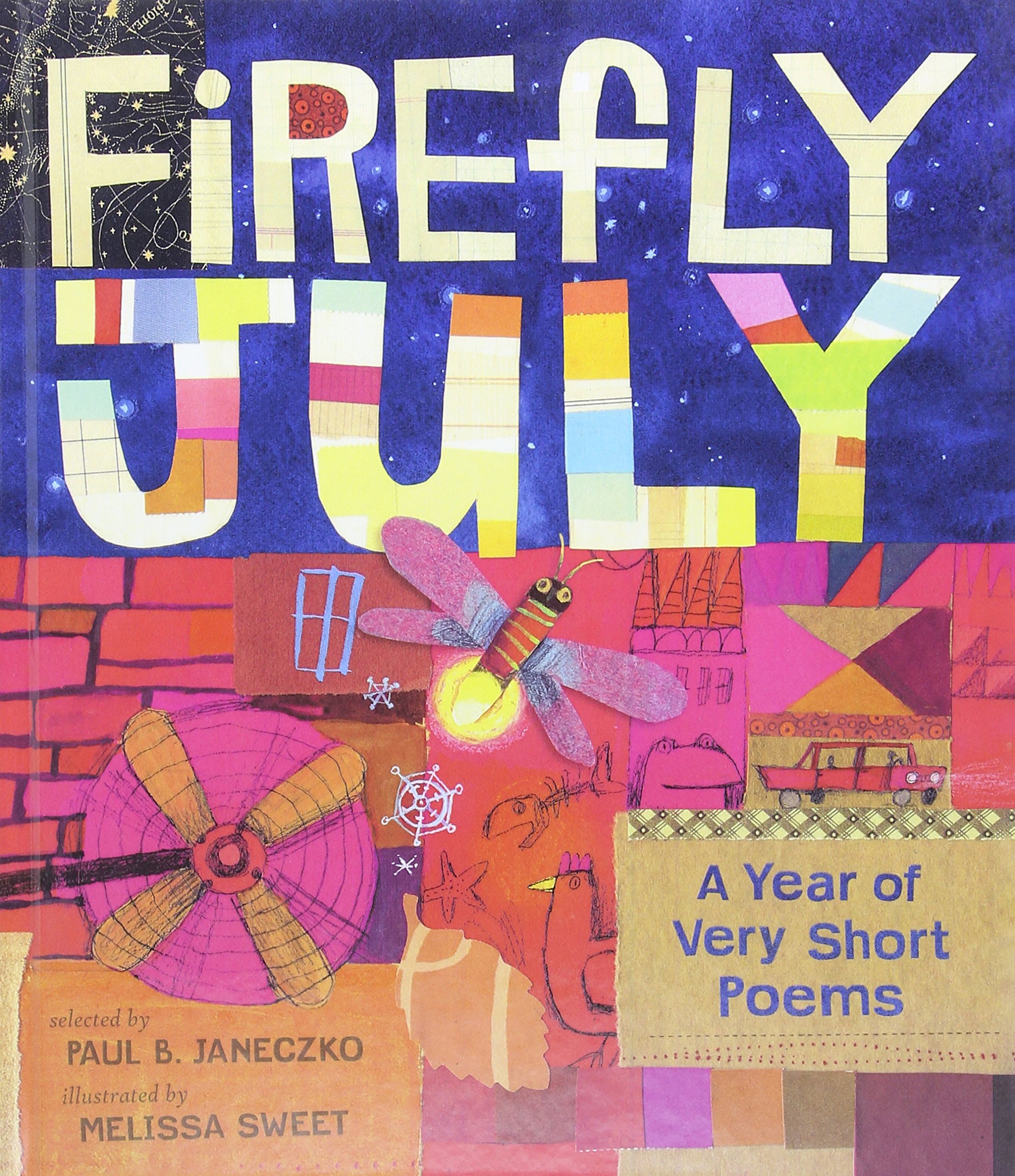
Book review: Firefly July

  Selected by: Paul B. Janeczko Illustrated by: Melissa Sweet Published by: Turtleback Books, April 10, 2018 ISBN: 978-0606409025 Plot Summa...