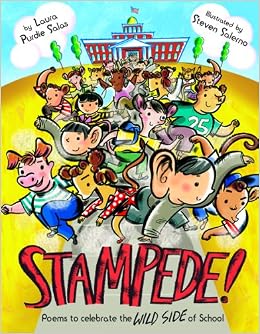
Title: Stampede: Poems to Celebrate the Wild Side of School
Written by: Laura Purdie Salas
Illustrated by: Steven Salerno
Published by: Clarion Books, April 6, 2009
ISBN: 978-0618914883
Plot Summary
Stampede is a collection of 18 fun poems that begin with students waiting for school to start and then follow the course of their day, ending in dismissal. Each poem uses an animal to describe how students might act during that portion of the school day. The fun and funny poems follow the structure that one might recognize from animals being described in a zoo or on a nature program.
Critical Analysis
The school day is the focus of the poems in Stampede. Some will inspire readers to laugh out loud, while others are more thoughtful and touch upon the range of emotions that students may experience throughout the day or year. All of the poems utilize rhyme but they do so in many different formats. For instance, "Ducks in a Row" is an acrostic poem, using the first letters of the word "ducklings" to describe how students look as they walk in a line through the halls of the school. The lines are broken up by their first letters so they are not all a uniform length. However, the rhyme scheme follows the same rhythm based on the syllables in the words throughout the poem. "Prickly" has a more traditional alternate rhyme format, but the poet plays with the rhymes, making them appear throughout the poem and not just on every other line- the first stanza has 3 rhyming lines in a row. The second has a more common every other line rhyming pattern, but the last two words on each of those lines rhyme, giving the poem a more solid rhythmic sound.
Since all the poems use a different animal to describe the parts of the school day, symbolism and metaphor can be found frequently throughout the book. In "Nesting" the student is a quiet fox with their desk as their den. The clever illustration shows another student peeking at the desk, which is cracked open just about an inch and from which only a pair of eyes can be seen. Flowing out of the crack is a reddish-brown tale- perhaps that of a fox or just a girls' ponytail. It shows the fox actually hiding inside the desk, while a human student would see the desk as their safe spot to hide all their precious treasures without actually having to climb inside themselves. The end of the poem says that their den/desk makes them feel safe when they're not understood. This would be true both of an actual fox, who would seek safety from predators in their den, but also of a student who may feel more protected and sheltered from the class's looks or the teacher when seated in their "safe space".
Onomatopoeia is used in the poem "Rumble, Grumble Growl" to describe the noises students' stomachs make when they're ready for lunch but it's not quite time to eat. In this poem, a bear is used for comparison, since both bears and stomachs are known to rumble, grumble, and growl. More specifically, the poet says they are "a bear in springtime". This will bring to mind that feeling that students have when they wake up in the morning and are starving for breakfast. Not only is the student in the poem hungry, they're as hungry as a bear that hasn't eaten in months due to hibernation. The poem has an alternate rhyme scheme, with every other line rhyming. It also uses repetition in the first two lines- "Hear my stomach rumble, hear my stomach roar". The accompanying illustration shows a child dressed in brown whose shoes have fallen off, revealing somewhat paw-like feet. Their hair has gathered up on either side to resemble a bear's ears and they're dreaming about the mentioned chips, fruit, and cake.
There is an interesting contrast between the poems that describe students at the beginning versus the end of the school day. The book starts off with "Swarm", comparing the gathering children to bumblebees. The reader can picture students hovering around the doors in anticipation, and can almost hear the buzz both of conversation and of the excitement of a new day. The line "we buzz and flitter-tumble" creates a picture similar to the one shown in the illustration with children dressed in black and yellow stripes buzzing, flying, flitting, and tumbling around the yard, eager to find friends, and begin their day.
The book ends with the titular poem, "Stampede", which compares the students to elephants as they leave school for the day. The anticipation from the beginning of the day and the beginning of the book is gone, but the eagerness remains, although now they are eager to get out of school and stampede home. The students are shown dressed in grey with an arm raised like a trunk, and with slightly larger than normal ears. Rather than individuals buzzing from place to place like they did in "Swarm", they are now all a group with one shared goal, running as one in the same direction (out the school doors). They are now "thundering, fumbling" elephants who "spill outside". In addition to being an apt portrayal of how kids change throughout the school day, being equally excited to leave as they were to arrive, this transformation can be applied to many other parts of life where we are as excited to finish as we were to begin.
Excerpt
"Prickly"
When I'm feeling
porcupine-y,
I get nasty,
I get whiny.
Stay away or
I might stick you.
My sharp words are
quills to prick you.
Use
Introduce the poem by discussing porcupines with students. Show them a picture and ask them to share things that they know about the animal. Then read the poem aloud to students, allowing them to listen to it twice. Discuss why the poem is named "Prickly". Students can do a choral reading of the poem, listening for its sing-songy sound and the rhyme scheme. End the discussion with a chance for students to suggest other emotions they may feel and the animals that could be used to describe them.



No comments:
Post a Comment