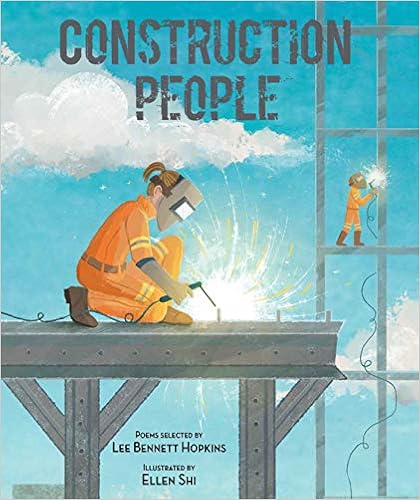
Title: Construction People
Poems selected by: Lee Bennett Hopkins
Illustrated by: Ellen Shi
Published by: Wordsong, March 17, 2020
ISBN: 978-1684373611
Plot Summary
Construction People is a collection of 14 poems written by various poets and compiled by Lee Bennett Hopkins. They point the spotlight on the people and machines that are used to construct buildings. The book starts with a poem focused on the early stages of a building- when it is just plans and blueprints. It ends with a fully constructed skyscraper and along the way, we get to meet the people and see the processes that work together to complete it.
Critical Analysis
The book opens before the building has even begun. The first poem "What Will I Become", by Rebecca Kai Dotlich, provides an overview of all the work it will take to construct the building. Arranged in verses, this poem doesn't use rhyming but does include other poetic elements. Repetition is present in the poem, which begins with the line "I will rise". We see this line again in the later stanzas of the poem, and it works as a guidepost, leading us through the steps taken to create the masterpiece that the building will become. The accompanying illustration shows the very first tools that will be used for the building- not hammers or cranes, but protractors, rulers, and blueprints. The prints are hazy, perhaps showing the plan isn't yet complete, but this also serves to mirror the clouds that are shown in later images of the building itself.
"Backhoe Operator", by Georgia Heard, has a rhyming couplet scheme- it is arranged into pairs of lines, each of which rhyme with one another. The simplicity of this style is combined with the more complicated words used, mirroring the job of the backhoe operator. The job itself seems straight-forward: moving dirt. However, there is much careful and detailed work required on the part of the operator behind the scenes to make his work appear easy. The poem uses personification to describe the backhoe, telling of how it sinks its teeth into solid ground. This line helps to paint a picture of the first moment that it begins to dig and will help students to imagine what it looks like as they can think about how it looks for a person to bite into something solid, like an apple. In the picture, the backhoe operator is shown with a dark skin tone, and throughout the book, the illustrations show people from a variety of ethnic backgrounds, as evidenced by their skin, hair, and facial features. This helps students to see themselves in the book and to realize that anyone can do these jobs.
"Dump Truck Drivers" by Darren Sardelli makes use of several poetic elements. Onomatopoeia is found in the poem and is used to describe the noises that the trucks make: "BEEP BEEP SCREEEEECH HARUUUUMFFFFF FA LUMFFFFF". These are the sounds we hear when the trucks drive and reverse on the site. Those lines are written in all capital letters and are italicized. This serves to make them stand out on the page, much like the sounds they describe stand out among quieter sounds in the city and at the construction site. The mounds of dirt the truck carries are compared to brownie mix. This metaphor helps students to visualize the dirt in terms of something with which they are likely familiar. The poem ends with some wordplay, talking about how dump truck drivers are here to "back up builders". They indeed literally back up to dump materials in their spots, but also help to lend support to the other workers, thus figuratively backing them up as well. The last line says that their "caring contributions help them build a strong foundation." Again, the foundation is literal since they are helping to construct a building's actual foundation, but also refers to the figurative foundation built between the workers cooperating with one another.
Excerpt
"What I Am " by Rebecca Kai Dotlich
A storied tower
called
splendid
etched with echoes
of chatter and shouts,
an iron chime of voices,
topped by a slender slant
piercing the bluest of skies.
Majestic with steel spine;
once known
as blueprint
now part of a
breathtaking
spectacular
skyline.
Use
Read the poem aloud to students twice without showing them the poem in the book. Then show a printed version so students are able to see the layout of the words on the page. Read the poem again, and then discuss how the poem flows the relationship between that and the layout on the page. Discuss all the words in the poem that are used to describe the building and the process that it takes from being a blueprint to becoming a part of the skyline.



No comments:
Post a Comment