Written by: Jessica Love
Published by: Candlewick Press, April 23, 2018
ISBN: 978-0763690458
Plot Summary
Julian is riding with his Abuela on the subway when he sees 3 mermaids. Julian tells his Abuela that he is a mermaid too and daydreams about turning into a mermaid with a real tale. When they get home, Abuela takes a bath and Julian finds items around the house that will turn him into a mermaid. When Abuela gets out of the bath and sees Julian dressed like a mermaid, she gives him a gift and takes him to see a surprise.
Critical Analysis
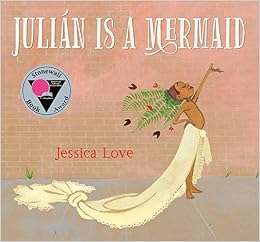
Julian is a Mermaid is a touching story about Julian's relationship with his Abuela and her accepting and supportive treatment of his true self. Julian and his Abuela always start off their Saturday with a swim and the first pages that the reader sees upon opening it is Julian submerged in a pool with Abuela and her friends. The ladies are all at the top of the pool floating and bobbing up and down, all of them in swim caps. Julian, however, swims beneath the surface, exploring the water. This sets the scene for the story.
On the subway on the way home, they see 3 women dressed as mermaids on their way to the Coney Island Mermaid Parade. Julian knows in his heart that he is truly a mermaid. There is no overt discussion of Julian's gender. On the very first page, Julian is introduced as a boy and throughout the book, Abuela refers to him as "mijo", which is a masculine term of endearment, literally translated as "my son". However, Julian's insistence that he is a mermaid is never held at odds with the fact that he is a boy, his Abuela's mijo. There is no conflict between these 2 parts of Julian's identity.
After Julian sees the mermaids on the subway, the book segues into several pages of just illustrations with no text. We see Julian transforming from a boy sitting on the subway into the water, his clothes shedding and his hair growing, until he is a fully formed mermaid with a tail, face-to-face with a large fish. It is obvious that these illustrations show Julian's internal concept of his true self. Julian is Julian, yet he is also a mermaid. These things do not contradict one another.
The style of the illustrations themselves are fluid, almost as if one is looking at an image under water. Abuela's hair stands up in the images of them on the subway and in their apartment, almost defying gravity. The rich tan color of the background lends itself to Julian and Abuela's skin tone. Had the backgrounds been in white or off-white, the color of their skin would stand out more. As is, they are surrounded by other rich tones, making their own skin tones one with their surroundings. This helps to show how at-home Julian must feel.
The climax of the story occurs when Abuela exits the shower to find Julian has used items from around their household to create his mermaid costume. At first, one might think that she is angry, given the look on her face. But, she never chastises Julian, In fact, she goes to find a beaded necklace, which ends up being the perfect finishing touch for his ensemble. This act of acceptance says so much without using any words. Then, she goes even further and takes him to see the Coney Island Mermaid Parade. She tells him that they are mermaids, just like him. This ultimate act of acceptance from his parental figure cements the "rightness" of Julian's self identity.
Awards Won
2019- Stonewall Book Award Winner
2019- Klaus Flugge Prize
Review Excerpt
From Kirkus Reviews published March 4, 2018
"In a sequence of wordless double-page spreads, the watercolor, gouache, and ink art—perfect for this water-centric tale—depicts adorable Julián’s progression from human to mermaid: reading his book on the el with water rushing in, then swimming in that water and freeing himself from the constraints of human clothing as his hair grows longer (never losing its texture). When Julián discovers he has a mermaid tail, his charming expressions make his surprise and delight palpable. At home, Julián tells Abuela that he, too, is a mermaid; Abuela admonishes him to “be good” while she takes a bath. A loose interpretation of being “good” could include what happens next as Julián decides to act out his “good idea”: He sheds his clothes (all except undies), ties fern fronds and flowers to his headband, puts on lipstick, and fashions gauzy, flowing curtains into a mermaid tail. When Abuela emerges with a disapproving look, readers may think Julián is in trouble—but a twist allows for a story of recognition and approval of his gender nonconformity. Refreshingly, Spanish words aren’t italicized.
Though it could easily feel preachy, this charmingly subversive tale instead offers a simple yet powerful story of the importance of being seen and affirmed."
Though it could easily feel preachy, this charmingly subversive tale instead offers a simple yet powerful story of the importance of being seen and affirmed."
Connections
Share pictures of the real Coney Island Mermaid Parade: https://www.coneyisland.com/programs/mermaid-parade
Read other books about gender expression and self-expression: Be Who You Are by Todd Parr, They, She, He, Me: Free to Be! by Maya and Matthew Smith-Gonzalez, or Children Just Like Me: Understanding Gender Expression from DK.