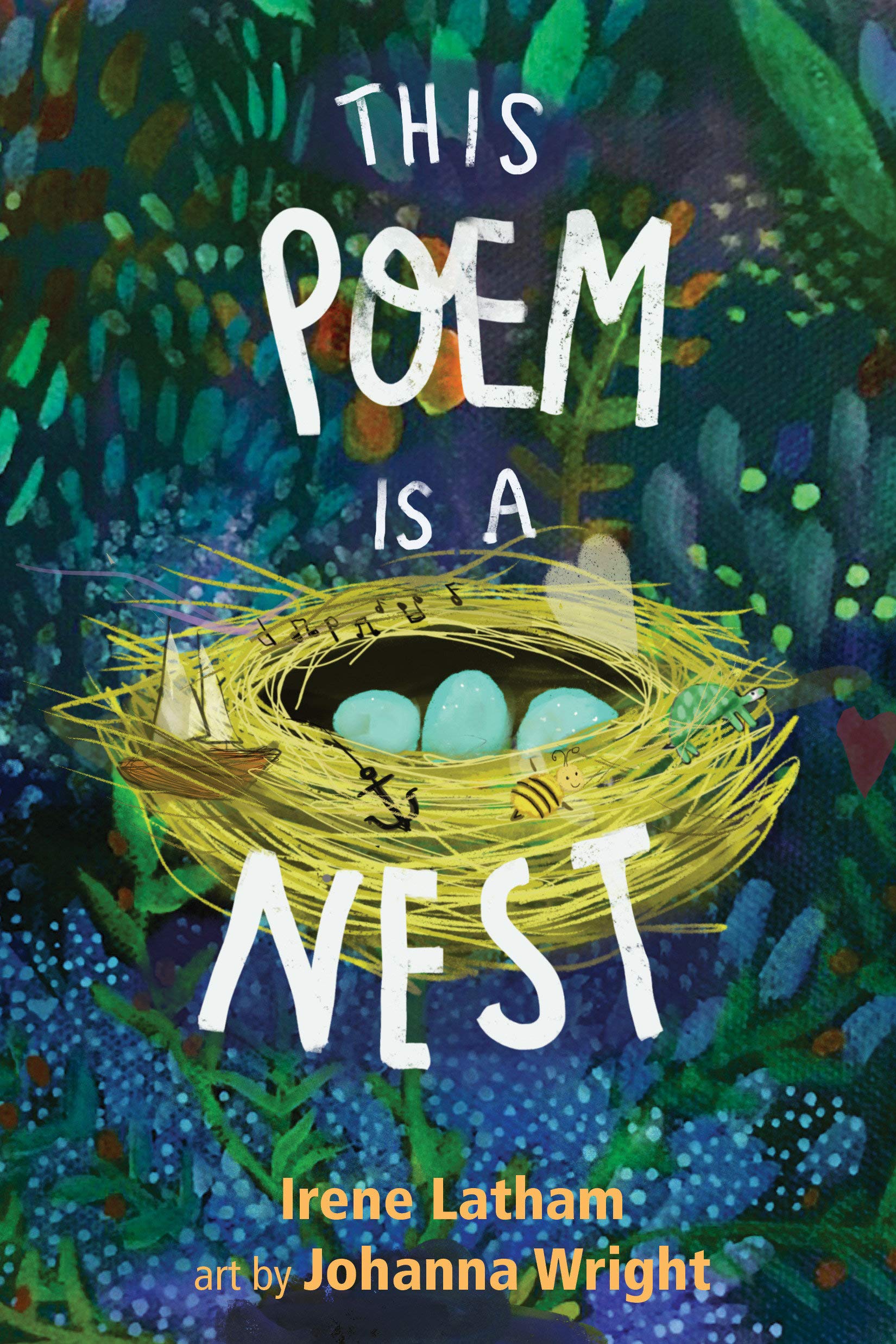
Written by: Irene Latham
Art by: Johanna Wright
Published by: Wordsong, September 29, 2020
ISBN: 978-1684373635
Plot Summary
This Poem is a Nest consists of an initial source poem, titled Nest, and 161 nestling poems. The nestlings are all made up of words from the source poem. They cover numerous different topics and are divided by those topics into sections. Most of them focus on simple themes like humans or animals.
Critical Analysis
The source poem, Nest, is separated into 4 sections, each named for a season. The first, Spring, is full of words that evoke imagery surrounding birth and infants. Obviously, a nest itself is a place where life begins with eggs hatching. In this section, it is described as a cradle, with the leaves providing a lullaby. All of these words combine to give the reader the feeling of new beginnings and unlimited potential that can accompany spring.
Next up is Summer. This section evokes feelings of hustle and bustle. There are literally honeybees buzzing near the nest, bringing to mind the saying "busy as a bee". The robins that were hatchlings in the spring have now taken flight, leaving the nest empty during the day. This mimics a family home with children leaving on adventures to the park or pool in the summer days, with the quiet mornings as the only time the house is full.
Autumn follows, this time with a focus on quiet preparation for the cold season to come. Numerous words in this section give off a feeling of quiet and calm- breathe, reach, whisperweight, ballet, and wordless. The nest has now been abandoned and is described as a shipwreck. This evokes imagery of the nest as a thing that was, rather than is. Its usefulness has ceased and it is a memory of what once was.
The poem ends with Winter. In this ending is a new beginning as a mouse discovers the nest and makes it new again. We see the first sentence of the poem again "this poem has twigs in it, and little bits of feather-fluff." This repetition shows the nest's life as a continuing cycle, rather than a straight line from point A to B. The words in this section bring to mind a white, crisp, and cold winter- frost-kissed, rattlesong, chill.
After the initial poem, the book moves into the nestlings. They are divided by themes. The first focuses on time, including poems about different times of the day as well as the months of the year. This section plays into the original organization of the poem by season and the idea of the nest's life being cyclical. There is a collection of poems that use words only found within their section- Spring, Summer, Autumn, or Winter. This provides a short summary of each section's focus and breaks down the feelings and imagery of the section into a short taste of the theme- birth, adventure, preparation, and cold.
Further sections include poems about animals, humans, words, places, and then a final section titled (Out of) Time. Each section includes several short nestling poems created using the words from the source poem. It is amazing to see the creative uses of the words from the source poem and how they can create different feelings based on the other words with which they are paired and the structures used to create the poems. The Wordplay Poems are particularly delightful, using formatting to set the scene in Sneeze Poem. The simple wording "it's it's it's it's you!" is amplified with the spacing of an "it's" on each line, each one spaced further to the right, with you at the end of the line. The use of the words to mimic the sound of a sneeze will delight readers of all ages.
Excerpt
Emotion Poems
Fear
long-buried
chatter
turns tiger
into mouse
Lonely
Dark fate:
moon becomes
grey-
distant
as faith
Heartbroken
open-shut-open heart
has twigs in it now
Annoyed
little stones
flap-flap--
nothing trills
Depressed
day
becomes
a tiger
Grief
dark season
when time
won't climb
What Hope Is
a cup
of stars
Faith
ancient heartbeat
of hope
Joy
it's got wings
stars,
dizzy sun
Vulnerable
sudden splash--
clouds naked
as moonlight
Brave Poem
you climb
into wild
boat
Proud Poem
cradle
of sun
becomes a home
for you
Mad Poem
world
a box
Confused Poem
with that
or
as that?
in
or
in to?
This poem
is
you!
When You're Happy
poemsky
expands--
you climb
up and up,
settle
into sun
Use
Have students divide into groups by choosing one of the emotion poems. As a group, they will decide how to present their poem with all members participating in some way. They can do a choral reading, divide it into parts, or have some students read while others act out the poem or choreograph movement to accompany it. Students can then pick an emotion and write a short poem for it. This poem can be a nestling from the original poem, Nest, or from another source poem the teacher chooses.