Tuesday, January 28, 2020

Book Review: Millions of Cats


By: Wanda Gag
Published by: G. P. Putnam's Sons, 1928
ISBN: 978-0-399-23315-9

Plot Summary


An old man and woman are very lonely and the woman decides she would like a cat. The old man goes to get her a cat and comes upon a hill covered in millions of cats. He can’t choose one and ends up bringing them all home. The old woman says they can’t keep them all and wants the cats to choose which will stay. The cats begin to fight and the old man and woman go inside. When they come back, there is one scraggly kitten. They keep it and feed it and it grows into a beautiful cat. 

Critical Analysis

This book makes use of repetition to draw in children and keep their interest. We first hear the phrase when the old man finds the cats on the hill:

“Cats here, cats there,
Cats and kittens everywhere,
Hundreds of cats,
Thousands of cats,
Millions and billions and trillions of cats.”

This familiar phrase is said several times throughout the book. This repetition, along with the simple storyline, makes this an easy narrative to follow. Children are likely to be able to relate to wanting a pet like the woman in the story does. However, the story takes a turn from being a run-of-the-mill tale about getting a cat when the “millions and billions and trillions” of cats all follow the man home and certainly when they all begin to fight one another. The ending of the story offers a surprise that will be difficult for most to predict. 

Awards Won

Newbery Honor Book, 1929

Review Excerpt

From School Library Journal’s Top 100 Picture Books, published June 11, 2012

“Was Millions of Cats the impetus that brought about the Caldecott Medal?  Possibly. As Minders of Make-Believe puts it, “when librarians awarded Millions of Cats a Newbery Honor, they chose to recognize the book’s distinction while apparently not feeling quite right about giving the literature prize to a picture book.  It may well have been then that the idea for a companion award for illustration was born, although it would be another decade before the Caldecott Medal became a reality. . .” Remember, the first Newbery Award was given out in 1922. It wouldn’t be until 1938 that the Caldecott would come along as well.”

Connections

Children can discuss a time when it was hard for them to make a choice. They can share how they would have decided which cat to keep. As a writing extension activity, students can write about how they would take care of millions of cats. The repetition in the story makes this a good choice to use for an interactive read-aloud. 

Sunday, January 26, 2020

Book Review: Waiting Is Not Easy!


By: Mo Willems
Published by: Hyperion, 2014
ISBN: 978-1-4231-9957-1


Plot Summary

Piggie and Gerald are best friends. One day Piggie tells Gerald that she has a surprise for him. Gerald asks Piggie many questions about the surprise. Gerald has trouble waiting and gets frustrated. Piggie stays calm and tries to help Gerald be patient Eventually, Piggie reveals the surprise, a beautiful view of the stars. Gerald decides it was definitely worth the wait.


Critical Analysis


Gerald and Piggie are well-known and relatable characters for small children. In this story, Piggie lets Gerald know that she has a surprise for him, but he has to wait for it. Children and adults will be able to relate to the feeling of having to wait for something good or fun to happen and all the emotion that goes into that. Gerald uses different tactics to help himself wait, questioning Piggie, complaining, and groaning. Willems uses repetition with Gerald’s groaning and each time he does, the speech bubble containing the groan gets bigger and bigger (eventually taking up the entire page and crushing Piggie under its weight). This is a great visual representation of Gerald’s feelings. 


When we finally see that Piggie’s surprise is the beautiful stars above, Willems uses actual images of the Milky Way at the top of his illustrations which helps to depict just how amazing the sky is at night. We are there with Gerald and Piggie, experiencing their sense of awe and their satisfaction at the wait finally being over.

Awards

Theodor Seuss Geisel Honor Book- 2015

Review Excerpt

from: Kirkus Reviews, posted November 5, 2014

“Willems relies even more than usual on the slightest of changes in posture, layout and typography, as two waiting figures can’t help but be pretty static. At one point, Piggie assumes the lotus position, infuriating Gerald. Most amusingly, Gerald’s elephantine groans assume weighty physicality in spread-filling speech bubbles that knock Piggie to the ground. And the spectacular, photo-collaged images of the Milky Way that dwarf the two friends makes it clear that it was indeed worth the wait.”

Connections

Children will also enjoy the other books in the Elephant & Piggie series. They can read 2-3 books and compare how the characters are feeling in them. They can also read one of Willems’ other books, such as one from The Pigeon series, the Knuffle Bunny series or others and compare and contrast the stories and illustrations. Students can extend the lesson by writing their own Elephant & Piggie story. They can also act out the story using puppets.


Book Review: A Ball for Daisy


By: Chris Raschka
Published by: Schwartz & Wade Books, 2011
ISBN: 978-0-375-85861-1

Plot Summary


Daisy is a dog who loves playing with her ball. It is always by her side, even when she is sleeping. One day Daisy goes on a walk where her ball is lost behind a fence. Her owner retrieves it but another dog starts playing with the ball and ends up popping it. Daisy is heartbroken and goes home. The next day the owner of the dog who popped the ball gives her a new ball and she and the other dog play with it. Daisy takes her new ball home and is happy again. 


Critical Analysis


A Ball for Daisy is Chris Raschka’s wordless tale of a dog named Daisy and the love of her life, a red ball. Daisy is a lovable main character whose emotions are easily portrayed through her vibrant facial expressions. The storyline is one that a young child would easily follow and be able to relate to- that of having a toy so beloved that they spend all their time with it, both waking and sleeping. The action is ramped up when the ball is lost behind the fence, but Daisy’s owner comes to the rescue, only for tragedy to strike on the next page. The story’s climax occurs when another dog pops Daisy’s ball while Daisy is trying to get the ball back from the dog. 

Setting plays an important part in the story. The beginning of the book all takes place in Daisy’s home and makes the reader feel like this is a safe and happy spot for Daisy and her ball. When Daisy goes on a walk with her owner, the setting changes to the sidewalk outside of her house and there is a sense of adventure that is provided with that change of setting. There is some uncertainty that children would recognize in taking their prized possession outside of their homes. 

After Daisy’s ball breaks, she is comforted by her owner but sleeps alone. When the owner of the other dog gives her a new ball, the conflict is resolved and both Daisy and her owner make new friends. The theme of the book shows that there are things that are even more fun and valuable than possessions, no matter how loved they may be.

Awards Won

Caldecott Award- 2012

Review Excerpts


From The Horn Book: Caldecott Calling, by Lolly Robinson, November 11, 2011
"Daisy's joy and sorrow are shown magnified through her body language and by impressionistic splotches of watery color. Less significant aspects of Daisy's life are painted faintly (her "owner," details of the park she plays in) while everything that is important to her (the ball, the couch, another dog at the park) get fully saturated colors. Daisy herself is rendered with light gray outlines, but her eyes, nose, ears, tail, and toes are dark, punctuating the pages that show repeated images of her.

Throughout, Raschka sense of rhythm is flawless. Repetitions of the red ball dot the playful spreads while Daisy's post-ball depression is shown with a static repetition of the green couch, the dog sinking deeper and deeper into its cushions. Look at how simply Raschka draws this. He just shows less and less of Daisy until in the fourth panel all we see is ears, a bit of back, and a sagging tail.
Because Rashcka's style is so gestural (if I may use that term outside of human figure drawing) and his brush strokes so loose, it's sometimes hard to see exactly where Daisy's mouth or eyes are. But there is never any question of the emotion being depicted."

Connections

If you enjoyed "A Ball For Daisy", you will probably also enjoy its sequel, "Daisy Gets Lost".

There are many opportunities for responses after reading this book. Children can discuss their own favorite toys, a time something they loved was broken or lost, or a time they made a new friend.

Older students can extend the lesson by writing their own versions of the story.


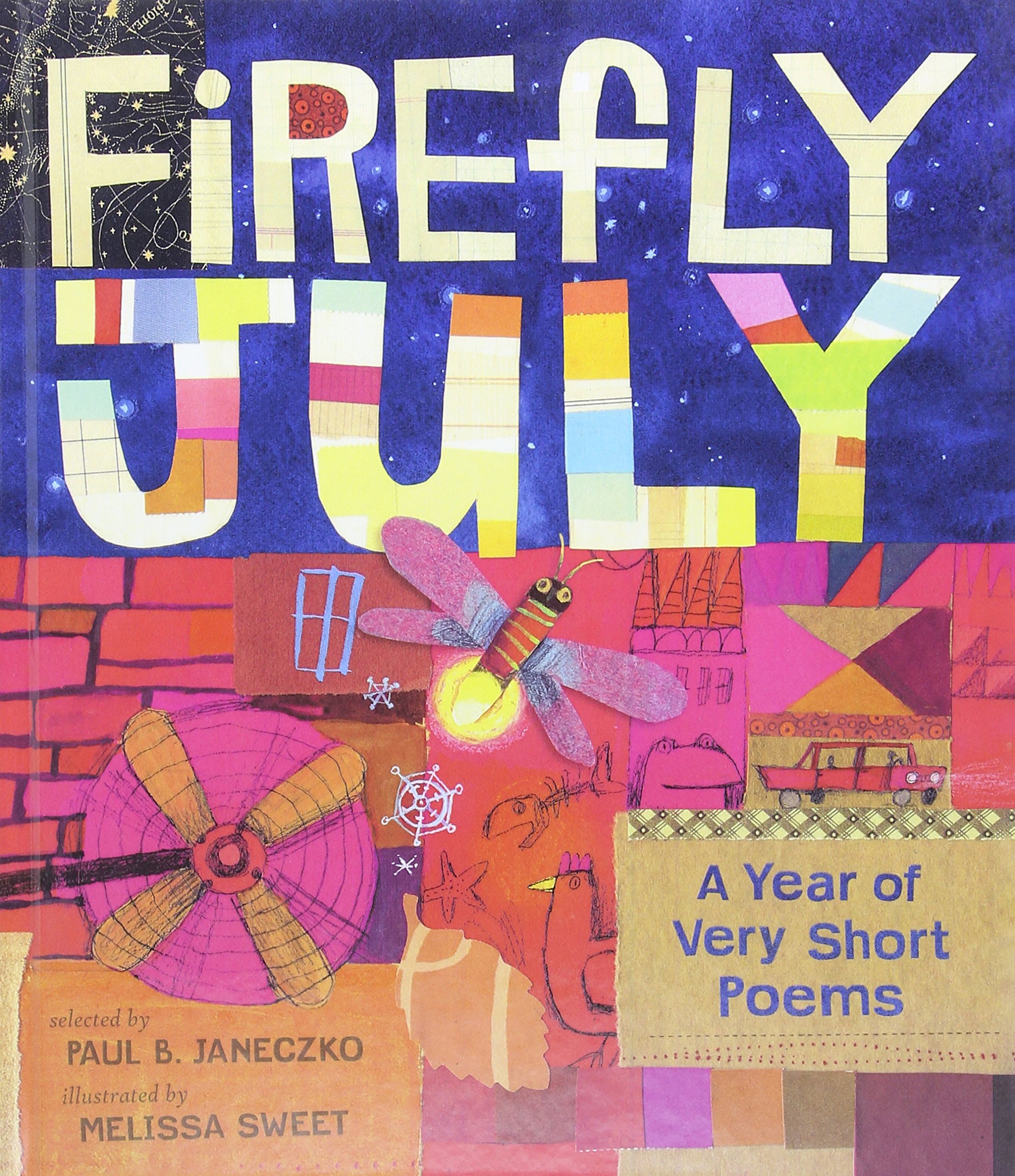
Book review: Firefly July

  Selected by: Paul B. Janeczko Illustrated by: Melissa Sweet Published by: Turtleback Books, April 10, 2018 ISBN: 978-0606409025 Plot Summa...