Monday, March 22, 2021

Book Review: César: ¡Si, Se Puede! Yes, We Can!


Written by: Carmen T. Bernier-Grand

Illustrated by: David Diaz

Published by: Two Lions, February 26, 2013

ISBN: 0761451722

Plot Summary

César: ¡Si, Se Puede! Yes, We Can! tells the story of the life of César Chávez. Chávez was a labor leader who helped to form the National Farm Workers Association. From his humble beginnings outside of Yuma, Arizona, César began working alongside his family in the fields at a young age. He eventually tired of this work and decided to join the Navy. However, after his time in the military, he returned and began working as an organizer, helping farmworkers fight for better conditions and higher pay. 


Critical Analysis
Family and culture are two things that were obviously very important to César. The very first word in the book is ¡Hijole! which is an expression of surprise or wonder in Spanish. By starting the book with this word, Bernier-Grand immediately lets the reader know that César Chávez valued his first language, which he spoke at home. The poem "I Am a Clown" recounts his experience at school where a teacher told him that he should only speak English if he wanted to be an American. This is an experience that has been shared by many immigrants and native-born citizens in the United States who are bilingual. At home, the Chávezes believed that "Quien sabe dos lenguas vale por dos." or "He who knows two languages is more valuable than he who knows only one." This mindset differed from many other families who believed that their children should only speak English in order to assimilate to their home. 

The combination of cultures is also present in the poem Cesario, which was César's real name. Teachers and other English speakers called him "See-zar", or possibly César (say-zar), either unwilling or unable to learn his given name. However, his given name was at the heart of who César was, for he was named after his abeulito, or grandfather. The phonical pronunciation of his name that is used in this poem really serves to emphasize the difference in the anglicized version of his name verses the Spanish version. As time has passed, more and more people 
have spoken out about the importance of pronouncing names correctly rather than changing them to make things easier on the person pronouncing them. However, this was definitely not the case in the 1930s when César was in school. The poem ends with what he likely considered his most important title, "Friend of the Farm Workers", since that was the identity he strove for during most of his life. 

The illustrations in the book are painted in bold colors, giving the book an attractive look and likely mimicking the brightly colored crops that populated the fields that Chávez spent his life working in. In the pictures where a large group is present, such as those showing protests or press conferences, you can see a variety of skin tones in the people shown. On the cover, Chávez is featured holding the "cortito" or short-handled hoe, which he worked hard to have banned. He is wearing a bandana around his neck, which farm workers wore to protect themselves from breathing in dirt or harmful chemicals while working in the fields. 

The end of the book contains source material, including a brief synopsis of Chávez's life, notes with citations for facts found in the book, a glossary containing Spanish terms used in the book, a timeline of his life, a list of the sources consulted, and finally a selection of Chávez's own words in which he describes his story himself. The inclusion of this material lends authority to the book along with providing background information that will help the reader gain a deeper understanding of it. After reading, one could also consult the references to learn more, if desired. 

Excerpt
Cesario

Cesario was his real name. 
Not See-zar. Not even César. 

Cesario Estrada Chávez
was the name given to him
by his parents,
Juana Estrada
and
Librado Chávez
en el dia su santo,
March 31, 1927,
near Yuma, Arizona. 

Cesario,
named for his abuelito,
better known as Papá Chayo. 

Calling him See-zar Cha-VEZ
came later, 
when his teacher couldn't 
or wouldn't
call him Cesario.

People called him
See-zar Cha-VEZ
or César Chávez.
It was better to call him
Friend of the Farm Workers
for these were la gente
for whom he struggled. 

Use
Read the poem out loud to students, first without showing them a copy of the poem. Then display a copy and re-read it to them to allow them to follow along. Ask students to create their own name that describes what is important to them, like César was "Friend of the Farm Workers". Students can share their own names and explain why they chose them. 


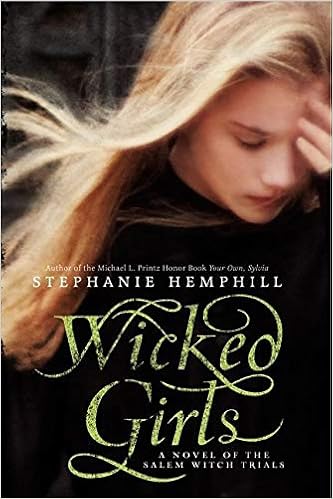
Book Review: Wicked Girls


Written by: Stephanie Hemphill

Published by: Balzer + Bray, October 1, 2013

ISBN: 978-0061853302

Plot Summary

Wicked Girls follows 7 girls who are "afflicted" with fits that have been caused by townspeople they claim to be witches during the Salem Witch Trials of 1692. The ringleader is Ann Putnam, Jr, daughter of a respected resident of Salem who is a major accuser during the trials. Also in the group are Mercy Lewis, a servant in the Putnam household, Margaret Walcott, Ann's cousin, as well as several other young girls who live in the village and one from Salem town. The motivation for their accusations as well as their indecision about who the leader of their group should be drives the action forward and leads to tension both within the group and in the entire village, as it is split between those who believe the girls' accusations and those who doubt them.


Critical Analysis

The book covers the entire year of 1692, with each month delineated by an opening poem. These lines seem to set the tone for the entries that follow. Each chapter is written in the voice of one of the girls and shows their changing emotions and doubts throughout the year. Each girl is introduced with a brief biography in the opening section. One point of interest here is that they are generally identified in relation to males in their family or household. This speaks to the patriarchal society in which they lived and gives us a glimpse at the potential reasoning behind their accusations. Women, and particularly girls, were rarely listened to in Salem in the 17th century but these girls had the attention of the entire town when they claimed to be afflicted by witches. They wielded power in a way that they never had before. 

The verse for January 1692, simply titled Salem introduces us to a cold and dark place, seemingly the perfect setting for a story about witches. "The cold is gray and fierce, bitter as a widow at the grave. The trees' bare bony fingers point crookedly toward Heaven or Hell or worse than that, toward nowhere."  The words have been carefully selected here to reflect the physical reality of Salem at this point in time but also the fearful place it must have been for its citizens once the accusations began. Then February's poem says that "Something stronger than fever quakes and curls through Village girls . . . 'Tis a sight to behold, distraction from cold." This alludes to the theory that the girls were merely bored and looking for something to entertain them rather than suffering from any malady, whether medical or spiritual. 

When Mercy comes to live at the Putnam house, Ann is immediately entranced by her. She describes her name as a blessing, which has a double meaning since Mercy is a quality that would have been held dear by Ann at that point in time, but is also more interesting than her own name, which she shares with her mother. Mercy's beauty is referenced numerous times throughout the book, leading her to be the subject of both Isaac's attention, and, due in part to that, Margaret's jealousy. Ann begins trying to help Mercy with her household duties, to her mother's distaste. However, when Mercy later decides that they should stop their accusations, Ann quickly becomes vengeful towards her, harming the things that Mercy holds dearest. 

We learn of the fate of Mercy's family in her section titled "A Kin to Whom". Her introduction describes her as an orphan of the French and Indian War, but this passage describes in detail how her family was killed as she hid under the bed. Rhyme isn't used in much of the book, but it is present here, "night comes restless with wind that claws over the roof like trapped cat paws." The sing-song quality of the lines is at direct odds with the serious and tragic nature of the memory they describe. 

Metaphor is used throughout the book and helps to provide an image of the girls. Mercy says that Ann "buzzes in my ear like a barnyard fly" and the reader is able to picture the older girl, hard at work while the younger flits about her, constantly talking. She is seen as a minor annoyance, but not a danger. Later, Susannah is described as a daisy, yellow and tender while Ann is like a puppy running behind the other girls. These comparisons allow the reader to picture the scene and show Susannah as plain and common, as well as weaker than the other girls. Yellow is frequently used as a synonym for cowardly, potentially another meaning behind her description as a daisy. 

Although the girls seemingly start their accusations as a way to entertain themselves, their motivation becomes darker as the book moves through the year. Both Ann and Mercy begin to accuse people who have wronged them in the past. Mercy seeks revenge for her family's murder by accusing John Alden, who sold the weapons that were used to kill them. Mercy and Margaret also nearly accuse Isaac, who has been vocally against the trials as a warning to him to keep quiet. In the end, Margaret's wish to become his wife overcomes her relationship with the other girls and she claims she can no longer see evil. Mercy's own guilt at seeing innocent people hanged causes her to renounce her claims and she sets out to find her aunt so that she can be part of a family again. 


Excerpt
Dissolution
October 1692

Holiday ends. 
Time to unpack your bags and launder
your clothes. 

Some stay on the road,
refuse to reenter
home and resume
regular life,
the sunrise-to-sunset
day of cooking,
spinning, tending, study-
pierced with the dagger of silence. 

Use
There are 12 monthly poems spaced throughout the book and used to mark the passing of time and changing of attitudes along with the weather. Students will work in pairs to present their assigned monthly poem aloud to the class. They can decide if they would prefer an oral presentation or one using other media, such as painting or drawing to best represent their poem. 


Book review: Animal Ark


Written by: Kwame Alexander

Photographs by: Joel Sartore

Published by: National Geographic Children's Books, February 14, 2017

ISBN: 978-1-4263-2767-4

Plot Summary


Animal Ark features vivid photos of animals in every shape and size. The main focus is on animals that are endangered and threatened. The poem that runs throughout the entire book focuses on the unique characteristics of every creature, highlighting their individual talents and curiosities. The middle of the book features smaller images of the animals and includes lines of prose, telling about the interconnectedness of all life on Earth and emphasizing our responsibility to care for all of its creatures. 


Critical Analysis


The first animal featured in its own spread is a small primate. Its light-brown fur contrasts nicely with the solid black background. The accompanying verses discuss its "eyes, full of secret places to hide and play." The book's focus on readers seeing humans and animals as a part of one bug Earthly family is clear in both the words and images seen in these opening pages. The animal's eyes are a bold orangey-brown color that do, indeed, include depths that seem more human than animal. His hand is over his mouth in a look of surprise or wonder, mirroring the playful words of the poem. 


Several pages later we see a group of tortoises. Although their general physical characteristics are all quite similar, one is able to see small unique qualities when looking at the 4 of them so closely in a line. The patterns and colors of their shells are all different from one another and even the scales on their legs are of varying sizes and shapes. It is amazing to look at the positions of their heads and see what looks like their own personalities coming through the photograph. The lines on this page. "homes of courage on humble backs, this is not a race" embody the distinct qualities of these animals. Frequently they are seen as cowardly when retreating into their shells, but here they are described as courageous. Indeed, at the angle of the photograph, the shells look like impressive fortresses. Tortoises are, of course, known for being slow, which the words allude to in stating that this is not a race. However, one could also interpret those words in another way, reiterating the overlying message of the book that all creatures on Earth are one, and using the word race in its definition as a group of humans with similar characteristics. 


That idea of interconnectedness is shown in an amazing way on the pages that feature a leopard and a squid. Although these are very different creatures, the images highlight their spots, which seem almost identical when displayed side by side. "Spots blend unseen so they can STALK, swim, sneak up on us." Again, the words are drawing connections between the two animals, both of whom use their spots to blend into their surroundings. This makes the reader realize that the same pattern is present in both grasslands and the ocean, furthering the idea that not only are humans and animals all connected but also different ecosystems on the Earth's surface are as well. One would generally think of the ocean and the savannah as very different places but these animals show us that they have more in common than we might think. 


Differences are also pointed out, as with the pages that feature a black widow spider and a pair of baby pandas. Both pages are primarily black and white but include bright patches of red with the spider's markings and the text color on the panda's page mirroring one another. The marking is described as "a deadly tattoo". This speaks to the spider's known reputation as a "bad guy" in the animal world since their venom is incredibly dangerous. The connection here reflects the opinion of many that people who have large or bold tattoos might be more dangerous or live a life that is a bit more on the "wild side". In contrast, the baby pandas look like big, soft balls of fur. They are described as "strong, yet gentle". This makes an interesting comparison with the black widow since the small spider is a deadly creature while the larger and stronger pandas are more gentle and humans who are trained can be around them safely. 


Excerpt

Chorus of Creatures

We are family. Miraculous each. The strangely inquisitive and the dangerously direct. Some nearly invisible with oversized zest. Breathing one sky. Forever connected by this peculiar and wonderful family tree. Branches that soar, swim, stalk. Butterflies, turtles, leopards. 


Use

Students can look at the smaller pictures of the animals on the pages that include the poem, Chorus of Creatures. They will choose 2 animals to compare and contrast and write their own verses telling about each creature they have selected and how it is similar and different from their other chosen animal. 


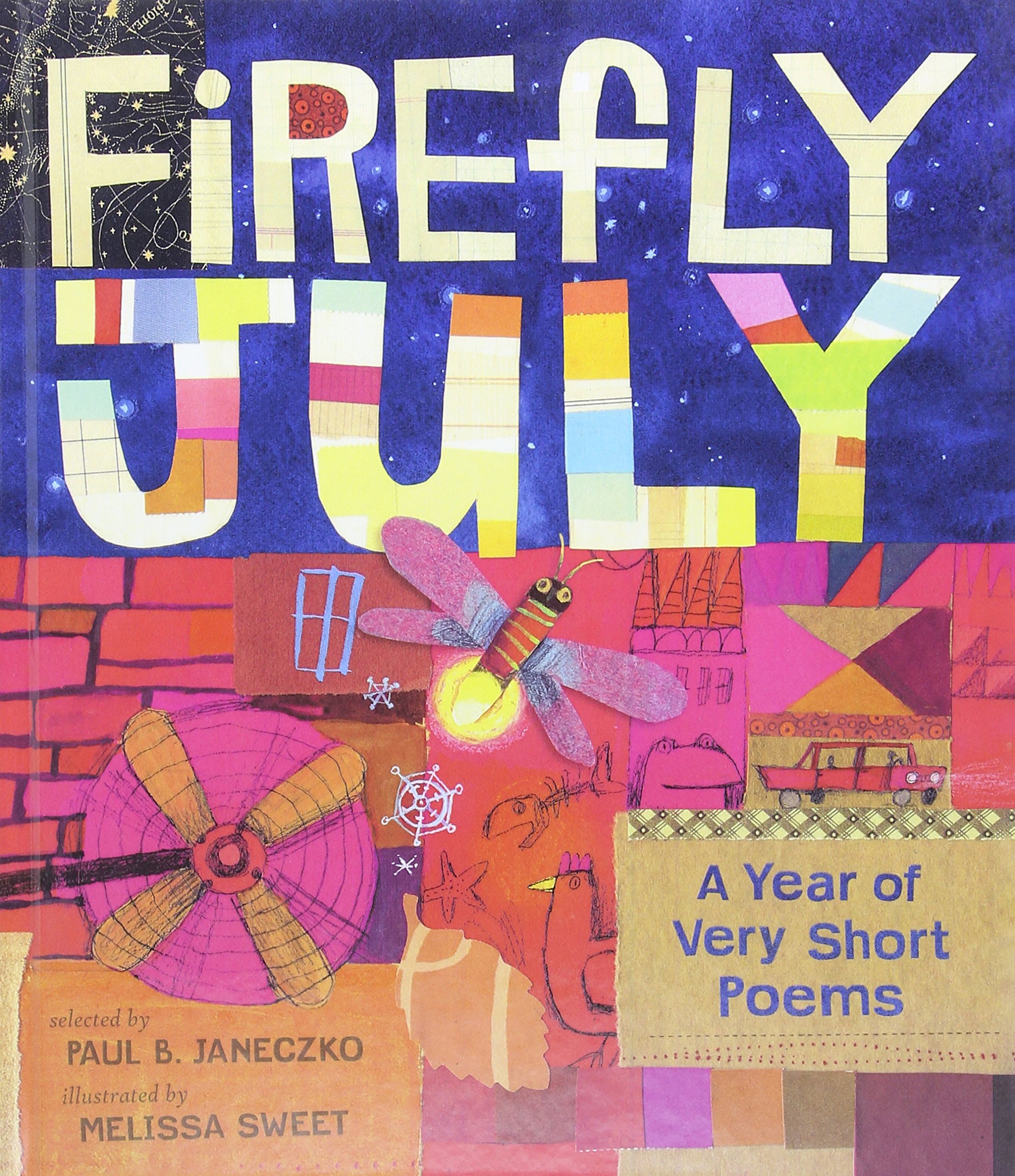
Book review: Firefly July

  Selected by: Paul B. Janeczko Illustrated by: Melissa Sweet Published by: Turtleback Books, April 10, 2018 ISBN: 978-0606409025 Plot Summa...