Sunday, March 22, 2020

Book Review: Just a Second


Written by: Steve Jenkins
Published by: Houghton Mifflin Books for Children, 2011
ISBN: 978-0-618-70896-3


Plot Summary

In Just a Second, Steve Jenkins tackles the concept of time. Beginning with one second and moving through different measures of time from smallest to largest, he ultimately ends with one year. For each section, he includes some background behind how that unit was chosen to measure time. The bulk of the book, however, is dedicated to different occurrences in nature that take about as long as the featured time-frame to be completed.


Critical Analysis

Steve Jenkins has written dozens of informational children's books and has established himself as a well-known and trustworthy author of the genre. Although the individual facts in the book are not cited, he does include a note at the end of the book stating that the facts included in the book come from a variety of sources. He also states that while some facts are well-known general knowledge, others are estimates, since it is impossible to know the exact amounts of some of the examples. He says that in those cases, he's used multiple sources and used values in the middle of a range. This note helps the reader to feel at ease in the fact that the information presented is accurate.

The book is laid out in a logical sequence, moving from the smallest unit of time to the largest. Each section begins with a note on how that particular unit came to be. After progressing through one second, one minute, one hour, one day, one week, one month, and one year, he also includes sections at the end of the book titled "Very Quick" and "Very Long". The "Very Quick" page features events that take place in much less time than even one second, for example, a Shasta salamander snapping up an insect with its tongue in 1/100 of a second. The "Very Long" section includes events that take much longer than a year, for example, the life expectancy of a koi fish, which is 226 years. These final sections are perfectly placed to fascinate readers who have just read through all the other units of time and are therefore thinking very methodically within those parameters.


After the "Very Quick" and "Very Long" sections, Jenkins includes a timeline of the history of the universe, a bar graph showing the Earth's human population from 1750 to the present and beyond, timelines showing the life spans of plants and animals, and a list of important dates in the history of time and timekeeping. These additional sections provide a wealth of knowledge presented in easy to read graphics that will enhance the facts already presented throughout the book.


Jenkins chooses interesting facts that children will enjoy learning about and presents them in an engaging way. To accompany the text, he includes vibrant illustrations using his collage technique. This adds depth and texture to the illustrations and makes them look more lifelike- some almost look like photographs rather than illustrations. The bottom of each page is bordered with a solid black line separated with grey hash lines at regular intervals. This simple border imitates a timeline with great effect.


Review Excerpt

From School Library Journal, published December 1, 2011

"Jenkins's fascinating way of looking at time is bolstered by a wide variety of examples from nature and man, and while many are simply fun, others will give somber pause, like the average use of 19 gallons of fresh water per hour for every person on Earth or the use of 200 billion sheets of letter-size paper in one day. With his trademark torn- and cut-paper collages in rich earth tones, Jenkins renders this package both eye-catching and mindboggling." 

Connections

Incorporate this book into a study of time. This will give students a better understanding of how the different increments of time actually feel so that they will be more concrete.

Have students create their own activities that take a certain timeframe to complete. Students can make their own book based on "Just a Second" by giving an example from their own life for what takes a second, minute, day, week, month or year.


Students can use the timelines at the back of the book as an example to make a timeline of their own life.


This can also be incorporated into a unit about space and used as a jumping-off point for a discussion about the Earth's revolution around the sun, the age of the universe and other topics.

Book Review: Funny Bones: Posada and His Day of the Dead Calaveras


Written by: Duncan Tonatiuh
Published by: Abrams Books for Young People, 2015
ISBN: 978-1-4197-1647-8

Plot Summary

In Funny Bones, Duncan Tonatiuh tells about the life of Jose Guadalupe Posada. During his childhood in Aguascalientes, Mexico, Lupe learned to draw and write from his brother, Cirilo, who was a teacher. At the age of 18, he began working at Don Trinidad Pedroza's printing shop, learning techniques like lithography and engraving.

Later, Jose moved to Mexico City with his family and opened his own printing shop. Others called him Don Lupe out of respect and worked with Antonio Vanegas (Don Antonio) making broadsides. Later Don Antonio begin publishing Calaveras, short funny poems focused on skeletons. Don Lupe began illustrating them and became a master at it. He drew Calaveras based on Mexican leaders and the Revolution.

When he died in 1913, people were familiar with his drawings but didn't know who he was. Artists like Jean Charot and Diego Rivera along with historians became curious about the man behind the Calaveras, who is remembered today merely as Posada.

Critical Analysis

Tonatiuh weaves a tale about the life of Jose Guadalupe Posada with information about various printing techniques, Mexican historical references, and Dia de Los Muertos traditions. The book reads like a picture book and the facts are seamlessly included throughout so they are enjoyable to read without feeling like a how-to book about engraving or a historical timeline of Mexico's Revolution. It's obvious that Tonatiuh has done his research on all the included subjects in the book and children and adults alike will be so immersed in his tale that they may not even notice all the knowledge they are taking in.

He includes an extensive bibliography at the end of the book, along with art credits for the works used that weren't created by him. He also includes a helpful list of museums where one can go to view Posada's works in person. Another reference aid incorporated into the section at the back of the book is an index so that readers can find particular subjects quickly. Tonituah also included a long note about Dia de Los Muertos at the end of the book to give more background on the traditional Mexican holiday.

The illustrations in the book represent not only its subject matter, but also the author's background. He grew up in San Miguel de Allende, Mexico. In addition to his own illustrations, he also includes many examples of Posada's original broadsides and Calaveras. Being able to see the artist's original works really adds depth and value to the design and style of the book. There are both full-page examples of them written in English as well as smaller versions incorporated into Tonatiuh's illustrations that are written in the original Spanish and show the characters in the drawings reacting to them much as they must have done in real life.

The style of the book does a great job of honoring the Mexican culture that it reflects. The characters are all clad in traditional clothing that fits both the time and the place where the story is taking place. Skulls and bones can be found bordering the text on several pages, a nod to the skeletons that became Posada's most well-known works.

In the section where Tonatiuh uses some of Posada's own Calaveras, he reaches out to the reader to encourage them to interpret the meaning behind the art. He provides some suggestions as to what Posada's motivations and thoughts could have been while he was creating the pieces. Readers may agree with him or they may be encouraged to think of possible other messages that Posada was trying to convey through his art.


Awards Won

2016- Robert F. Sibert Informational Book Medal Winner
2016- Pura Belpre Award

Review Excerpt

From School Library Journal, published September 18, 2015

"The beautifully expressive Day of the Dead–inspired illustrations on heavy paper pages sport borders of bones, grinning skeletons, and Tonatiuh’s signature figures shown in profile, influenced by the ancient Mexican art of his ancestors. Simple yet effective sentences accompany step-by-step images detailing the artistic processes that Posada learned as a printer’s apprentice: lithography, engraving, and etching." 

Connections

Students can create their own Calavera poems and drawings.

Study Day of the Dead and its traditions. Read other books on the subject, including:
- The Day of the Dead/ El Dia de Los Muertos by Bob Barner
- Dia de Los Muertos by Roseanne Greenfield Thong
- Calavera Abecedario: A Day of the Dead Alphabet Book by Jeanette Winter

Saturday, March 21, 2020

Book Review: The Family Romanov: Murder, Rebellion and the Fall of Imperial Russia


Written by: Candace Fleming
Published by: Schwartz & Wade Books, 2014
ISBN: 978-0-375-86782-8

Plot Summary

The Family Romanov tells the tragic story of Russia's last tsar and his immediate family. Nicholas's leadership style is laid out in honest detail and it is easy to follow the trail that, little by little, leads to the downfall of his entire family and plunged Russia into years of struggle under Communist rule.

Included in the story are vignettes of the family's day-to-day life, set alongside historical events. Interwoven into these parallel tales of the Romanovs and Russia are stories of life "beyond the palace gates", which give insight into how hard the lives of Nicholas's subjects were while his family lived in luxury.

Critical Analysis

The Romanovs' story is laid out like a narrative and draws the reader in from the first tale of the ball that Nicholas and Alexandra held for the belaya lost, or nobility, in 1903. The rich details in this opening scene give the reader a glimpse into the opulence of their lives but also hints at their awkward personalities and the disconnect between them and their subjects, even those of the highest classes.

Beginning in the preface and continuing throughout the book, Fleming contrasts life as a royal with life as a Russian peasant with great effect. This contrast is also present before you open the book, with the cover photos. The royal family is shown at the top of the cover, looking relaxed and almost bored in their finery and jewels. Their faces are clean and even those of Nicholas and Alexandra are unlined. Compare that to the photo below the title, which shows a family of peasants. They are dressed in old clothes, with dirty faces that are careworn. Even the children look worried and seem much older than their royal counterparts.

Fleming uses the "beyond the palace gates" sections through the book to continue this comparison. Putting those experiences right beside the tales of the Romanovs' lives is eye-opening.

Accuracy is the most important component to look at when evaluating non-fiction texts, including biography and Fleming provides ample evidence to back up her spellbinding tale of the Romanovs. All quotes included in the book are referenced in a notes section that is accompanied by an extensive bibliography that includes both primary and general sources.

The layout of the book is chronological. In the beginning, Fleming includes both a family tree as well as a map of Imperial Russia. These are helpful tools to flip back to during the reading to better understand the relationships and locations that are mentioned throughout. She also includes a note on royal Russian titles and names used in the book along with a note on Russian dates. An index is found at the back of the book for quick access to certain subjects.

Contained in two large sections near the beginning and end of the book are photographs. Again, Fleming has chosen to include not only pictures of the royal family, but also those of Russian peasants. These add to the understanding of the monumental differences between the lives of these people who lived in the same place at the same time but who were worlds apart.

The story on its own is interesting, and Fleming is able to make it riveting. Reading a book where one already knows the ending has the potential to be less motivating, but Fleming interjects just the right tone to make it a page-turner.


Awards Won

2015- Robert F. Sibert Informational Book Medal Winner
2015- NCTE Orbis Pictus Award

Review Excerpt

From The Horn Book, published July 16, 2014

"She cogently and sympathetically demonstrates how each group was the product of its circumstances, then how they all moved inexorably toward the tragic yet fascinating conclusion. Each member of the Romanov family emerges from these pages as a fully realized individual, but their portraits are balanced with vignettes that illuminate the lives of ordinary people, giving the book a bracing context." 

Connections

Students can read Animal Farm by George Orwell and compare his tale based on the Russian revolution with the actual events presented in this book. 

Study World War I in more detail and allow students to research the events mentioned in this book to find out more details about them.

Study the various tales of people who claimed to be the lost Romanov children throughout history and discuss the motivations that could have led them to do so.

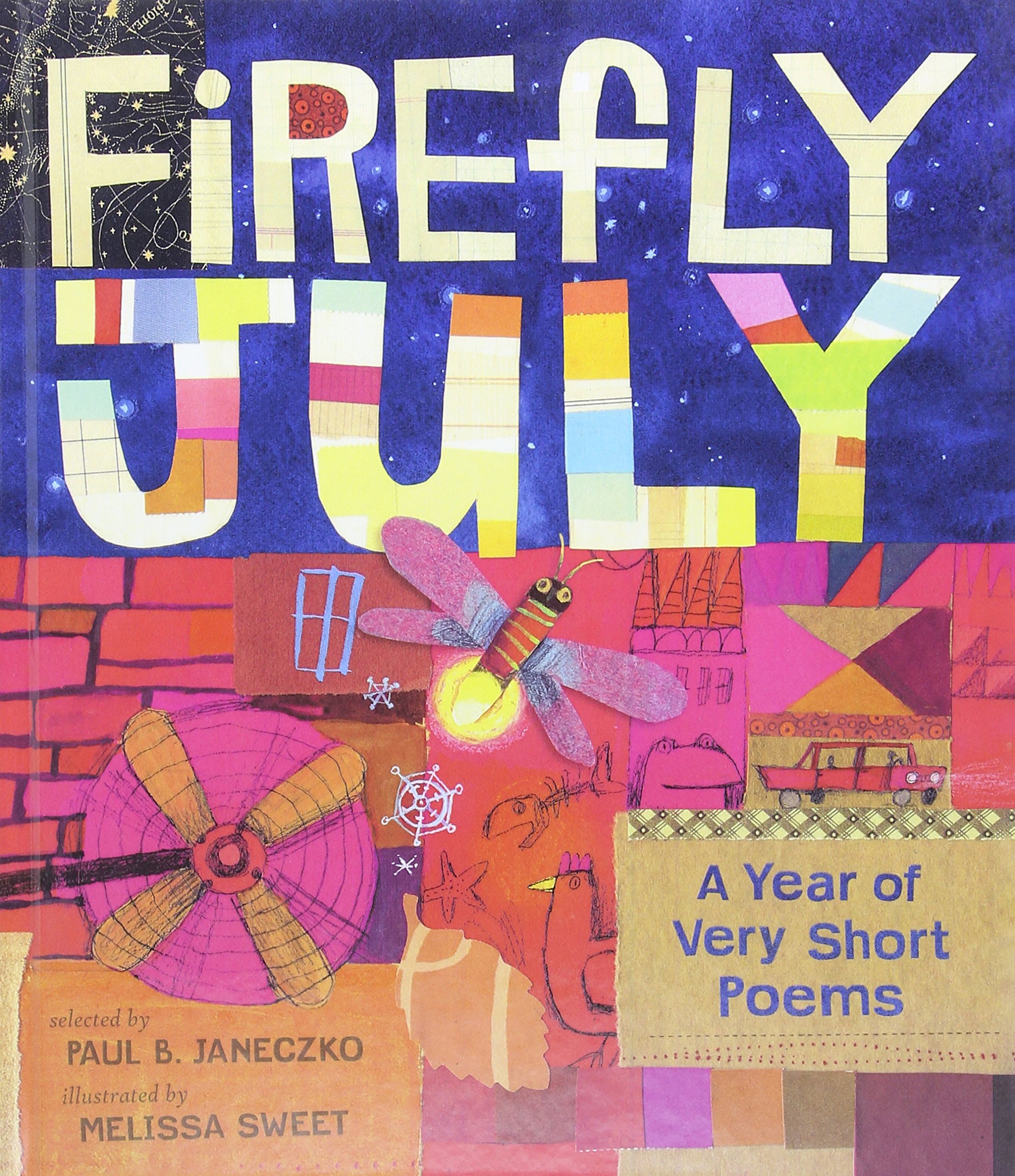
Book review: Firefly July

  Selected by: Paul B. Janeczko Illustrated by: Melissa Sweet Published by: Turtleback Books, April 10, 2018 ISBN: 978-0606409025 Plot Summa...