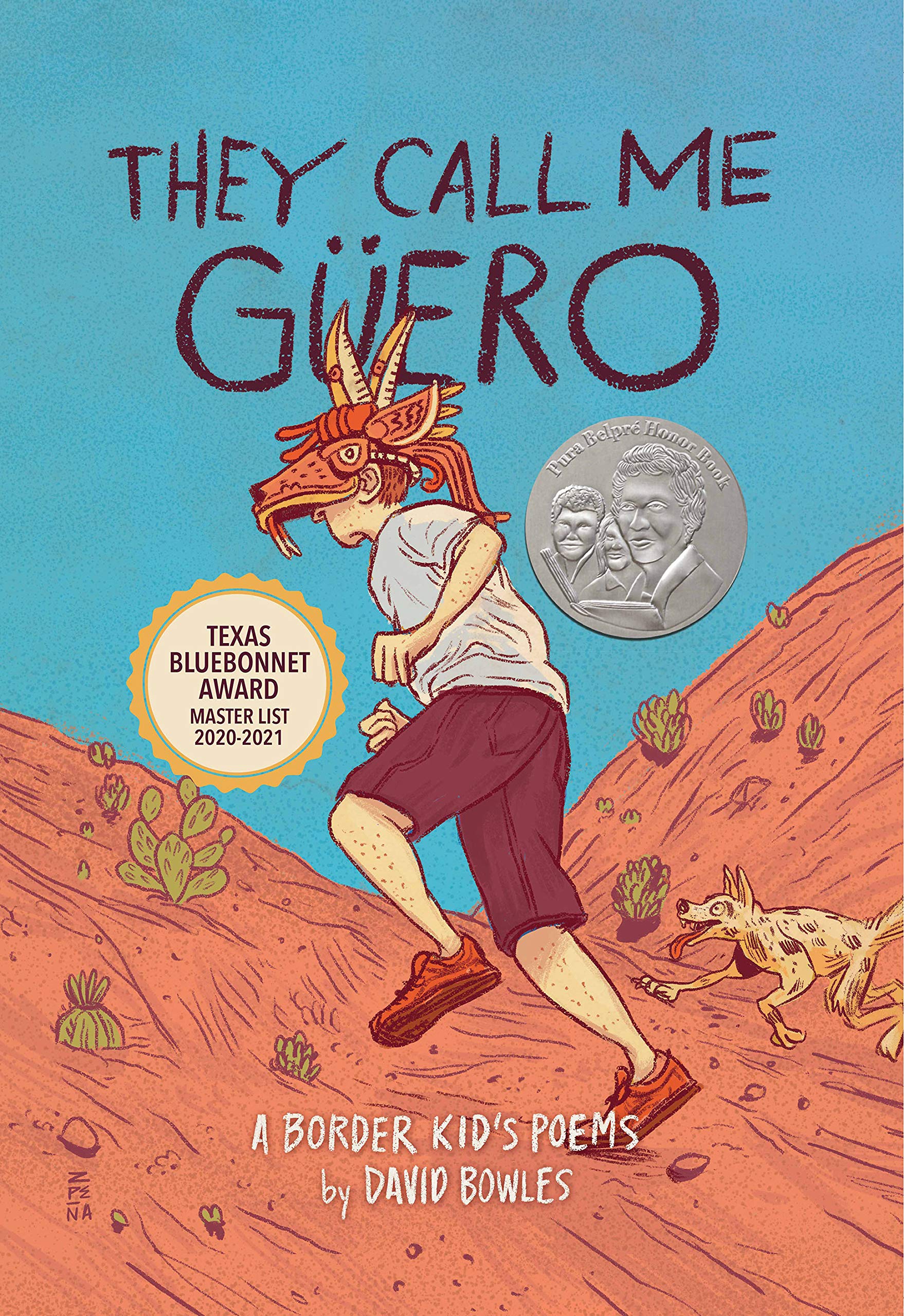
Title: They Call Me Guero
By: David Bowles
Published by: Cinco Puntos Press, November 27, 2018
ISBN: 978-1947627079
Plot Summary
They Call Me Guero tells the story of what it is like to live in a small border town. This story is woven through a series of poems, told from the point of view of a young teenage boy. His lighter skin and hair coloring have caused him to have the nickname of Guero (meaning "person with pale skin" according to the glossary included at the back of the book) bestowed upon him by his family and friends. The poems weave together family traditions that remind him of his ancestors' lives in Mexico along with modern situations, such as his desire to have a phone or his crush on a classmate.
Critical Analysis
The poems in They Call Me Guero serve to represent the most important aspects of the life of the main character, who is called Guero. The poems are a mix of English and Spanish, just like his day-to-day life in a town on the Texas border. They combine to represent his life, which will be familiar to other students who live in the area or in any place where a large group of immigrants has settled and continues to observe the traditions and culture of their former country while discovering those of the new.
In the opening poem, Border Kid, he discusses mornings when he and his father cross back over to Mexico to visit. His father describes him as a "border kid with a foot on either bank". This can be seen as both a figurative description since they live in a place that incorporates so many of the traditions from Mexico, as well as a literal one since they live close enough to cross back over the border every Saturday. The poem furthers this idea with its use of metaphor, in the line "with Spanish spoken everywhere just the same but English mostly missing till it pops up like grains of sugar on a chile pepper."
In Our House, it is said that their house took "years to grow" and compares it to an oak tree growing from an acorn. This metaphor describes not only the time that it took for Guero's parents to save up to buy the house but also the way that his family built it piece by piece, over time. One can visualize the house slowly growing up from its foundation- walls, roof, and then room by room being slowly added on, like the trunk and then the branches of a tree. But more than just the physical aspects have grown in the house- the things that really make it a home- memories and times spent together, have grown throughout the years as well.
Confession tells about Guero's experience going to Catholic confession with his priest. The physical layout of this program on the page is representative of the format in which an actual confession takes place. The text of Guero's thoughts are all situated on the left side of the page, while those of the priest are seen on the right, much like he and the priest would be sitting in the confessional itself, in separate compartments separated by a wall. This poem makes reference to an earlier poem, Bottle Rocket Battle, in which Guero accidentally hits the priest with a bottle rocket during a fight with his cousins. He mentions that the priest already knows all his sins, which is true since the priest likely sees or hears all that goes on in a small town. This can also be seen as a comparison to an all-seeing God.
One of the last poems in the book is A Sonnet for Joanna. Joanna is Guero's girlfriend, who was previously introduced in Joanna La Fregona (which the glossary lets us know means tough girl). Typically a sonnet is comprised of fourteen lines, each of which has ten syllables and this sonnet follows that pattern. Specifically, this is a Shakespearean sonnet, with three quatrains and a couplet at the end. The quatrains discuss how tough Joanna is, along with her other talents, explaining that she could beat up a bully, change the oil in a car, and help your team win an online game. However, the couplet provides a different side to Joanna, where he describes her as being "as sweet as girls can be" when it's just the two of them. This clever use of the sonnet's structure shows off all the sides of Joanna.
Excerpt
"Ms. Wong and the Rabbit "
This year, my English teacher
opens up a whole new world to me.
I can tell right away that Ms. Wong
will be different. For example-
she has a white rabbit in her room: Nun.
White, with floppy ears. A "lop" she says.
(Bobby Lee says "Nun" means "snow" and
"Eye" in Korean- the bunny's eyes are red.)
The first week of school, Ms. Wong talks about
the Moon Rabbit. In both Korea and Mexico,
people have long believed the marks on the moon
are the shape of a rabbit, placed there by the gods.
We read Aztec and Maya myths with her,
then Chinese and Korean legends too.
My mind is totally blown. But Ms. Wong
is just getting started. She plays us a song:
"Bandal", which means "Half Moon,
a slow, pretty tune from her childhood.
Gliding across the Milky Way, across the dark sky.
A little white boat carries a bunny and a tree.
The lyrics of songs, she tells us, are just poems
set to music. I'd never thought of it that way.
Use
Play Bandal, the song mentioned in the poem for the class (https://www.youtube.com/watch?v=4j8dAE5mlCI). Discuss what Ms. Wong said about songs being poems set to music. Students can use their devices to look up their own favorite songs to see how the lyrics are laid out in verses, similar to a poem's stanzas. Discuss the legends referenced in the poem and the similarities between the tales from different cultures.



No comments:
Post a Comment