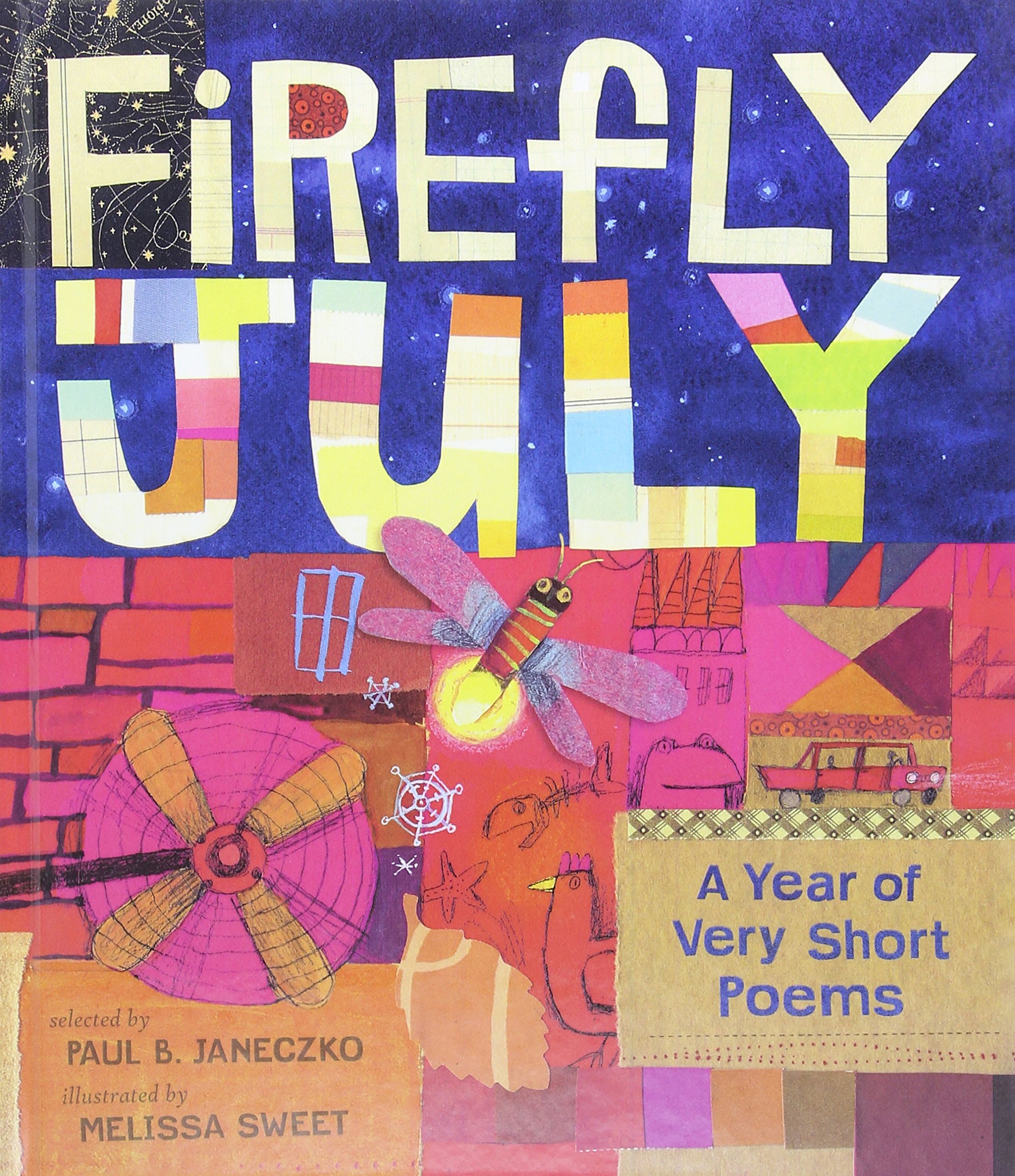
Selected by: Paul B. Janeczko
Illustrated by: Melissa Sweet
Published by: Turtleback Books, April 10, 2018
ISBN: 978-0606409025
Plot Summary
Critical Analysis
The first season represented is spring. Poems about aspects of nature dominate this section. In The Island, poet Lillian Morrison describes a small island. She likens the island to an elephant, making the connection between the appearance of the grey stone with the wrinkled skin of an elephant. The accompanying illustration shows a small island with strategic areas of rock that look like an elephant. The illustration brings the pictures that the words create to life and you can see the image of an elephant bathing in the water with half of its body under the water, crouching down and waiting. This is similar to personification, but it is comparing the island to an animal rather than a person. The ending lines describe the birch trees treading on the skin and again, the illustration portrays those words, as it looks as though the trees are also animals walking carefully along the elephant's back.
In Passing is one of the poems in this section that focuses on a manmade item rather than a natural one. It speaks of a truck passing by. The language used in this poem gives it a childlike sound with a nice rhythm. It is described as a "dumpy junktruck", which is almost a tongue-twister since we would be more used to saying "dump truck" but it's been switched for junk in this case. Changing it from dump truck to the adjective "dumpy" changes the way that the reader pictures the truck, since rather than just describing the truck's intended use, it describes its appearance and gives a mental image of a shabby, short vehicle. Then we add on the stacks of fans with the repetitive wording- unplugged, unsteady, undone. The image of the whirling fans almost lightens the idea of the dumpy truck and makes it seem like it could go faster, almost flying with the help of the spinning blades.
Next, we move on to summer and the strong imagery present in Sandpipers. Most beachgoers have encountered these birds walking along the sand and poking their beaks inside it. The poem describes their long, thin beaks as "needle beaks" and their digging motion as "hemming the ocean". This description allows one to picture the birds walking along in a line and slowly poking holes in a line, just as someone would do when they are sewing a piece of clothing. Personifying the birds with the human action of sewing helps to picture their actions and allows one to see the edge of the ocean as a large piece of cloth. The accompanying illustration shows beachgoers on their towels. The bright rectangles of color create an image that looks similar to a quilt, thus furthering the sewing metaphor.
Summer is also represented through In the Field Forever. This poem likens summer to a roaring dandelion. This wording plays on the "lion" part of the plant's name, but also allows the reader to picture the seed heads on it spreading through the air after being blown. The phases of the moon are represented by calling it a scythe and a silver flower, which again brings in the floral theme. We end with the stars as clover, always the same throughout the night. However, they do shift from season to season. This poem also incorporates some rhyme, with flower and hour, as well as clover and over.
In headline, a falling leaf is compared to a newspaper, landing on a doorstep. Much like an actual newspaper, the leaf brings news to a household when it lands on the doorstep since it lets the inhabitants know that fall has arrived. Its simple message is clear and welcome since the contents of the newspaper can often be more complicated. The poem even says that you don't even have to pick up the leaf to know the news that it brings.
Winter is the last season included in the book. Since spring is generally seen as a new beginning, it makes sense that winter would be put at the end. Snow Fence is included in this section. The imagery of the fence poking up out of the snow evokes the feeling of winter, which can be seen as barren. The words say the fence has "no meat on its ribs" and this can be a representation of the animals in winter who are hungry and in search of food. The imagery of the fence posts as ribs also let the reader picture them poking up from the snow. In the illustration, the fence has birds perching on it, also in search of nutrition during the long winter months.
Excerpt
Firefly July
When I was ten, one summer night,
The baby stars that leapt
Among the trees like dimes of light,
I cupped, and capped, and kept.
-J. Patrick Lewis
Use
With so many different poems in the book, the collection is a perfect choice for a class to take on. The excerpted titular poem above has a nice rhythm and encapsulates the feeling of summer so well. Allow students to choose a poem to read aloud or, if they are uncertain, they can narrow it down to a season and get teacher help to choose one poem. Students can read on their own, as pairs, or in small groups, depending on their comfort levels. If students do not want to read aloud, they can choose an artistic representation of a poem to display during the readings. Plan a poetry reading (either virtual or in-person) to share the poems with parents or students in other classes.


No comments:
Post a Comment