Sunday, September 27, 2020

Book Review: Uptown


Written by: Bryan Collier
Published by: Henry Holt and Company, 2000
ISBN: 978-0-8050-5721-8

Plot Summary

Uptown is a love song written to the Harlem neighborhood. In it, Collier describes important mainstays of the neighborhood, including landmarks such as the Apollo theater and brownstones, cultural institutions like jazz and chicken and waffles, and regular sightings, such as girls in yellow dresses going to church. Each of these aspects of the area is illustrated using a combination of collage and watercolor that brings them to life.

Critical Analysis

Although a young boy is portrayed as the narrator of the story, one can argue that the main character is the neighborhood of Harlem itself. It is surprising to learn that Collier was raised in Maryland and moved to New York City as an adult, as the narrative is so convincingly written to convey the voice of someone who has lived in Harlem for his entire life. His love for the neighborhood is apparent through the words and pictures.

The collage style of the illustrations adds a richness to them and allows them to include small details that pull in the text as well. Collier describes the brownstones as looking like they're made of chocolate. In inspecting the accompanying image, one finds that the brownstones in the photo are actually constructed of chocolate bars. This small detail captures the type of language and imagery that would be used by an actual child and creates an image that is both immediately identifiable as a row of brownstones and is made from chocolate bars. No detail is too small, as the flowers in the window boxes are small images of real flowers.

125th Street is widely known as the "Main Street" of Harlem. Much of the neighborhood's population would conduct their business there and the busy nature of the picture conveys that message. In looking at it, you can imagine how it feels to be there in a crowd on the weekend. The inclusion of certain textures and fabrics helps to represent the culture of the neighborhood. The shoppers are shown wearing bright fabrics that represent their Black heritage and carrying what looks like Djembe drums, which are originally from West Africa and can be seen being played regularly around Harlem. The text says "the vibe is always jumping as people bounce to their own rhythms", which likely includes both the drumming as well as the hum of the busy crowds. Only two shop signs can be read on the page. One is for a wig shop, which would be a major central shop in any Black-centric neighborhood. The other is for the Apollo Theater.

The Apollo also warrants its own page. It is on the U.S. National Registry of Historic Places and is a New York landmark. Millions of people visit it each year to watch famous African American performers. This is one of the defining venues of Harlem and its sign dominates the image, much like the Apollo dominates the street. The yellow page behind the text seems to represent the bright lights present at the theater.

While including aspects of Harlem that represent the neighborhood as a whole, Collier is also able to include subtle differences to show that the citizens of Harlem are not a cultural monolith. He includes jazz music, the Djembe drums, and the Boys Choir of Harlem. This shows that there is not just one type of music that represents Harlem- that its residents are a rich and diverse group that enjoy all different styles of music. However, there are also experiences that are universal based on the traditions of the neighborhood- the illumination of the streetlights symbolizes that it's time for children to return home.

Uptown fits the important theme of school and community in African American literature. It allows children to see themselves as a member of a community and an important part of a shared experience.

Throughout the book, the reader finds themselves immersed in Harlem. You can close your eyes and imagine the sights and sounds of the neighborhood and get a small taste of what it is like to live there. Collier uses so many different examples of what Harlem is throughout the book. But, in the end, he describes it in just one simple word: home.

Awards Won

2001- Coretta Scott King Illustrator Award Winner
2001- Ezra Jack Keats Illustrator Award Winner

Review Excerpt

From Kirkus Reviews, published June 1, 2000

"Collier debuts with a set of dazzling paint-and-photo collages paired to a child’s tribute to his Harlem neighborhood. From his window the young narrator sees “Uptown” in the Metro North commuter train crawling caterpillar-like over the river; sisters in matching dresses parading to church; weekend shoppers on 125th Street; jazz; Van Der Zee photographs; playground basketball; chicken and waffles served any time of day. (“At first it seems like a weird combination, but it works.”) This complex, many-layered vibe is made almost tangible by the kaleidoscopic illustrations.

Connections

Have students use the book as a model to create their own book about their city or neighborhood, including text and illustrations about their favorite aspects of the place. 

Show students examples of Van Der Zee photographs. Teach them about James Van Der Lee and his importance to the Harlem Renaissance and contributions to Black art and culture. 


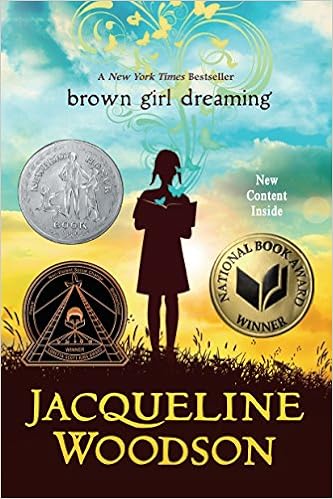
Book Review: Brown Girl Dreaming


Written by: Jacqueline Woodson
Published by: Nancy Paulsen Books, 2014
ISBN: 978-0-399-25251-8

Plot Summary

Brown Girl Dreaming is the story of Jacqueline Woodson's childhood. Born in Columbus, OH in 1963, Woodson was the youngest of 3 children. After their parents' divorce in 1964, they move with their mother back to her hometown of Greenville, SC to live with her parents. Their contact with their father after that point was non-existent for much of Woodson's childhood, so they begin to call their grandfather "Daddy". Their mother moves to New York City with their Aunt Kay and eventually comes back to Greenville to collect the children to come live with her. She also brings the news that they'll be gaining a baby brother soon.

Woodson and her siblings struggle to find a place to fit in in New York while also missing their grandparents and the familiar way of life in Greenville. At a young age, she discovers her love and talent for writing, which is the only academic pursuit in which she outperforms her older sister. Throughout hardships and celebrations, Woodson and her family support one another and face everything together.

Critical Analysis

Jacqueline Woodson tells the story of her life in verse, which adds a richness to the tale. The majority of the book is not written in rhyme, but there are times when it is used to great effect. While most of the chapters have unique titles, there is a series that are all named "How to Listen" and then numbered in order. In "How to Listen #2", rhyme is used to describe how Jackie and her siblings are followed when they are in stores in downtown Greenville. The short structure of the section along with the rhyme scheme give it almost a sing-song quality. All of the chapters in that series are just 3 lines and can be interpreted as young Jackie's first poetic works. The preceding chapters have discussed the right for equal rights in more detail. This short chapter seems to sum up a young girl's interpretation of what she's seeing around her.

While Jackie's life is at the forefront of the story, national events are constantly running through the background. She tells about their neighbor in Greenville, Miss Bell, who hosts planning meetings for the marchers in her home. Her mother also gets involved in the protests and her grandfather teaches her and her siblings about the importance of the fight. However, her mother has to sneak out when she thinks their Grandma Georgiana isn't looking. It becomes apparent that Grandma Georgiana knows just what is happening when she warns her not to get arrested. This shows that not all Black people in the South agreed with the actions of the protestors. Even in one family, people had differing opinions on the actions being taken. This represents not only the true actions of the author's family, but also exemplifies the fact that cultures are not a monolith- that within cultures and even within families people have their own opinions about important issues.

Jackie's mother eventually moves her children to New York City where their Aunt Kay lives. Before they moved, Jackie described New York City as a fantastical place, where "there is money falling from the sky, diamonds speckling the sidewalks." This imagery gets to the heart of what she expected to find in the city. She imagined her mother in a place ripe with opportunity, where one could find and live their dreams. The reality she finds when she arrives is likely a combination of her heartache at missing her grandparents, losing the only home she remembers, and that disappointment that can come when you build something up too large in your head so that the actual thing has no chance of being as amazing as you thought it would be. The real New York she finds is "only gray rock, cold, and treeless as a bad dream." While local New Yorkers would likely never describe the city that way, someone who was used to green space and a rural community would surely feel that way in such a large city full of buildings and people.

Woodson's strength is in her use of words to create a full picture. This is evident when she describes her uncle when they visit him in prison. She titles the section "Not Robert" because everything about her uncle that made him "him" seems to have been stripped away from him. His signature afro has been shaved, his eyebrows are thicker, and even his smile has faded. These physical manifestations represent the toll that being imprisoned can take on someone. She also talks about how quickly he has turned from a human into just the numbers that are across the chest of his uniform and says that she is "waiting for them to morph into letters that spell out his name." This personal experience reflects the struggle of many Black families in the United States, as events such as the War on Drugs and the school to prison pipeline have resulted in a much higher proportion of incarcerated black men in comparison to their percentage of the population. In comparing this book to Stamped, one is able to put a personal face to the national issues designed to keep Black people enslaved even after the Emancipation Proclamation was issued.

Another running theme through the book is the transformation of Woodson's grandfather, whom they call "Daddy". The first time he is described in the book, it is said that he "seems taller than anyone else in all of Greenville. More handsome too". It becomes clear that he is suffering from lung cancer and as he begins to decline, it is obvious how worried Woodson is. She describes him "moving as if underwater" as he continues to tend to his beloved garden, and, years later, he is too tired to eat and she chooses to spend her summer visit caring for him inside rather than outside with her siblings. Since her grandmother and mother have raised her and her siblings as Jehovah's Witnesses, she worries not only about his health, but also that they may not end up in the same eternity if what she has been taught at church is true. However, her grandfather has a different attitude- believing that God sees the good he has done and will not punish him. This is another example of people in the same culture and family having different beliefs, this time they are spiritual, again representing cultural pluralism.

At its heart, Brown Girl Dreaming is Jacqueline Woodson's memoir. However, it includes so many other important themes in African American literature. Discussions of spirituality, family and friends, and school and community are woven throughout the book. These themes combine to create a work that demonstrates both similarities and differences that people share across all of these themes.

Awards Won

2015- Coretta Scott King Award Winner
2015- Newbery Honor Book
2015- NAACP Image Award Winner- Literary Work- Youth/ Teens
2014- National Book Award Winner

Review Excerpt

From The New York Times, published August 22, 2014

"Jacqueline Woodson’s writing can seem so spare, so effortless, that it is easy to overlook the wonder and magic of her words. The triumph of “Brown Girl Dreaming” is not just in how well Woodson tells us the story of her life, but in how elegantly she writes words that make us want to hold those carefully crafted poems close, apply them to our lives, reach into the mirror she holds up and make the words and the worlds she explores our own.

Connections

Read and discuss some of Langston Hughes' popular works, such as "I, Too, Sing America", "Mother to Son", or "Life is Fine".  Re-read the section "Learning with Langston" and discuss why his work was likely such a strong influence on Woodson. Read "Dreams" and have students model their own poems on it, as Woodson did in the book. 

Discuss the national events that are mentioned during the book and evaluate how those events mirror the ones in Woodson's own life. 

Saturday, September 26, 2020

Book Review: Stamped


Written by: Jason Reynolds, Ibram X. Kendi
Published by: Little, Brown, and Company, 2020
ISBN: 978-0-316-45369-1

Plot Summary

Stamped is not a history book. That is how Reynolds begins this book that does contain quite a lot of history. But, rather than just listing them out for purposes of memorization or similar, the events covered in the book, which begins with the Portuguese enslaving Muslims from Morocco in 1415 and travels all the way to the creation of the Black Lives Matter movement in 2013, are carefully and explicitly linked with one another. 600 years of assimilationist and segregationist racism are covered, with some antiracism in the mix as well. Important historical events shape the structure of the book, but the focus is really on the figures throughout history who were both working to preserve racism and to demolish it.

Critical Analysis

Stamped is a remix of Ibram X. Kendi's book for adults, Stamped from the Beginning. Kendi is the Andrew W. Mellon Professor in the Humanities and the Founding Director of the Boston University Center for Antiracist Research. Reynolds is an award-winning author of young adult books and says that his main goal is to write books that aren't boring. He certainly succeeds with Stamped, as the way that the history builds upon itself and comes off the page is engaging for adults, young or otherwise. He is able to connect the central figures throughout different parts of history and make connections that aren't immediately obvious but that are certainly there. Both Kendi's and Reynolds's credentials and reputations lend credence to the book and ensure its accuracy.

The book is organized into different sections based on timeframes. This organizational scheme works well and, as previously mentioned, allows the history to build upon itself. It also shows the growth and change of some of the figures, such as W.E.B DuBois's transition from an assimilationist to an antiracist. The book challenges much of what has been taught in history classes for years. The story of W.E.B. DuBois told each February is incomplete, glossing over the fact that he is so widely studied and known because of his initial assimilationist ideas and teachings. This is important for several reasons. First, it shows that the majority of American history taught has been American History written by white people. It's often said that history is written by the victors, so we've been presented throughout time with stories of "kind whites" and "respectable blacks" so that those racist ideas have been ingrained in our society and our children's minds.

The book includes a list of further reading, extensive source notes, and an index of topics at the back. These reference aids, along with the timeline-centered table of contents make the book easy to use as a reference either before or after reading it cover to cover. The source notes are separated by section and then chapter, and they include page numbers, for ease of use and to facilitate flipping back and forth while reading. All of these features add to the authenticity of the information in the book, allowing the reader to have confidence that the information is accurate and is appropriately presented and cited.

The cover shows the silhouette of a young black man with the title and read streaks on top of him. It is styled after the book it is based on, Stamped From the Beginning, by Kendi. There are some subtle differences in the two covers- the background colors are different, with this book's being stark white, in contrast to the first book's beige coloring, which serves to make it look like an aged document. The white cover has a more modern look and combined with the red streaks and blue title, reminds one of the American flag. The streaks are left open to interpretation and in fact, could represent a number of meaningful things- lash marks across a slave's back, or the bars of a jail cell.

The silhouette is used throughout the book, shown on blank pages between the sections. The hairstyle of the silhouette alternates with each image, showing different popular black hairstyles, from a closely cropped cut to longer twists and a short deadlock style. The different hairstyles present a visual representation of the journey of black people in American from slaves to free.

Reynolds's writing style is engaging and straight-forward and will quickly capture the attention of the reader. He lays out the entire history of racism in the United States like it's one long and interconnected story (which this book proves that it is). He also uses font size for emphasis, such as on page 72 when talking about Thomas Jefferson's complicated ideas about slavery- printing CONTRADICTION in all caps and several times larger than the surrounding text.

Overall, Reynolds accurately and engagingly presents the struggle of Black Americans for the past 600 years. It is a tragically eye-opening fact that racism has existed in the United States of America before America itself even existed. Reynolds draws in the reader with his writing style and also by exposing the real truths behind systemic racism in a way that young adults can understand the upper hand that white citizens of this country have been given at the expense of its Black citizens.

Awards Won

2020- #1 on New York Times Bestseller List

Review Excerpt

From Publishers Weekly, published March 11, 2020

"Reynolds (Look Both Ways) lends his signature flair to remixing Kendi’s award-winning Stamped from the Beginning into a powerful “not a history book” primer on the historical roots and present-day manifestations of antiblack racism in America. In five sections, Reynolds’s conversational text discusses the influential figures, movements, and events that have propagated racist ideas, beginning in 1415 with the publication of the infamous work that laid the groundwork for subsequent religious justifications of enslaving African peoples and continuing through the “war on drugs” and #BlackLivesMatter.

Connections

Students should discuss the differences between the history covered in the book and what they have been taught previously in school. Focus on prominent figures in the black community, such as Booker T. Washington and W.E.B. Dubois. 

Students can keep a journal while they read to record their thoughts and observations. Invite them to share any thoughts they would like with the class. 

Sunday, September 13, 2020

Book Review: Brown


Written by: HÃ¥kon ØvreÃ¥s
Published by: Enchanted Lion Books, 2019
ISBN: 
978-1592702121

Plot Summary

Brown tells the story of a young boy named Rusty whose grandfather dies at the beginning of the book, right after Rusty's family has moved to spend more time with him. Rusty takes cans of brown paint from his aunt's house with the intention of using them to paint the fort that he and his friend, Jack, have made. When he arrives at the fort, he sees 3 older boys destroying it. After an altercation, they chase him to his friend, Lou's house, and then damage his own home that evening.

That night, instead of sleeping, Rusty creates a superhero outfit and becomes his alter ego, Brown. He paints one of the bully's bikes brown. While he is out he comes across a vision of his grandfather and speaks with him. His father defends him when the bullies confront him the next day. Rusty and his friends, Jack and Lou, become the superheroes, Brown, Black, and Blue together and plan to take blue paint from his grandfather's garage to paint the church spire but discover there is only 1 can left. When they get to the church, the bullies are there painting it and the 3 superheroes paint their bikes blue.

Their own lesser indiscretion of painting the bikes is overshadowed by the bullies painting rude words on the church. Rusty has one last vision of his grandfather who lets him know that he will be going now since Rusty has made such good friends.

Critical Analysis

The overarching theme in Brown is Rusty's struggle to accept his grandfather's death as well as his place in his new town. When he speaks to Lou about his grandfather dying, he even says that he isn't sad about it. Lou speaks of her own mean granny and asks if Rusty's grandfather was mean as well. When he says that he wasn't, Lou expresses confusion at Rusty's lack of sadness over his death. It is clear that Rusty is still in the early stages of grief and has not yet accepted the permanence of his grandfather's death. This is a universal theme that readers will be able to identify with.

In addition, since Rusty's family has just moved to the area, there are other minor themes at play- making new friends, moving to a new place, and learning how to fit in and where you belong. Even if a child hasn't experienced the death of a loved one, they may be able to identify with the idea of unmet expectations- Rusty's family moved to spend more time with his grandfather, but he died soon after. There are many situations that do not end up going the way we expected them to and we must learn to adjust to reality and let go of those expectations at some point.

Rusty's parents give him his grandfather's pocket watch, which doesn't work. However, at night, when Rusty becomes Brown instead of Rusty, the hands on the watch start to work. This is also the time that Rusty sees visions of his grandfather and has conversations with him. This element of magical realism serves as a distinction between Rusty's two selves. When the hands of the watch are moving, it seems that almost anything is possible- Rusty is no longer just Rusty, he is the superhero Brown who is brave and daring. Grandpa is not really gone (or maybe he is, as his ghost identifies himself as "Brownpa" after Rusty says that he is Brown and Rusty is home in bed), but can be seen and heard. When the watch is still, Rusty is just Rusty, lonely, and the victim of bullies, and Grandpa is gone.

There are some minor cultural markers in the book, mainly in Auntie Ranveig's home, which smells of liverwurst. Overall, the book is a more general tale about loss and friendship and those universal themes overshadow the setting and culture. The location is never mentioned, other than to say that Rusty's family has recently moved from the city to the country. The only technology mentioned is the TV show that Rusty watches featuring the superhero, Ray-X, who is perhaps part of the inspiration for his alter ego, Brown. This means that the timing of the book could be a large range- from the 1950s to the present-day or even in the future. This will allow readers to make a connection to their own lives.

The illustrations in the book are simple line drawings mainly accented with colors of yellow, green, blue, and brown. The one exception is the use of a bright orange-red color on Lou's hair and one of the bully's shirts. The color is also used in the illustration of the bullies kicking down the fort- emphasizing the violence of the moment and the anger felt by Rusty. All of Rusty's interactions with Grandpa are in shades of Blue until the last one when Grandpa tells Rusty that he has to go, which is highlighted in bright yellow. This can symbolize the fact that Grandpa's spirit can move on to rest now that he knows that Rusty has close friends to keep him company.

Rusty's two friends are unique but display personality attributes that will be familiar to readers. Jack is a typical teller of tall tales. He has a tendency to one-up Rusty. When Rusty mentions that his grandpa has died, Jack says that his uncle died from falling into a glacier and freezing. However, despite this somewhat annoying habit, Jack proves himself to be a loyal friend. He helps Rusty to re-build their fort and joins in to seek vengeance on the bullies as his own superhero alter ego, Black. Lou seems to be the wise and stable influence in the friend group. When fleeing the bullies, Rusty finds safety at her house. She attempts to get him to face his true feelings about his grandfather's death and initially is shocked at the idea of the superheroes painting the bullies bikes, but ends up joining the "Guardians of the Fort" as the superhero Blue.

At the end of the book, all of the situations have resolved themselves. Although at times it seems like Rusty will be caught for his revenge on the bullies, they end up getting into serious trouble for stealing paint out of his grandpa's garage and using it to paint rude words on the church steeple (ironic, since one of them is the minister's son). Rusty's grandpa's spirit can be at rest since Rusty has adapted to his new home with the help of his friends and has come to accept the permanence of his death. The pocket watch will serve as a memento for Rusty to remember him with.

Awards Won

2020- Mildred L. Batchelder Award

Review Excerpt

From Kirkus Reviews, published May 1, 2019

"Small, fine-lined ink drawings with color highlights on nearly every page supply this tongue-in-cheek escapade with evocative vignettes depicting Rusty’s flights of fancy, quizzical-looking parents and other grown-ups, and masked prowlers in homemade outfits. The cast defaults to white.

Connections

Students can think of their own Superhero and color name to go with Brown, Black, and Blue from the book. They can write a description of their hero and draw a self-portrait. 

Read The New Kid by Jerry Craft, another book about a boy learning to fit in. 


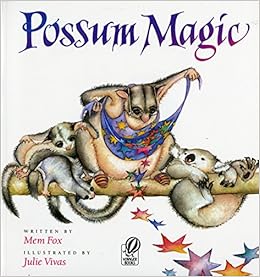
Book Review: Possum Magic


Written by: Mem Fox; Illustrated by: Julie Vivas
Published by: Voyager Books, 1983
ISBN: 978-0-15-200572-6

Plot Summary

Possum Magic talks about all the amazing things that Grandma Poss can make happen with her bush magic. But the best magic is making Hush invisible. Hush loves being invisible, and all the things it allows her to do until one day she wants to see herself again. Grandma Poss knows that the solution involves food but can't remember which kind. They end up going on a tour around Australia until they find the right combination to reverse the magic.

Critical Analysis

Possum Magic is a fun and fantastical tale that also intertwines Australian culture into the story. The book begins by talking about all the magic that Grandma Poss can do, which all centers around Australian creatures found in the bush where they live- wombats, kookaburras, dingoes, emus, koalas, and kangaroos. Her best magic is making her granddaughter, Hush invisible. We are told that although there are many benefits to this magic, the main reason Grandma Poss did it was to protect Hush from snakes. This relationship between the two main characters is something with which children will be able to identify.

Hush's dilemma is one that is also relevant to children- having something that you really want and then realizing that it's not as great as you thought it would be. Many young children (and adults!) have probably wished that they could be invisible at some point in time. Being able to hide when you're embarrassed or just to be sneaky is a common desire. But, being invisible without the ability to see yourself for a long period of time (or possibly forever), would cause one to lose their sense of self-identity.

Grandma Poss's love for Hush is apparent through all her actions in the book- making Hush invisible in the first place to protect her, agreeing without question to make her visible again, and then traveling far and wide to find the thing that will allow her to see herself again. Additionally, while there are many things that Grandma Poss can do- change the color and size of things, she only makes Hush invisible, demonstrating their special bond with magic that is just for her.

In addition to the Australian animals at the beginning of the book, Grandma Poss and Hush's search for the antidote takes them on a trip across Australia. They travel to every area and eat a number of traditional foods, looking for the one that will make Hush visible again. This gives a nice introduction to Australian culture. While not as deep a dive into "little c" culture as one might desire, this is appropriate for the audience that the book is targeting.

At the back of the book, a map and a glossary of Australian terms are included. The map shows the characters' path on their search and has illustrations of the foods they eat in each location. This gives young children a visible introduction to Australia and lets them see how far Grandma Poss and Hush travel to find what they are looking for. The glossary clearly explains each food they try and allows the reader to remain in the book, not having to turn to an Internet search to discover the taste and appearance of the different foods.

The illustrations really lend to the magical feel of the book. The stars on Grandma Poss's apron represent her magic and a trail of them can be seen on pages representing the spells she is doing. One of the best examples of this is on the page where she makes Hush invisible. You can see the trail of stars transforming Hush from her normal self into almost nothing as she slowly fades throughout the illustrations. The drawing of Grandma Poss and Hush at the pond where Hush tells Grandma Poss that she wants to see what she looks like again is an excellent way to visually demonstrate the fact that Hush is invisible. Children may have a hard time grasping the concept since a vague outline of Hush is shown to demonstrate her interactions with the other animals. On the page at the pond, Grandma Poss's reflection is clearly seen in the water as she brushes her teeth and even her reflection is more solid-looking than invisible Hush, who hangs on a branch nearby, but has no reflection to look at in the water.

Grandma Poss and Hush's possum qualities are on full display throughout the book. Their big eyes, pointy noses, and long curly tails are all highlighted in the bold drawings. In fact, the very first part of Hush that reappears after eating the Vegemite sandwich is her tail, representing the fact that it is the most distinctive feature of a possum. They are frequently shown balancing on limbs with their tails steadying them or hanging from branches by their tails.

Although it isn't directly referred to in the text, the illustrations make it clear that the possums are getting their Australian fare through discarded bits from humans. In the movie theater, Hush is seen taking Minties from the box being held by the boy next to her and a trail of them is on the floor. The Vegemite sandwich seems to have been dropped from one of the people sitting on the bench behind them and the use of forced perspective is powerful as the possums appear larger than the people due to their distance from the reader- representing that they are the main characters in the story.

The book ends with Grandma Poss and Hush eating Vegemite sandwiches, pavlova, and half a lamington each year on her birthday to make sure she stays visible forever. While the main purpose of this is to keep the spell from starting to work again, it also represents birthday traditions that families celebrate yearly. Children will be able to relate to this and can connect it to their own traditions.

Awards Won

1984- Ethel Turner Prize for Young People's Literature

Review Excerpt

From Children's Literature, published 1990

"An international bestseller, Possum Magic casts two Australian bush possums in starring roles but also features wombats, dingoes, and emus, rendered endearing by Julie Vivas' soft-toned watercolors. In addition to introducing Australian animals, Fox takes her possums on an eating adventure in search of the Australian foods--vegemite sandwiches, pavlovas, and lamingtons--that will work a necessary magic. The book provides a warm, wonderful first exploration of Australia!" 

Connections

Bring in samples of the foods that Grandma Poss and Hush eat in the book and allow students to taste them.

Students can write about or discuss what things they would do if they were invisible like Hush, or other magic that they would do if they had Grandma Poss's abilities.  

Read other books by Mem Fox: Koala Lou, Ducks Away, or the companion books, Possum Magic Animals and Possum Magic Numbers. 

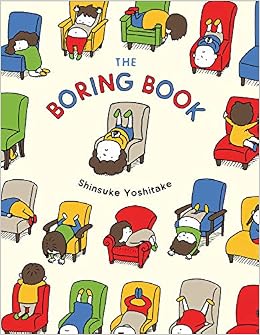
Book Review: The Boring Book


Written by: Shinsuke Yoshitake
Published by: Chronicle Books, 2019
ISBN: 9781452174563


Plot Summary

The Boring Book tells the story of a little boy who finds himself being bored because he has nothing to do. He begins to think more about what it means to be bored and why things are boring. He tries out different activities to see what is or is not boring, and thinks about different situations that are boring. He also realizes there is a state where you are neither bored nor having fun, an in-between. Finally, at the end of the book, he seeks out his dad to ask his advice on being bored.


Critical Analysis

The Boring Book explores the question "What makes something boring?" Since this is such a universal question, the book will hold interest for children as it asks some questions they've likely asked themselves as well as those they haven't. Readers will identify with the main character starting on the first page as he complains that his toys are all boring and there's nothing on TV. Grown-ups will also chuckle at the small jokes included for their benefit, such as when the boy asks tells his mother that he is bored and she responds "What do you want me to do about it?" with a haggard look on her face, obviously at the kitchen sink in the middle of cooking a meal.

The book raises many questions about boredom, some of which are answered but there are others that remain open-ended. This will allow readers to form their own opinions and encourages discussion if the book is shared as a read-aloud. At the end of the book the boy's father explains that boredom can be useful because it makes fun experiences even more fun, but since the boy has heard someone say that before, he deems it boring, thus ending the book on the same note on which it began.

The book was originally written in Yoshitake's native Japanese. Its English translation retains the thought-provoking questions and fun imaginative thoughts. However, the original was published with a hand-written text, which has sadly been replaced in the English translation. There are some cultural markers pointing to the book's Japanese heritage. When the boy asks his grandpa about the most boring thing that has ever happened to him, Grandpa is shown sitting on the floor at a low table with his legs crossed, a position that is common in that culture.

The illustrations are simple, using only black, white, red, blue, green, and yellow. However, they are still very interesting and emotive and contain a lot of detail. There is a recurring theme throughout the illustrations of the main character being drawn in a series of poses that differ only slightly from one another. This can be seen on the opening page when he is shifting around in his chair, as well as several pages in where he tries to see if boredom can be cured by constantly changing the way he sits. This illustration shows him trying different positions, accented by red arrows to demonstrate his progression and the occasional "Rustle" and lines of movement.

The illustrations of the park and the amusement park are anything but boring. The fun park looks like something out of a child's imagination with looping slides, double-decker swings, and a climbing structure that resembles a spaceship. In contrast, the boring park has only a tree and a bench. Even the ground is a gray color, without even green grass to make it interesting.

The pages with the amusement park present a nice contrast between the drawing and the text. The story is talking about the attractions that would be included in the world's most boring amusement park- a slow roller coaster, low Ferris wheel, closed rides, easy games, lukewarm drinks, tired characters, and a haunted house that isn't scary. However, the illustration is anything but boring, with so many detailed things to look at. Certainly, the people at the amusement park are all bored, this is apparent even with their simply drawn faces- the addition of extra lines around their eyes makes a stark difference and clearly communicates their lack of entertainment. In fact, the only people smiling are in the haunted house, definitely out of the norm, but another great detail included in a book that is rich with them.

Although the culture of the book isn't front and center, as previously discussed, there are subtle markers in the illustrations- the Grandpa's posture, as noted, the schoolchildren in uniforms, and the fish that the mother is preparing for dinner. The culture does not override the plot points about boredom, but it is present.

Overall, the book is a simple but not at all boring look at a universal concept that all people experience. It serves as not only a fun read, but also a jumping-off point for conversations about the nature of boredom and tactics that can be used to overcome it.

Awards Won

2019- Cybil's Award Nominee

2019- New York Times/ New York Public Library Best Illustrated Children's Books Award WInner
Review Excerpt

From Publishers Weekly, published May 13, 2019

"Japanese author and illustrator Yoshitake (Still Stuck) zeroes in on a ubiquitous childhood experience and probes it with dry wit. The creator's human figures draw smiles from the get-go as a boy sprawls on the couch, dead bored: My toys are boring. There's nothing to watch on TV. His mind wanders: Why am I bored? What does boring mean, anyway? In vignettes and multistage spreads, the boy considers the many permutations of ennui. I wonder what the worlds most boring amusement part is like, the boy says, as Yoshitake shows children in an advanced state of stupor shuffling through a park (The Ferris wheel is low. The roller coaster is slow. Most of the rides are closed for repairs)." 

Connections

Have students create a list of things they like to do when they are bored.  

In the book, Yoshitake describes the world's most boring amusement park. Have students create their own "world's most boring" venue or event and describe it. 

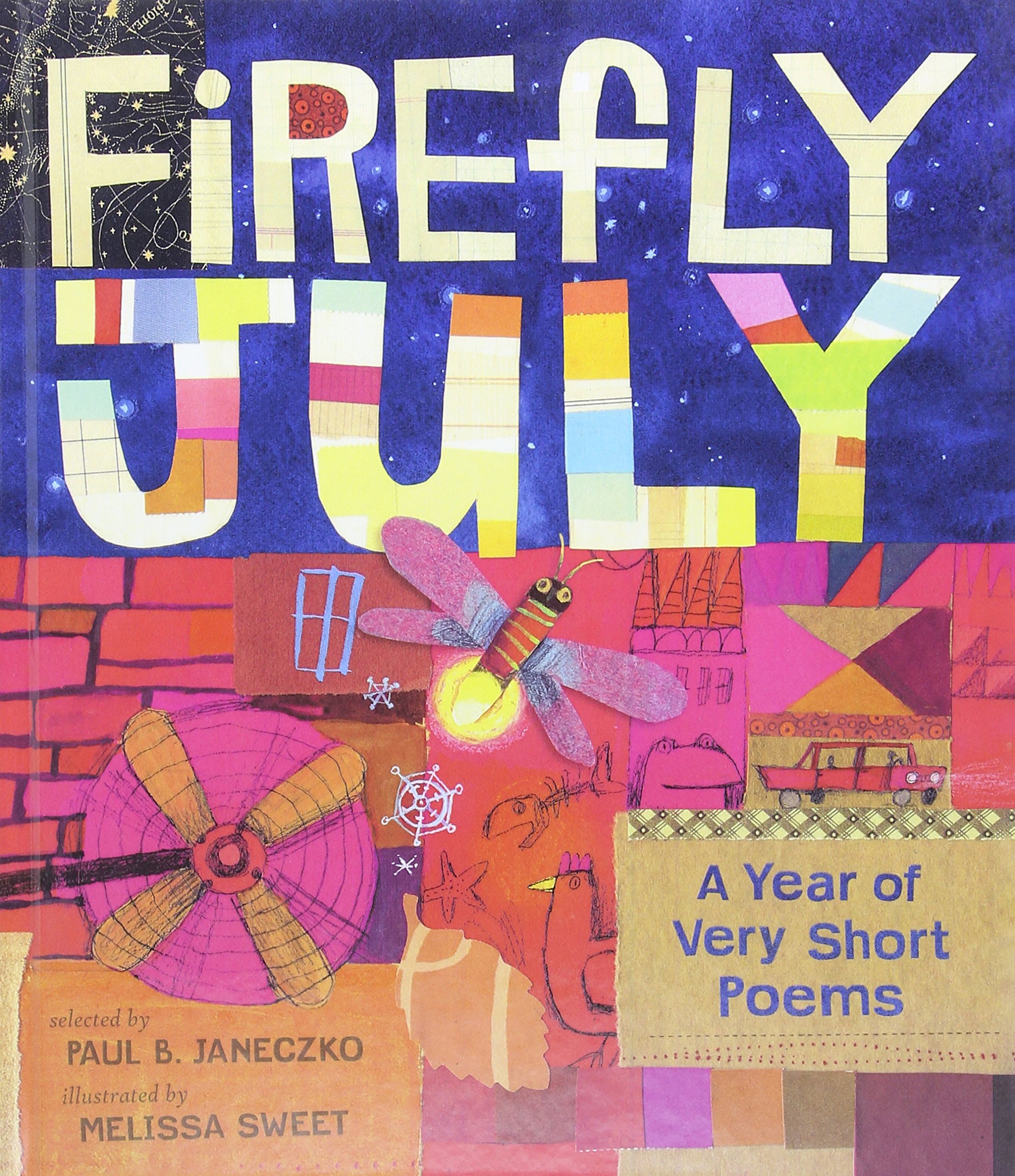
Book review: Firefly July

  Selected by: Paul B. Janeczko Illustrated by: Melissa Sweet Published by: Turtleback Books, April 10, 2018 ISBN: 978-0606409025 Plot Summa...