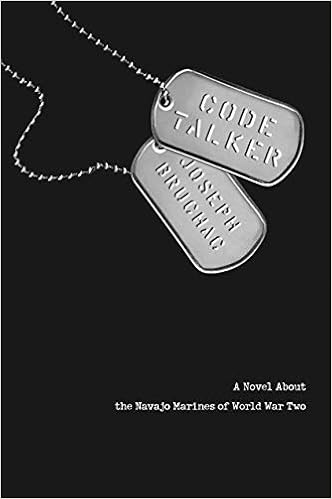
Written by: Joseph Bruchac
Published by: Dial Books, 2005
ISBN: 978-0803729216
Plot Summary
Code Talker is a novel about a group of Navajo Marines who were selected for a special group during World War II. It tells the story of Ned Begay, a fictional character, who is sent to a boarding school where the students are forbidden to speak Navajo. They can only speak English and their bilagaanaa teachers punish students who are caught speaking their own language. Ned studies hard and is determined to join the Marines after Pearl Harbor. Although he is not technically of age, his parents agree, and he is chosen to join a special group of Navajo recruits, who are tasked with sending messages in code using their Navajo language. Ned tells about the horrors of war and his experiences afterward, keeping the secret of his duty for many years post-war.
Critical Analysis
Code Talker is written as a story told by the fictional Ned Begay to his grandchildren, explaining the medal he earned in World War II. Writing the novel in this fashion emulates the rich oral tradition that the Navajo culture has of handing down the history of their people through storytelling. Although the book and Ned himself are fictional, they represent the many Navajo soldiers who lived this experience.
Bruchac does an amazing job of maintaining authenticity within the story. Although he is Native American, he is from the Abenaki tribe. His interest in the preservation of Native American languages is one thing that led him to write this book. His research is apparent from the author's note and selected readings he includes at the end of the book. He is able to seamlessly work in both the Navajo language and the culture into the book by making it a part of the story. When Ned's uncle takes him to boarding school, he leaves without looking back and Bruchac writes, "There is no word for good-bye in Navajo."
The sense of community and family that is present among the Navajo is shown in the reasoning behind the children attending the boarding schools. This was part of an agreement made when the United States government allowed the Navajo people to return to their home. The Navajo had to live by their rules and send some of their children to the mission schools to reassure the Americans that they would not fight them again. So, the children went not so much so that they could be taught, but as representatives of their tribe's willingness to maintain peaceful relations.
Sadly, the experience at the boarding school was not a positive one for the Navajo children. It started with the white teachers renaming some of them if they deemed their name "too difficult" and cutting their hair. Keeping their hair long was sacred to the Navajo and cutting it was believed to bring you misfortune. Although Ned's time at boarding school isn't the main plot of the book, it includes valuable information about this experience that was shared by so many Navajo children. Telling the story through the point of view of the Navajo allows their truths to be told. It explains that their hair was sacred to them and that is why it was so upsetting for it to be cut. Forcing other cultures to conform to the dominant culture's standards can be very damaging, particularly when the people enforcing those standards don't bother to learn about the culture of the people on whom they are inflicting their own norms.
With that welcome to school, it is unsurprising that the teachers did not have high expectations of their students. It is apparent that they assumed that the Navajo children were not as smart as their white counterparts. In fact, this is said outright when Bruchac writes, "Neddie, you are almost as smart as a little white child," as if this was a compliment. Ned decides that he will one day become a teacher and treat all of his students the same. As studies have been done, it has become apparent that children from all cultures are equally intelligent and that standardized tests or other assessments that may show otherwise are biased towards white students. Again, this is why it is so imperative that educators are aware of the different cultures of their students.
Following their treatment by the United States government and their bilagaanaa teachers, it is interesting to learn that the Navajo were still willing to stand up and fight alongside the country in World Wars I and II. In Boot Camp, Ned meets a friend, Georgia Boy, who he knows throughout the war. He discovers that his new friend cannot read and promises to teach him. He learns that although his teacher had always told him that white men knew everything, that they did not and that people can always learn from one another. Through experiencing new things and meeting people who are different from him, Ned is able to cast aside his own misconceptions about his own culture and about white culture. His experience at school had left him with some internalized ideas about white supremacy courtesy of his teachers. Learning more about himself and others allowed him to cast aside those ideas and start believing even more in his own potential.
Ned's time at war is authentically portrayed and the hardships are well-described without being too gory for the young adult audience. While the Code Talkers obviously had to be kept secret due to their mission, it almost seems as if that secrecy allowed the Marines to overlook them altogether. Even after the war ended, their mission was kept secret so it was many years until they were invited to the White House and formally recognized. One must wonder if the biased attitudes towards Native Americans affected their willingness to wait so long to recognize them for their achievements. Bruchac writes similar thoughts, "We were kept invisible . . .It was easy to forget Indians."
However, there were plenty of commendations written about the Navajos from their generals. For many, this was the first time that they had heard positive feedback from white men in positions of authority. The Code Talker program grew throughout the war due to the excellent performance and results of the Navajo Marines who were involved in it.
Writing the story of the Code Talkers in the Second World War lets everyone know that the Navajo are not an extinct people who only existed in the 1800s. They are people who fought alongside soldiers of many other cultures in World War II and beyond. Hearing about them transmitting messages on radios and flying in planes makes them more real, even though these events are now 70+ years in the past.
Awards Won
2006- Best Books for Young Adults
Review Excerpt
From Booklist Starred Reviews, published February 15, 2005
"The book,
addressed to Ned’s grandchildren, ends with an author’s note about the
code talkers as well as lengthy acknowledgments and a bibliography.
The narrative pulls no punches about war’s brutality and never adopts
an avuncular tone. Not every section of the book is riveting, but slowly
the succession of scenes, impressions, and remarks build to create a
solid, memorable portrayal of Ned Begay. Even when facing complex
negative forces within his own country, he is able to reach into his
traditional culture to find answers that work for him in a modern context. Readers who choose the book for the attraction of Navajo code
talking and the heat of battle will come away with more than they ever
expected to find"
Connections
Students can create a Navajo glossary of the words that are used in the book.
Read other books by Joseph Bruchac, suggestions areTwo Roads, Jim Thorpe: Original All-American, or Talking Leaves.