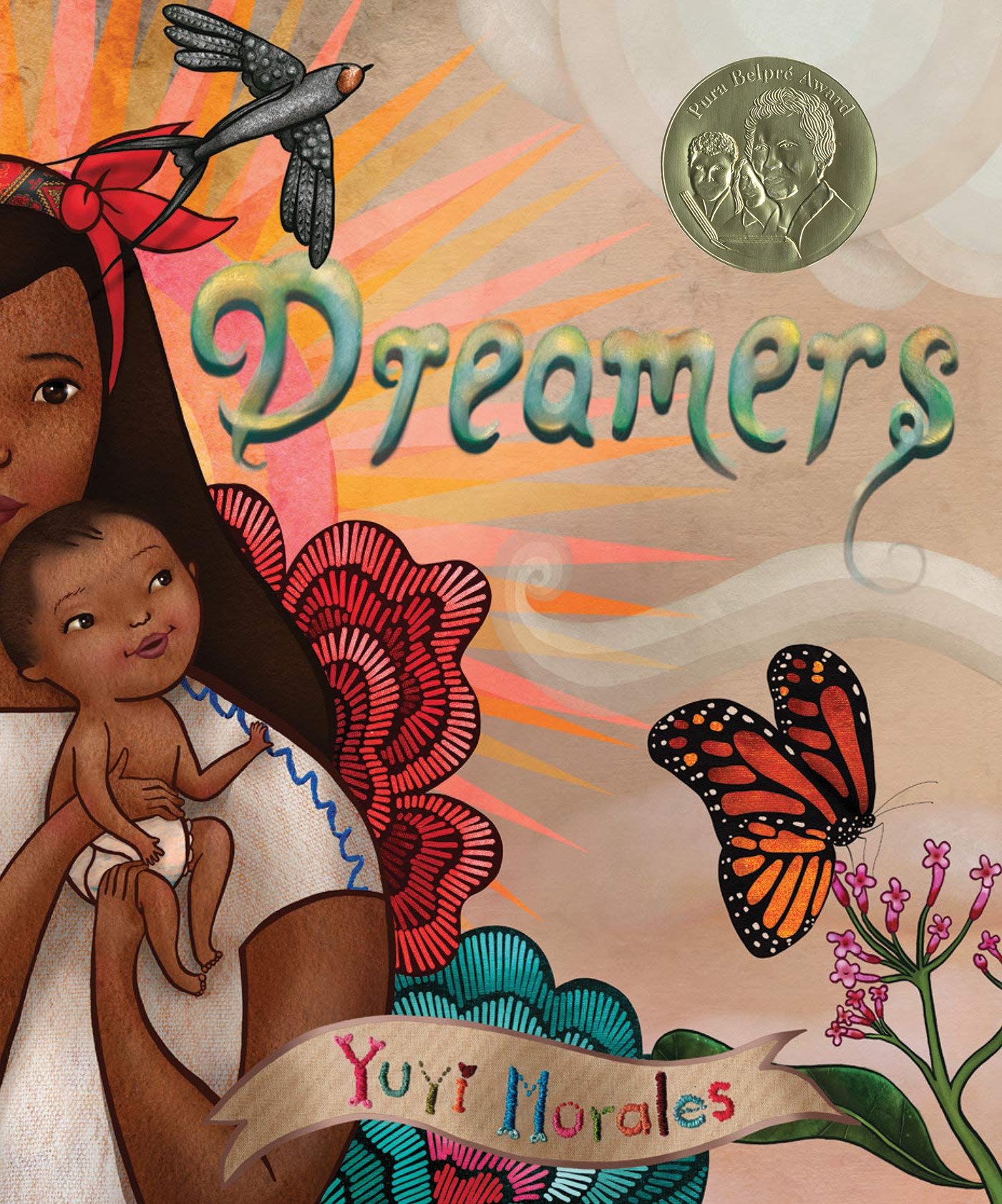
Written by: Yuyi Morales
Published by: Neal Porter Books,2018
ISBN: 978-0-8234-4055-8
Plot Summary
In Dreamers, Yuyi Morales tells the story about how she and her son came to the United States to visit his ill grandfather, and ended up as immigrants after she married her son's father. Although her immigrant status came about unusually, Morales shares many of the emotions that immigrants feel and conveys those emotions through the words and illustrations in the book. Finally, they find the library and it not only makes them feel like they have a home, but it also inspires them to dream about the future and the potential they have.
Critical Analysis
Yuyi Morales combines a picture book and her own memoir into a beautiful story in Dreamers. Although their path towards becoming immigrants was somewhat unexpected, their story still retains the immigrant experience that is quite common in the Hispanic culture throughout the United States. Their experience, like so many others, is full of joy and pain simultaneously. They ache for the sights and sounds of home while at the same time, finding their way in a new place that they will one day come to call home.
In the case of Morales and her son, the remembrance of what they have lost is possibly more heartwrenching due to the fact that they were unaware of exactly what they were leaving behind. However, this only becomes apparent when one reads the note at the end telling the story behind her experience. The book, as written does a nice job of interweaving those immigrant hopes and fears in not only the text but the illustrations as well. The smoke in the air shows phrases that immigrants likely hear all too often "What?" "Speak English." This is also a valuable realization for citizens of the United States to understand what their words may sound like when speaking to recent immigrants who have undergone trauma.
Morales deftly avoids the negative stereotypes that can be pervasive in Hispanic literature when she reveals that the place that felt like home was the public library. A far cry from the barrio, often portrayed as dangerous and undesirable, Morales and her son find a place to be themselves in the library. Although she first describes it as suspicious and improbable, this is understandable coming from someone who has never seen a library before and whose experiences in the United States have seemed less than welcoming. She goes on to say that it is unbelievable and surprising, moving into a more neutral tone, and ends up saying that books became their language, home, and lives. This journey from feeling that the library is suspicious to it being a home represents the way that many immigrants feel about their new countries.
The illustrations serve to further the messages in the text. Morales includes a note at the end of the book stating that they were painted with acrylic and drawn on paper with ink and a nib pen that once belonged to Maurice Sendak. She also photographed and scanned many important items. When you study the illustrations closely, you can see the unique textures of the pictures that have been scanned. They add a reality and a richness to the images as well as incorporating important pieces of the author's life into the story.
She also includes the actual covers of a number of books in the illustrations of the library. Students will delight in picking out some of their own favorites among the stacks in the drawings. Morales includes a list with information about some of the books that inspire her at the end of the book.
A familial resemblance is clear in the faces and skin tones of Morales and her son, the main characters in the story. However, the other people pictured are shown with varying skin tones and different features. This shows that, while they may share immigrant status, or a love of the library, they are not a monolith, but rather individuals that are able to come together over common threads.
Morales uses some Spanish words to great effect in the book. Rather than just repeating the exact same word in English and Spanish, she uses context clues to give meaning to the words and chooses the Spanish words quite carefully. For example, "lucha" literally means fight or struggle, and while that certainly describes immigrants, she uses resilience after it, almost in contrast.
Awards Won
2019- Pura Belpre Illustrator Award Winner
Review Excerpt
From Publishers Weekly, published September 4, 2018
"As the languages blend, so do the images. Mexican motifs—a genial skeleton, a painted dog, embroidered flowers—dance through the pages, keeping mother and son company on their journey, and the library shelves swoop and curve, embracing them. (Readers will recognize favorite titles among the carefully painted book covers.) Many books about immigration describe the process of making new friends and fitting in; this one describes what it’s like to become a creative being in two languages, and to learn to love in both. “We are two languages./ We are lucha./ We are resilience./ We are hope."
Connections
Explore Yuyi Morales's website, particularly the section that says not to click. :)
Read other books by Yuyi Morales- Viva Frida, Just a Minute, and others.



No comments:
Post a Comment