Friday, April 23, 2021

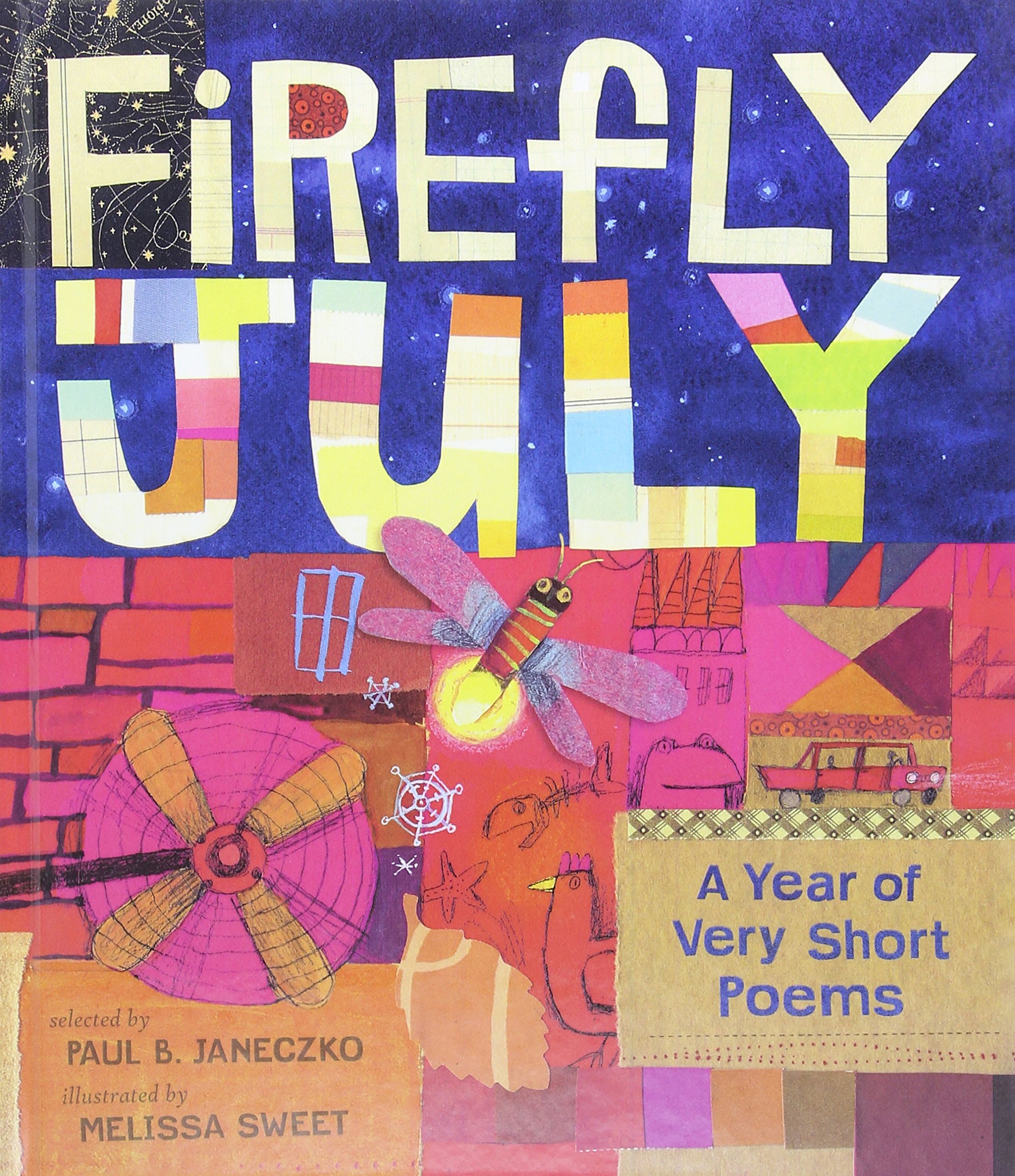
Book review: Firefly July


Selected by: Paul B. Janeczko
Illustrated by: Melissa Sweet
Published by: Turtleback Books, April 10, 2018
ISBN: 978-0606409025

Plot Summary


Firefly July is a collection of poems about the year. It is separated into four sections, one for each season. The included poems are short, but each evokes feelings that represent their season. The collection includes well-known names in the genre, such as Langston Hughes and William Carlos Williams. 


Critical Analysis

The first season represented is spring. Poems about aspects of nature dominate this section. In The Island, poet Lillian Morrison describes a small island. She likens the island to an elephant, making the connection between the appearance of the grey stone with the wrinkled skin of an elephant. The accompanying illustration shows a small island with strategic areas of rock that look like an elephant. The illustration brings the pictures that the words create to life and you can see the image of an elephant bathing in the water with half of its body under the water, crouching down and waiting. This is similar to personification, but it is comparing the island to an animal rather than a person. The ending lines describe the birch trees treading on the skin and again, the illustration portrays those words, as it looks as though the trees are also animals walking carefully along the elephant's back. 

In Passing is one of the poems in this section that focuses on a manmade item rather than a natural one. It speaks of a truck passing by. The language used in this poem gives it a childlike sound with a nice rhythm. It is described as a "dumpy junktruck", which is almost a tongue-twister since we would be more used to saying "dump truck" but it's been switched for junk in this case. Changing it from dump truck to the adjective "dumpy" changes the way that the reader pictures the truck, since rather than just describing the truck's intended use, it describes its appearance and gives a mental image of a shabby, short vehicle. Then we add on the stacks of fans with the repetitive wording- unplugged, unsteady, undone. The image of the whirling fans almost lightens the idea of the dumpy truck and makes it seem like it could go faster, almost flying with the help of the spinning blades. 

Next, we move on to summer and the strong imagery present in Sandpipers. Most beachgoers have encountered these birds walking along the sand and poking their beaks inside it. The poem describes their long, thin beaks as "needle beaks" and their digging motion as "hemming the ocean". This description allows one to picture the birds walking along in a line and slowly poking holes in a line, just as someone would do when they are sewing a piece of clothing. Personifying the birds with the human action of sewing helps to picture their actions and allows one to see the edge of the ocean as a large piece of cloth. The accompanying illustration shows beachgoers on their towels. The bright rectangles of color create an image that looks similar to a quilt, thus furthering the sewing metaphor. 

Summer is also represented through In the Field Forever. This poem likens summer to a roaring dandelion. This wording plays on the "lion" part of the plant's name, but also allows the reader to picture the seed heads on it spreading through the air after being blown. The phases of the moon are represented by calling it a scythe and a silver flower, which again brings in the floral theme. We end with the stars as clover, always the same throughout the night. However, they do shift from season to season. This poem also incorporates some rhyme, with flower and hour, as well as clover and over. 

In headline, a falling leaf is compared to a newspaper, landing on a doorstep. Much like an actual newspaper, the leaf brings news to a household when it lands on the doorstep since it lets the inhabitants know that fall has arrived. Its simple message is clear and welcome since the contents of the newspaper can often be more complicated. The poem even says that you don't even have to pick up the leaf to know the news that it brings. 

Winter is the last season included in the book. Since spring is generally seen as a new beginning, it makes sense that winter would be put at the end. Snow Fence is included in this section. The imagery of the fence poking up out of the snow evokes the feeling of winter, which can be seen as barren. The words say the fence has "no meat on its ribs" and this can be a representation of the animals in winter who are hungry and in search of food. The imagery of the fence posts as ribs also let the reader picture them poking up from the snow. In the illustration, the fence has birds perching on it, also in search of nutrition during the long winter months. 


Excerpt

Firefly July

When I was ten, one summer night, 
The baby stars that leapt
Among the trees like dimes of light, 
I cupped, and capped, and kept. 

-J. Patrick Lewis

Use

With so many different poems in the book, the collection is a perfect choice for a class to take on. The excerpted titular poem above has a nice rhythm and encapsulates the feeling of summer so well. Allow students to choose a poem to read aloud or, if they are uncertain, they can narrow it down to a season and get teacher help to choose one poem. Students can read on their own, as pairs, or in small groups, depending on their comfort levels. If students do not want to read aloud, they can choose an artistic representation of a poem to display during the readings. Plan a poetry reading (either virtual or in-person) to share the poems with parents or students in other classes.

Thursday, April 22, 2021

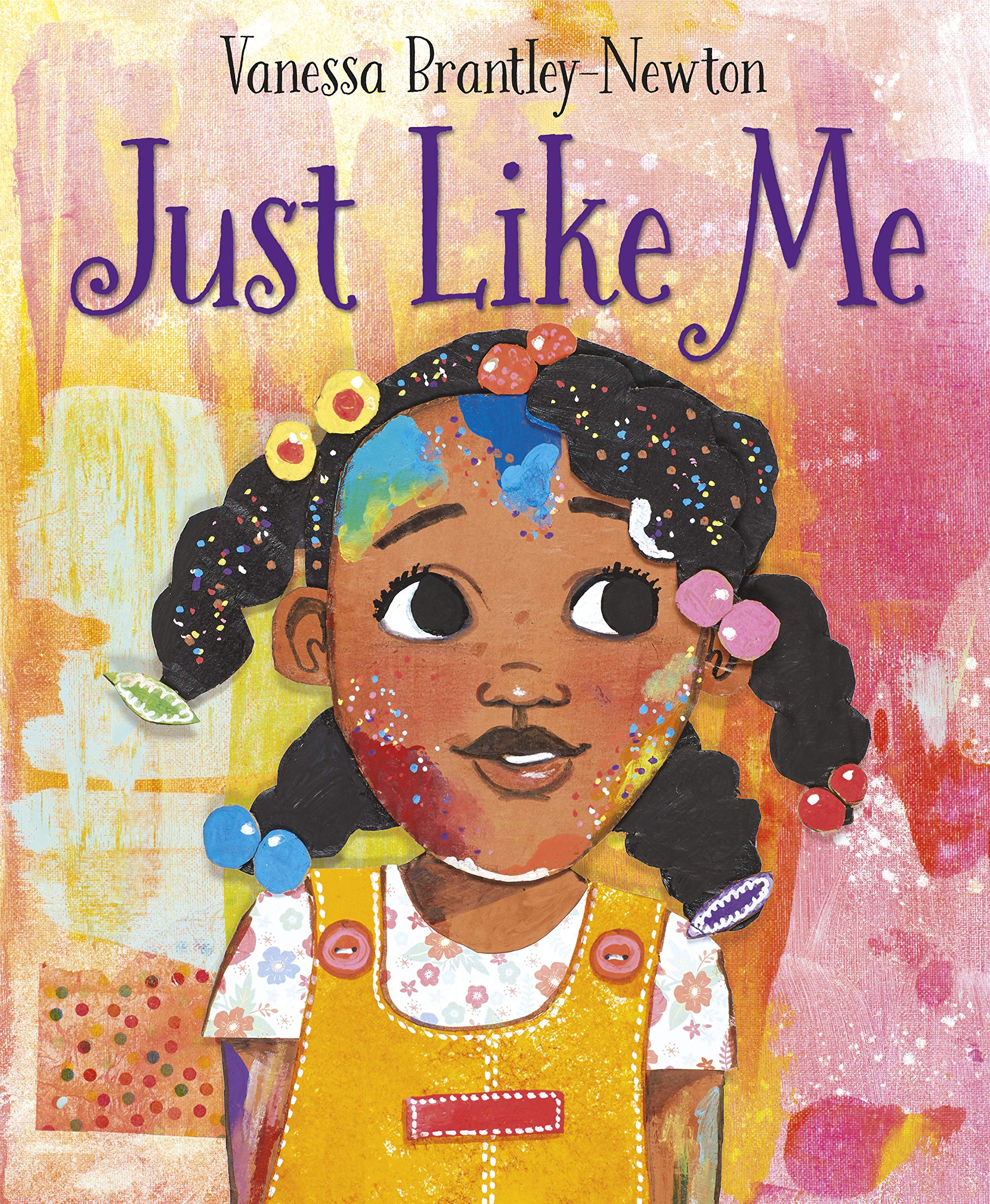
Book review: Just Like Me


Written by: Vanessa Brantley-Newton
Published by: Knopf Books for Young Readers, January 14, 2020
ISBN: 978-0525582090

Plot Summary

Just Like Me is a collection of poems that celebrate girls being themselves. The poems tackle topics such as self-identity, living in a global community, body positivity, hopes and dreams, and friendship. The poems inspire girls to be their best selves and work with others to make their world a better place. 

Critical Analysis

The book opens with I Am a Canvas which describes how we are all influenced by the people that surround us. Children, in particular, are trying to find themselves and discover who they are. It allows the reader to picture either themself or a child as a blank canvas, and the words being said to them are showing up on that canvas. This provides a lesson both in being aware of how much of an influence your comments can have on others, particularly children, and even more specifically girls. It also makes one aware of how they internalize the words of others, allowing it to change their mood and outlook. 

This poem segues into the second, The Day I Decided to Become Sunshine. Unlike in the first poem, where the girl is being affected by the words of others, in this one, she has decided to make light shine everywhere she goes. This shows her taking control of her own life and steering her emotions and influence in the ways that she wants them to go, rather than allowing them to be determined by others. The positioning of these poems one right after the other shows the growth that has occurred from the child merely being influenced by others into learning how to wield their own influence. 

Repetition is a poetic element that is found in Warrior. The poem both begins and ends with the lines "I am a warrior willing to fight the good fight." This repetition helps to bookend the poem and drive home the main idea behind it. At the ending, the words "of love" are added to the repeated lines. This helps us to know what the poet is fighting for. The fight of love almost seems like a oxymoron, but fighting for love is a very real and necessary part of the human experience. The accompanying illustration shows strong and determined girls in powerful stances, standing up for their beliefs and being strong. 

Figurative language is found in Pimples. This poem about an adolescent annoyance that so many face includes the wording "This pimple has invited itself to my perfect picture day." The illustration shows a calendar with school picture day labeled. The phrase "picture perfect day" is a commonly used one and here the words have been flipped to perfect picture day instead. The appearance of the pimple has certainly ruined the literal picture day, but it could also be said to have ruined the poet's perfect day as well. 

Cool Like That makes effective use of onomotopoeia. The poem tells about a girl playing the drums and the words included (bip, bop, blat, bap) are sounds that can be made by playing the drums. They also demonstrate alliteration with all the "b" sounds. The words of the poem were carefully selected because many of them both have meaning but also can be added to the list of words that sound like drumbeats (hip, hop, tap, rap). 

Similes make up the brunt of the poem Feelings. This is such a difficult subject for many children to understand, so the use of similes for this poem helps to make feelings a more accessible topic for kids. In addition, the feelings included cover a wide variety of emotions, and include wording that lets the reader know that so many conflicting feelings can all be inside us at once. 

Excerpt

City and Country Dreams

I am a city girl                                                I am a country girl
longing to be a country girl                            longing to be a city girl
climbing trees and picking butter beans        chasing bright lights and crowded streets
Drinking sweet tea and watching the sun      and dirty water dogs
    set on soft sandy dirt roads                        And learning that fast city talk
and the gentle sound of crickets               and watching the suns set from fire escapes
I am a city girl                                                  I am a country girl
longing to be a country one                            longing to be a city one


Use

This poem is perfect to be read aloud by two voices. There are several different options on how to organize the phrasing of the read-aloud. The first student can read the entire city girl part and then the second can read the entire country girl part. Another option is for the students to take turns, reading one line at a time to really highlight the similarities and differences in the words. One more possibility is to have the students read the first two and last two lines in unison, then to read the other lines one at a time taking turns between each line. 

Wednesday, April 21, 2021

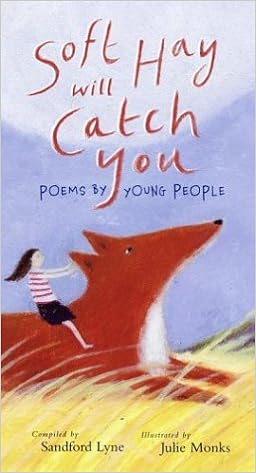
Book review: Soft Hay Will Catch You


Compiled by: Sandford Lyne
Illustrated by: Julie Monks
Published by: Simon & Schuster Books for Young People, February 24, 2004
ISBN: 978-0689834608

Plot Summary

Poet Sandford Lyne collected the poems included in Soft Hay Will Catch You when he taught a poetry workshop at the K-8 school in Kentucky where his cousin was a teacher. The poems encompass much of the rural lifestyle that the students experienced daily and include discussion of work on the farm, barns, and other common country pastimes. However, other poems show the dreams and creativity of the children as well. 

Critical Analysis

The poems in Soft Hay Will Catch You are divided into six different sections, based on their subjects- search for the self, solitude and loneliness, the home and family, the soul's journey and the circle of life, awakenings and discoveries, and our connection to place. Tucked in among the poems are paintings by Julie Monks that evoke the simple yet beautiful feelings that are portrayed in many of the poems. Many of the students wrote about things that they encountered in their everyday lives, but they also created deeper meaning in their work by discussing important feelings of loss, loneliness, and hope. 

In the introduction, Lyne speaks of the "love of experiences" that he inherited from his parents. This is one of the traits that makes him an effective teacher of poetry. Successful poems help to make people feel things deeply, and can be enriched by having a wealth of experiences from which to draw. These experiences can be complex or simple, and writing about what you know is a sure way to craft an impactful poem, which is exactly what these young poets have done. 

In Shadows Lurk, the writer, Brenna, has an extremely effective way of using contradictory language to help describe the shadows. She refers to them as "merrily dancing", which at first glance seems to be an odd way to describe something that is lurking and frightening. However, after sitting with the poem and conductive multiple readings, the reader is able to imagine the image of the shadows both lurking but also dancing in columns and see just how scary that image actually is. The juxtaposition of the dark and ominous shadows that seem to hover and float with the image of them dancing merrily in columns is disarming. Often seeing something intimidating and frightening that seems joyful makes it even scarier. However, the poem's conclusion lets us know that its writer is staying strong since she is more powerful than the shadows. In this instance, the shadows are likely symbolic of her own fears. 

Different Worlds uses figurative language, speaking of both a "world in leaf" and one in flame. A world in leaf could be taken literally as a place with a lot of plants and foliage, such as  forest or a more rural location like the one in which the students live. It could also be seen more abstractly as a place for growth that is full of potential. Conversely, the world in flame is one being destroyed, no matter the sense in which it is meant. Perhaps it is this world holding her back, and she is trying to hold on to the world of her childhood that is disappearing in flame as she watches. The world in leaf could be the adulthood she mentions looking forward to with hope and future blooming. 

Personification is present in The Lonely Fire. Describing the fire as lonely makes it seem as though it has emotions. However, a fire is actually a perfect representation of loneliness because it needs to separated from people and objects so that they do not start to burn. The physical isolation of a fire is similar to the psychological isolation that is felt by people who are lonely. However, even through the fire is lonely, it is still dancing and the poet describes it as soothing to the sole. This is a good reminder that being alone doesn't always have to feel lonely. 

Excerpt
A Different Place

I'm moving away from all my friends.
I'm moving to a different place.
I'm going to live on a different street,
in a different house, on that different place. 
Everything will be different but the moon. 
The moon will follow us wherever we go. 

Use

The words and rhythm pattern of this poem makes it a good option to be read aloud by multiple voices. Optimally, 3 students could read it together, with each one reading one of the first 3 lines as a solo and then the first two students reading the first and second part of the 4th line as solos as well. Then all the voices can join in together for the 5th and 6th lines, symbolizing that while friends can move apart, they are still together under the same sky.


Friday, April 9, 2021

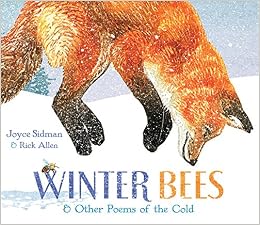
Book Review: Winter Bees & Other Poems of the Cold


Written by: Joyce Sidman

Illustrated by: Rick Allen

Published by: Houghton Mifflin Harcourt, November 4, 2014

ISBN: 978-0547906508

Plot Summary

Bees are just the tip of the iceberg in this collection of poems about animals in winter. Readers can also find verses on moose, snakes, swans, and more. Alongside the poetry that discusses how these animals prepare for the cold winter months, you can find a non-fiction paragraph full of helpful facts about each animal. 

Critical Analysis

Winter Bees is an interesting and informative collaboration of beautiful poetry infused with factual information about animals and their preparations for winter. The first poem focuses on the tundra swan. Rather than telling of their migratory journey, the poem focuses on the night before they leave. The words that have been selected give the poem a soft, dream-like quality and create a sense of quiet wonder, similar to what one might have while watching these majestic birds. The cold is described as "creeping" and "prickling", as it does when cold weather first moves in. This is likely how the swans know that it is time to move on. 

In their dreams, the sun is a "pale wafer" and there is a "crisp drink of clouds." This vision of the elements of the sky as consumable marks the time they will spend on their journey as one to be taken in over time. In the accompanying factual section, the reader learns that, true to their name, tundra swans do actually spend their summers breeding and raising their chicks in Alaska and Canada. However, these areas are too cold for the winter months, so they move almost 2,000 miles south for the season, to areas in California or New Jersey where the water isn't frozen over with ice. The illustrations of the swans show them waking and beginning their journey. Some are already in flight while others are preparing to take off. 

Big Brown Moose is written as a first-person (first-moose?) account of a baby moose's winter experience. The rhyme scheme used in this poem gives it a frolicking, sing-song quality that allows you to imagine how a baby moose might move in the wild. The moose vacillates between being big and brave and being a moose who is comforted by the fact that his moose mama is "close by my side". Parents and those who have spent a lot of time with young children will recognize this simultaneous desire to strike out on one's own and their wish to remain in close proximity to their mama for a sense of security. 

The word selection in Big Brown Moose contains many consonant blends that make sounds similar to those that a moose would make while walking through woods. Tramp, tromp, swamp, snort, crunch, and clump all contain sounds that are heavier in the mouth and provide the needed weight to describe a moose's movement. The non-fiction blurb discusses the moose's large body and how it is made for the cold weather, reiterating the language choices of the poem. 

The titular poem, Winter Bees, focuses on the importance of teamwork in the hive. They are described as an "ancient tribe, a hearty scrum." Bees have been around for hundreds of millions of years, so their description of "ancient" is certainly apt. "Ancient tribe" makes the reader think of peoples from long ago who worked to create great civilizations, such as the Mayans or Egyptians. Like these cultures, bees work together to build their hives and to serve their queen. In rugby, a scrum occurs before a play when players gather closely together to try to get the ball. Bees work together similarly towards a common goal in making honey and providing shelter and food for their hive. 

The yellow-orange color of the hive against the white background of the image mimics the language of the poem, "deep in the winter hive, we burn like a golden sun." The bees were an interesting choice for inclusion in this collection since they are "one of the few insects in the Northern Hemisphere that remain active in freezing weather", according to the source notes. The phrase "busy as a bee" is an accurate one, as even while other species may go dormant, the bees continue to work together. 

The book manages to marry poetry and non-fiction harmoniously. The inclusion of factual information on each page inspires the reader to look at the poem in different ways. There is also a glossary provided at the back of the book that readers can reference for assistance with any unfamiliar words. 


Excerpt
"Snowflake Wakes"

Snowflake wakes,
whirling,
arms outstretched,
lace sprouting from fingertips

Leaps, laughing
in a dizzy cloud,
a pinwheel gathering glitter

Drops into air,
suddenly soft
and full, a lattice
of stars spinning
silently

Drifts down,
touching
and tickling,
clinging 
and clumping

Hugs earth,
sighs and settles
Sleeps,
tucked in its own blanket

Use

Snowflake Wakes lends itself well to an active recitation. The teacher or librarian should read it first and just allow students to listen. Then, encourage them to stand and act out the movements mentioned in the poem- whirling, leaping, laughing, etc. Make this a repeated activity throughout the winter season and students will eventually start reciting the words along with the teacher as they act out the motions. 


Tuesday, April 6, 2021

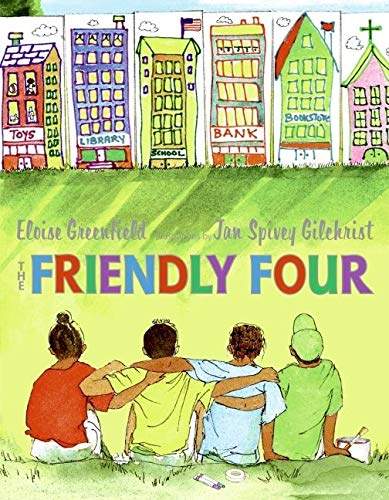
Book Review: The Friendly Four


Written by: Eloise Greenfield

Illustrated by: Jan Spivey Gilchrist

Published by: HarperCollins, June 13, 2006

ISBN: 978-0060007591

Plot Summary

Drummond lives on a street where he is the only kid, just him, two teens, and two babies. At the start of the summer, he spends his time wishing that it would end soon so that he can return to school and see his friends. But a new family moves in across the street and he meets and befriends Dorene. Soon, they find out another new boy has been adopted and will be coming to live on their street. Their foursome becomes complete when Dorene and her grandmother fly to retrieve her cousin, Rae, who is coming to stay with them while her mother is sick. The children become fast friends who are always together, and Drummond finds himself wishing the summer would never end. 

Critical Analysis

The formatting of the book mimics Drummond's own life on his street where he starts out alone and gradually finds more friends moving in. The poems in the first section of the book are written for just one voice, Drummond's. In each concurrent section, a new friend is introduced and another voice is added to the poems, eventually ending up with poems written in 4 voices, Drummond, Doreen, Louis, and Ray. The reader is able to watch their friendship grow and see Drummond's summer go from a bummer summer to a good summer. 

We meet Drummond first, who likes to wrestle and run. Unlike many children, he feels like "summer's a bummer" because he has nobody to play with. In "After the Baby" we find out that he is a big brother. This poem makes great use of wordplay. Many adults use this phrase when a baby is expected, to describe how things will change after the baby is born. However, in this case, Drum is talking about being stuck at home with his brother and the babysitter, constantly being told that they'll go to the playground "after the baby finishes his nap . . . has his diaper changed . . . eats." But "after the baby" always takes too long. You can really hear Drum's voice in this poem- an active and frustrated child who is constantly being asked to wait to do something fun. 

Drum's words are all written in red, so the first section of the book, just titled "Drum" is completely comprised of red text. However, at the end of his section, he sees new neighbors moving in, with a little girl around his age. We meet Dorene, and her voice joins Drum's in section two, with blue text to go with his red. Their first poem together, "Drum and Dorene" begins with repetition, which helps to set the rhythm of the poem and makes the reader picture a friendly but somewhat awkward meeting between two new neighbors. Before, the pace of the poems had been slow in Drum's solo section, but it picks up a bit here, mimicking the children's actions of running, chasing, and playing together. This section ends with a poem called "The New Boy." In it, Drum and Dorene learn that Ms. Lynn Bunton has a new son who is 6. Since they are both 7, they have decided that he is perfect for them, as well as for Ms. Bunton. This shows how close the two friends have grown since they are now thinking as a pair instead of individuals. 

In section three, we meet Louis, Ms. Bunton's new son. It is immediately apparent how much his new mother really loves him. His voice, in green text, joins Drum's and Dorene's, bringing in more color and life to their story. He says that his new mama's eyes remind him of someone he thinks he knew, maybe his mother. This connects his new mother with his birth mother, linking them together in love and care for him. The first thing they do to celebrate their newfound friendship is have a party. Louis is immediately welcomed to the group, in a spot that has seemingly been waiting for him the entire time. The children's joy is apparent in the words of "The Party": "Now, let's just be silly, and make too much noise, and laugh a lot, because we have a new friend, because I have two new friends. Let's be willy-nilly silly, and laugh. Because we want to." You can hear the excitement and raucous shouts that would be taking place at a party with these three new friends. 

Soon the mood turns more somber, in the last poem of section three, titled "Going to Get Rae". Dorene and her grandmother are going to get her so that she can stay with them while her mother is sick. In the next chapter, Rae's voice in purple completes the rainbow of text. In her opening poem, she explains that she doesn't plan to unpack her things because her mother will be better soon and the faster she can pack up, the faster she'll get home to her. This shows her child-like hope that her mother will recover soon and that she'll be able to return home to help her. 

Dorene convinces Rae to meet her friends and soon the four are close. Their voices begin to meld into one, represented by black text as the four speak in pairs, trios, and as a whole group. We see their attitudes change, as Drum becomes less and less ready to see the summer come to an end and Rae realizes that she'll miss her new friends when she's able to return home. 

The friends make their own town called Goodsummer in Drum's yard and have adventures at the movies, the bank, school, the office building, the library, the pet shop, and the concert hall. In the last section, they say goodbye, with plans to meet again next summer to continue their adventures. 

Excerpt
"At the Movies"

Drum: Is the monster still on the screen?
Rae: Yes. He's stomping
        I'm looking with one eye closed. 
Louis: I'm looking the other way.
Drum: I'm covering my face. 
Dorene: My head is in my lap. What's he doing now? 
Rae: He's waving his fist. 
Drum, Dorene, Louis: Ohhhh!
Louis: What's he doing now?
Rae: He's running . . .
Drum, Dorene, Louis: Oh, no! He's running!
Rae:  . . . away. The people are chasing him. 
All: Yaaay!
Rae: That was a great movie.
        That monster was mean. 
Drum, Dorene, Louis: That was the best movie
                                    I have ever not seen. 

Use

Students will read the poem aloud in a group of 4. Each one will take the part of one of the characters. They will pantomime the actions like the children are doing in the poem, pretending to watch a scary movie. 


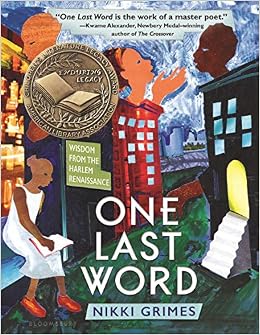
Book Review: One Last Word


Written and Collected by: Nikki Grimes

Published by: Bloomsbury USA Childrens, January 3, 2017

ISBN: 978-1619635548

Plot Summary
One Last Word is a collection of poems by poets who became famous during the Harlem Renaissance. Nikki Grimes has used these original works and created her own poems that have been inspired by those works by using the Golden Shovel Technique. In this technique, she has used an entire poem or just one line from a poem and used it to create a new work by ending each line with the words from the original line or poem. Grimes has taken these classic poems and written new ones that are sometimes reminiscent of the feelings from the original but at other times completely different. Interspersed among the poems are paintings and other artwork by Harlem artists. 


Critical Analysis
By including a selection of poems both by Grimes herself as well as classics from Harlem poets, Grimes has created a powerful and eclectic collection of poems that include a vast array of different poetic elements. The book is separated into 3 parts titled "Emergency Measures", "Calling Dreams", and "To a Dark Girl". "Emergency Measures" opens with a poem written by Grimes bearing the same title. It describes her choice to go back in time to the Harlem Renaissance and "dip her spoon into the bowl of years" to find inspiration and guidance. The image of dipping a spoon into a bowl of soup to locate and separate out small pieces of the whole creates a concrete image of the golden shovel technique that Grimes has used to write the poems in this book. Accompanying the poem is an illustration by Grimes, showing herself as a young girl atop an apartment building. She holds a large spoon she is dipping into the waters surrounding the building in which float the names of the poets included in the book. 

The first poem by another poet is "Storm Ending" by Jean Toomer. In it, she describes aspects of nature after a thunderstorm. The line that Grimes has chosen to use in her own poem is the opener and reads "Thunder blossoms gorgeously above our heads." Toomer extends the metaphor of the blossoming thunder by describing it as "bell-like flowers" that are "stretching clappers to strike our ears." This produces multiple images, the stamen of a flower and its similarity to a clapper inside a bell. The blooming rainclouds overhead taking on the qualities of both flower and bell, creating sound and "dripping rain like golden honey" over the Earth.

While some of Grimes's works are shorter poems, formed from just a line of another work, others take full verses of the other poet's words and create a set of accompanying poems from them. "Crucible of Champions" is one such work, consisting of 4 poems created from the first verse of "Life and Death" by Clara Ann Thompson. Each poem bears the name of a different young person with their own dreams- Jamar, Dina, Helena, Damian, Cora, and Blake. Each of them is experiencing their own crucible, or trial, from which they will emerge changed. Jamar's words discuss the dangers of merely being black in a country where that can be enough to put your life at risk. Dina talks about her undiagnosed dyslexia that causes people to think that she is stupid. Helena speaks of the lack of role models that look like her in her desired profession or marine biologist. Damian struggles with being a black boy whose true love is ballet. Cora's tale is about trying to fit in with the popular girls, and last, Blake talks about the pressure to get a basketball scholarship. This poems will be relatable to adolescents who may be experiencing similar issues. 

Repetition of words or lines is a poetic element that can be used for emphasis and effect. In "For a Poet", by Countee Cullen, the line "I have wrapped my dreams in a silken cloth" is repeated throughout the poem. This imagery allows the reader to see in their mind the poet delicately taking her fragile and valuable dreams and gently wrapping them up in a soft, silken cloth, taking extreme care to keep them safe. However, after being wrapped in the cloth, her dreams are "laid away in a box of gold". This is something that one would do with something valuable that they are not planning to use in the near future. Perhaps she is saving her dreams away for another day. 

Grimes uses that repeated line in her own poem, "A Safe Place." She makes great us of line breaks in this poem as well. Only the last line ends in punctuation. Every other line includes its period or comma in the middle. However, lines of poetry are written with intention, so this one must be read with a pause at the end of each line. Doing so almost adds in a breath or a thought in the midst of the sentences, time to think or reflect. This spacing is likely also a result of the poetic technique that Grimes has used throughout the book. Those intentional line breaks are also present in "The Sculptor". 

The end of the book includes biographies for each poet included in the collection, as well as each artist whose work appears in the book. It also includes sources for the poems, as well as the portraits of the poets that appear alongside their biographies. The book ends with an index, in which one can locate works by title, author, or subject. 


Excerpt
"The Sculptor"

No accident of birth or race or place determines the
scope of hope or dreams I have a right
to. I inventory my head and heart to
weigh and measure what talents I might use to make
 my own tomorrow. It all depends on the grit at my
disposal. My father says hard work is the clay dreams
are molded from. Yes. Molded. Dreams do not come.
They are carved, muscled into something solid, something true.

"Calling Dreams"

The right to make my dreams come true
I ask, nay, I demand of life,
Nor shall fate's deadly contraband
Impede my steps, nor countermand.

Too long my heart against the ground
Has beat the dusty years around,
And now, at length, I rise, I wake!
And stride into the morning break!


Use

The poems should be read aloud by a pair of students. One student will read "The Sculptor" in its entirety. The other student will read "Calling Dreams", the poem that was used to gather the words to write "The Sculptor". Since the first line of "Calling Dreams" is found in the the last word of each line in "The Sculptor", the second student will join in on the last word of each line, thus reading the first line of "Calling Dreams". They will then read the rest of the poem aloud. 

Monday, March 22, 2021

Book Review: César: ¡Si, Se Puede! Yes, We Can!


Written by: Carmen T. Bernier-Grand

Illustrated by: David Diaz

Published by: Two Lions, February 26, 2013

ISBN: 0761451722

Plot Summary

César: ¡Si, Se Puede! Yes, We Can! tells the story of the life of César Chávez. Chávez was a labor leader who helped to form the National Farm Workers Association. From his humble beginnings outside of Yuma, Arizona, César began working alongside his family in the fields at a young age. He eventually tired of this work and decided to join the Navy. However, after his time in the military, he returned and began working as an organizer, helping farmworkers fight for better conditions and higher pay. 


Critical Analysis
Family and culture are two things that were obviously very important to César. The very first word in the book is ¡Hijole! which is an expression of surprise or wonder in Spanish. By starting the book with this word, Bernier-Grand immediately lets the reader know that César Chávez valued his first language, which he spoke at home. The poem "I Am a Clown" recounts his experience at school where a teacher told him that he should only speak English if he wanted to be an American. This is an experience that has been shared by many immigrants and native-born citizens in the United States who are bilingual. At home, the Chávezes believed that "Quien sabe dos lenguas vale por dos." or "He who knows two languages is more valuable than he who knows only one." This mindset differed from many other families who believed that their children should only speak English in order to assimilate to their home. 

The combination of cultures is also present in the poem Cesario, which was César's real name. Teachers and other English speakers called him "See-zar", or possibly César (say-zar), either unwilling or unable to learn his given name. However, his given name was at the heart of who César was, for he was named after his abeulito, or grandfather. The phonical pronunciation of his name that is used in this poem really serves to emphasize the difference in the anglicized version of his name verses the Spanish version. As time has passed, more and more people 
have spoken out about the importance of pronouncing names correctly rather than changing them to make things easier on the person pronouncing them. However, this was definitely not the case in the 1930s when César was in school. The poem ends with what he likely considered his most important title, "Friend of the Farm Workers", since that was the identity he strove for during most of his life. 

The illustrations in the book are painted in bold colors, giving the book an attractive look and likely mimicking the brightly colored crops that populated the fields that Chávez spent his life working in. In the pictures where a large group is present, such as those showing protests or press conferences, you can see a variety of skin tones in the people shown. On the cover, Chávez is featured holding the "cortito" or short-handled hoe, which he worked hard to have banned. He is wearing a bandana around his neck, which farm workers wore to protect themselves from breathing in dirt or harmful chemicals while working in the fields. 

The end of the book contains source material, including a brief synopsis of Chávez's life, notes with citations for facts found in the book, a glossary containing Spanish terms used in the book, a timeline of his life, a list of the sources consulted, and finally a selection of Chávez's own words in which he describes his story himself. The inclusion of this material lends authority to the book along with providing background information that will help the reader gain a deeper understanding of it. After reading, one could also consult the references to learn more, if desired. 

Excerpt
Cesario

Cesario was his real name. 
Not See-zar. Not even César. 

Cesario Estrada Chávez
was the name given to him
by his parents,
Juana Estrada
and
Librado Chávez
en el dia su santo,
March 31, 1927,
near Yuma, Arizona. 

Cesario,
named for his abuelito,
better known as Papá Chayo. 

Calling him See-zar Cha-VEZ
came later, 
when his teacher couldn't 
or wouldn't
call him Cesario.

People called him
See-zar Cha-VEZ
or César Chávez.
It was better to call him
Friend of the Farm Workers
for these were la gente
for whom he struggled. 

Use
Read the poem out loud to students, first without showing them a copy of the poem. Then display a copy and re-read it to them to allow them to follow along. Ask students to create their own name that describes what is important to them, like César was "Friend of the Farm Workers". Students can share their own names and explain why they chose them. 


Book review: Firefly July

  Selected by: Paul B. Janeczko Illustrated by: Melissa Sweet Published by: Turtleback Books, April 10, 2018 ISBN: 978-0606409025 Plot Summa...