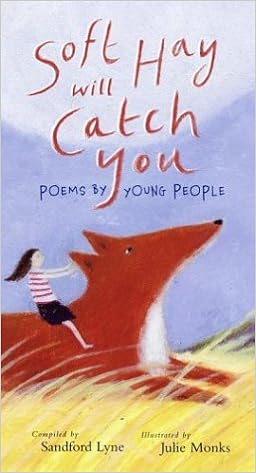
Compiled by: Sandford Lyne
Illustrated by: Julie Monks
Published by: Simon & Schuster Books for Young People, February 24, 2004
ISBN: 978-0689834608
Plot Summary
Poet Sandford Lyne collected the poems included in Soft Hay Will Catch You when he taught a poetry workshop at the K-8 school in Kentucky where his cousin was a teacher. The poems encompass much of the rural lifestyle that the students experienced daily and include discussion of work on the farm, barns, and other common country pastimes. However, other poems show the dreams and creativity of the children as well.
Critical Analysis
The poems in Soft Hay Will Catch You are divided into six different sections, based on their subjects- search for the self, solitude and loneliness, the home and family, the soul's journey and the circle of life, awakenings and discoveries, and our connection to place. Tucked in among the poems are paintings by Julie Monks that evoke the simple yet beautiful feelings that are portrayed in many of the poems. Many of the students wrote about things that they encountered in their everyday lives, but they also created deeper meaning in their work by discussing important feelings of loss, loneliness, and hope.
In the introduction, Lyne speaks of the "love of experiences" that he inherited from his parents. This is one of the traits that makes him an effective teacher of poetry. Successful poems help to make people feel things deeply, and can be enriched by having a wealth of experiences from which to draw. These experiences can be complex or simple, and writing about what you know is a sure way to craft an impactful poem, which is exactly what these young poets have done.
In Shadows Lurk, the writer, Brenna, has an extremely effective way of using contradictory language to help describe the shadows. She refers to them as "merrily dancing", which at first glance seems to be an odd way to describe something that is lurking and frightening. However, after sitting with the poem and conductive multiple readings, the reader is able to imagine the image of the shadows both lurking but also dancing in columns and see just how scary that image actually is. The juxtaposition of the dark and ominous shadows that seem to hover and float with the image of them dancing merrily in columns is disarming. Often seeing something intimidating and frightening that seems joyful makes it even scarier. However, the poem's conclusion lets us know that its writer is staying strong since she is more powerful than the shadows. In this instance, the shadows are likely symbolic of her own fears.
Different Worlds uses figurative language, speaking of both a "world in leaf" and one in flame. A world in leaf could be taken literally as a place with a lot of plants and foliage, such as forest or a more rural location like the one in which the students live. It could also be seen more abstractly as a place for growth that is full of potential. Conversely, the world in flame is one being destroyed, no matter the sense in which it is meant. Perhaps it is this world holding her back, and she is trying to hold on to the world of her childhood that is disappearing in flame as she watches. The world in leaf could be the adulthood she mentions looking forward to with hope and future blooming.
Personification is present in The Lonely Fire. Describing the fire as lonely makes it seem as though it has emotions. However, a fire is actually a perfect representation of loneliness because it needs to separated from people and objects so that they do not start to burn. The physical isolation of a fire is similar to the psychological isolation that is felt by people who are lonely. However, even through the fire is lonely, it is still dancing and the poet describes it as soothing to the sole. This is a good reminder that being alone doesn't always have to feel lonely.
Excerpt
A Different Place
I'm moving away from all my friends.
I'm moving to a different place.
I'm going to live on a different street,
in a different house, on that different place.
Everything will be different but the moon.
The moon will follow us wherever we go.
Use
The words and rhythm pattern of this poem makes it a good option to be read aloud by multiple voices. Optimally, 3 students could read it together, with each one reading one of the first 3 lines as a solo and then the first two students reading the first and second part of the 4th line as solos as well. Then all the voices can join in together for the 5th and 6th lines, symbolizing that while friends can move apart, they are still together under the same sky.



No comments:
Post a Comment