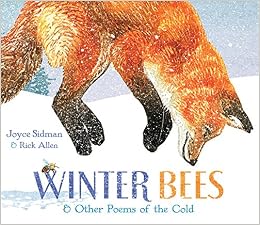
Written by: Joyce Sidman
Illustrated by: Rick Allen
Published by: Houghton Mifflin Harcourt, November 4, 2014
ISBN: 978-0547906508
Plot Summary
Bees are just the tip of the iceberg in this collection of poems about animals in winter. Readers can also find verses on moose, snakes, swans, and more. Alongside the poetry that discusses how these animals prepare for the cold winter months, you can find a non-fiction paragraph full of helpful facts about each animal.
Critical Analysis
Winter Bees is an interesting and informative collaboration of beautiful poetry infused with factual information about animals and their preparations for winter. The first poem focuses on the tundra swan. Rather than telling of their migratory journey, the poem focuses on the night before they leave. The words that have been selected give the poem a soft, dream-like quality and create a sense of quiet wonder, similar to what one might have while watching these majestic birds. The cold is described as "creeping" and "prickling", as it does when cold weather first moves in. This is likely how the swans know that it is time to move on.
In their dreams, the sun is a "pale wafer" and there is a "crisp drink of clouds." This vision of the elements of the sky as consumable marks the time they will spend on their journey as one to be taken in over time. In the accompanying factual section, the reader learns that, true to their name, tundra swans do actually spend their summers breeding and raising their chicks in Alaska and Canada. However, these areas are too cold for the winter months, so they move almost 2,000 miles south for the season, to areas in California or New Jersey where the water isn't frozen over with ice. The illustrations of the swans show them waking and beginning their journey. Some are already in flight while others are preparing to take off.
Big Brown Moose is written as a first-person (first-moose?) account of a baby moose's winter experience. The rhyme scheme used in this poem gives it a frolicking, sing-song quality that allows you to imagine how a baby moose might move in the wild. The moose vacillates between being big and brave and being a moose who is comforted by the fact that his moose mama is "close by my side". Parents and those who have spent a lot of time with young children will recognize this simultaneous desire to strike out on one's own and their wish to remain in close proximity to their mama for a sense of security.
The word selection in Big Brown Moose contains many consonant blends that make sounds similar to those that a moose would make while walking through woods. Tramp, tromp, swamp, snort, crunch, and clump all contain sounds that are heavier in the mouth and provide the needed weight to describe a moose's movement. The non-fiction blurb discusses the moose's large body and how it is made for the cold weather, reiterating the language choices of the poem.
The titular poem, Winter Bees, focuses on the importance of teamwork in the hive. They are described as an "ancient tribe, a hearty scrum." Bees have been around for hundreds of millions of years, so their description of "ancient" is certainly apt. "Ancient tribe" makes the reader think of peoples from long ago who worked to create great civilizations, such as the Mayans or Egyptians. Like these cultures, bees work together to build their hives and to serve their queen. In rugby, a scrum occurs before a play when players gather closely together to try to get the ball. Bees work together similarly towards a common goal in making honey and providing shelter and food for their hive.
The yellow-orange color of the hive against the white background of the image mimics the language of the poem, "deep in the winter hive, we burn like a golden sun." The bees were an interesting choice for inclusion in this collection since they are "one of the few insects in the Northern Hemisphere that remain active in freezing weather", according to the source notes. The phrase "busy as a bee" is an accurate one, as even while other species may go dormant, the bees continue to work together.
The book manages to marry poetry and non-fiction harmoniously. The inclusion of factual information on each page inspires the reader to look at the poem in different ways. There is also a glossary provided at the back of the book that readers can reference for assistance with any unfamiliar words.
Excerpt
"Snowflake Wakes"
Snowflake wakes,
whirling,
arms outstretched,
lace sprouting from fingertips
Leaps, laughing
in a dizzy cloud,
a pinwheel gathering glitter
Drops into air,
suddenly soft
and full, a lattice
of stars spinning
silently
Drifts down,
touching
and tickling,
clinging
and clumping
Hugs earth,
sighs and settles
Sleeps,
tucked in its own blanket
Use
Snowflake Wakes lends itself well to an active recitation. The teacher or librarian should read it first and just allow students to listen. Then, encourage them to stand and act out the movements mentioned in the poem- whirling, leaping, laughing, etc. Make this a repeated activity throughout the winter season and students will eventually start reciting the words along with the teacher as they act out the motions.

No comments:
Post a Comment