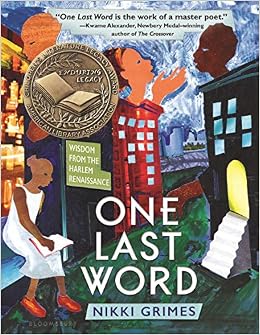
Written and Collected by: Nikki Grimes
Published by: Bloomsbury USA Childrens, January 3, 2017
ISBN: 978-1619635548
Plot Summary
One Last Word is a collection of poems by poets who became famous during the Harlem Renaissance. Nikki Grimes has used these original works and created her own poems that have been inspired by those works by using the Golden Shovel Technique. In this technique, she has used an entire poem or just one line from a poem and used it to create a new work by ending each line with the words from the original line or poem. Grimes has taken these classic poems and written new ones that are sometimes reminiscent of the feelings from the original but at other times completely different. Interspersed among the poems are paintings and other artwork by Harlem artists.
Critical Analysis
By including a selection of poems both by Grimes herself as well as classics from Harlem poets, Grimes has created a powerful and eclectic collection of poems that include a vast array of different poetic elements. The book is separated into 3 parts titled "Emergency Measures", "Calling Dreams", and "To a Dark Girl". "Emergency Measures" opens with a poem written by Grimes bearing the same title. It describes her choice to go back in time to the Harlem Renaissance and "dip her spoon into the bowl of years" to find inspiration and guidance. The image of dipping a spoon into a bowl of soup to locate and separate out small pieces of the whole creates a concrete image of the golden shovel technique that Grimes has used to write the poems in this book. Accompanying the poem is an illustration by Grimes, showing herself as a young girl atop an apartment building. She holds a large spoon she is dipping into the waters surrounding the building in which float the names of the poets included in the book.
The first poem by another poet is "Storm Ending" by Jean Toomer. In it, she describes aspects of nature after a thunderstorm. The line that Grimes has chosen to use in her own poem is the opener and reads "Thunder blossoms gorgeously above our heads." Toomer extends the metaphor of the blossoming thunder by describing it as "bell-like flowers" that are "stretching clappers to strike our ears." This produces multiple images, the stamen of a flower and its similarity to a clapper inside a bell. The blooming rainclouds overhead taking on the qualities of both flower and bell, creating sound and "dripping rain like golden honey" over the Earth.
While some of Grimes's works are shorter poems, formed from just a line of another work, others take full verses of the other poet's words and create a set of accompanying poems from them. "Crucible of Champions" is one such work, consisting of 4 poems created from the first verse of "Life and Death" by Clara Ann Thompson. Each poem bears the name of a different young person with their own dreams- Jamar, Dina, Helena, Damian, Cora, and Blake. Each of them is experiencing their own crucible, or trial, from which they will emerge changed. Jamar's words discuss the dangers of merely being black in a country where that can be enough to put your life at risk. Dina talks about her undiagnosed dyslexia that causes people to think that she is stupid. Helena speaks of the lack of role models that look like her in her desired profession or marine biologist. Damian struggles with being a black boy whose true love is ballet. Cora's tale is about trying to fit in with the popular girls, and last, Blake talks about the pressure to get a basketball scholarship. This poems will be relatable to adolescents who may be experiencing similar issues.
Repetition of words or lines is a poetic element that can be used for emphasis and effect. In "For a Poet", by Countee Cullen, the line "I have wrapped my dreams in a silken cloth" is repeated throughout the poem. This imagery allows the reader to see in their mind the poet delicately taking her fragile and valuable dreams and gently wrapping them up in a soft, silken cloth, taking extreme care to keep them safe. However, after being wrapped in the cloth, her dreams are "laid away in a box of gold". This is something that one would do with something valuable that they are not planning to use in the near future. Perhaps she is saving her dreams away for another day.
Grimes uses that repeated line in her own poem, "A Safe Place." She makes great us of line breaks in this poem as well. Only the last line ends in punctuation. Every other line includes its period or comma in the middle. However, lines of poetry are written with intention, so this one must be read with a pause at the end of each line. Doing so almost adds in a breath or a thought in the midst of the sentences, time to think or reflect. This spacing is likely also a result of the poetic technique that Grimes has used throughout the book. Those intentional line breaks are also present in "The Sculptor".
The end of the book includes biographies for each poet included in the collection, as well as each artist whose work appears in the book. It also includes sources for the poems, as well as the portraits of the poets that appear alongside their biographies. The book ends with an index, in which one can locate works by title, author, or subject.
Excerpt
"The Sculptor"
No accident of birth or race or place determines the
scope of hope or dreams I have a right
to. I inventory my head and heart to
weigh and measure what talents I might use to make
my own tomorrow. It all depends on the grit at my
disposal. My father says hard work is the clay dreams
are molded from. Yes. Molded. Dreams do not come.
They are carved, muscled into something solid, something true.
"Calling Dreams"
The right to make my dreams come true
I ask, nay, I demand of life,
Nor shall fate's deadly contraband
Impede my steps, nor countermand.
Too long my heart against the ground
Has beat the dusty years around,
And now, at length, I rise, I wake!
And stride into the morning break!
I ask, nay, I demand of life,
Nor shall fate's deadly contraband
Impede my steps, nor countermand.
Too long my heart against the ground
Has beat the dusty years around,
And now, at length, I rise, I wake!
And stride into the morning break!
Use
The poems should be read aloud by a pair of students. One student will read "The Sculptor" in its entirety. The other student will read "Calling Dreams", the poem that was used to gather the words to write "The Sculptor". Since the first line of "Calling Dreams" is found in the the last word of each line in "The Sculptor", the second student will join in on the last word of each line, thus reading the first line of "Calling Dreams". They will then read the rest of the poem aloud.



No comments:
Post a Comment