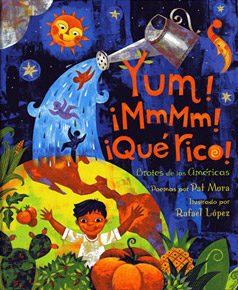
Written by: Pat Mora, Pictures by: Rafael Lopez
Published by: Lee & Low Books, 2007
ISBN: 978-1-58430-271-1
Plot Summary
Yum! ¡MmMm! ¡Qué rico! is a collection of Haiku about foods that are native to North and South America. Each page includes a poem about the food that describes its appearance, taste, or the experience of eating it. There is also a section included with facts about each food. Its origin is discussed, along with fun facts and ways to eat each food. At the end of the book is a note from the author explaining her interest in both Haiku and native foods, which led her to combine those interests into a book featuring both.
Critical Analysis
Books about Hispanic foods can easily be cast aside as a "cultural parade" and all too frequently, have only focused on the most basic, and stereotypical offerings- beans and tortillas. However, Yum! ¡MmMm! ¡Qué rico! is a richer offering, that includes much meaning and intent behind the included fare. There is factual information included for each food, including its place of origin, history, and other fun facts that offer a much deeper look than just a surface stereotypical mention.
The short format of the haiku provides a nice contrast to the long and fact-heavy explanations about each type of food. Mora mentions in the letter to the reader at the end of the book that her love of variety resulted in this book about foods native to the Americas written in a form of poetry that originated in Japan. The haiku's rigid structure of syllables and lines means that each word and sound should be carefully chosen for maximum impact and Mora's work definitely meets that criteria.
"Chile" is one of the poems that uses rhyme and assonance for effect. Eyes and sighs are used subsequently, varying from a traditional rhyme scheme, but creating a somewhat sing-song quality to the poem. Other long i words are found throughout the piece as well- bites and fire- to continue that theme and the sound. Describing the chile as "green mouth-fire" that Dad bites really serves to provide readers with a feeling of how it tastes. It's even more apparent that the heat is the pepper's defining flavor when Dad says "This heat tastes good."
The illustrations are a strong element of the book, and have bold colors bursting off of the pages. The skin tones and facial features are accurate representations of the Latinx culture. However, the people in the book are all unique, they are not all drawn the same- their features, skin tones, and hair styles are all varied. The illustrations contain lush wildlife. The animals, plants, and landscapes included in them are representative of what one would find if they visited the areas native to each food. But, there is also imagination and artistic expression present.
The peanut page is a prime example of this imaginitive quality of the drawings. In it, a little boy plays a bombo, a traditional Latin American drum, while a piece of bread covered in peanut butter dances and plays a trumpet. Their feet can be seen sinking into a pond made of peanut butter, and it is shown sticking to their soles. This "gooey party" between boy and snack is representative of the family celebrations that are an important part of Latinx culture.
Mora includes both a glossary of Spanish terms used in the book as well as a list of the sources she used to gather information about the foods in the book. By citing these sources, she is backing up the accuracy and authenticity of the work that she has created. The book could stand alone as a fun celebration of food and poetry, but the inclusion of the factual history about each selection gives the book a richer and more complete feel.
Awards Won
2008- ALSC Notable Children's Books
Review Excerpt
From Booklist, published 2007
"This inventive stew of food haiku celebrates the indigenous foods of the Americas. Each of the 13 poems appears on a gloriously colorful double-page spread, accompanied by a sidebar that presents information about the origin of the food. From blueberries to prickly pears to corn, the acrylic-on-wood-panel illustrations burst with vivid colors and stylized Mexican flair. The poems capture the flavor of the item in a way children can easily understand Chocolate: Fudge, cake, pie, cookies. / Brown magic melts on your tongue. / Happy, your eyes dance; Pineapple: A stiff, spiky hat / on thick prickly skin, inside / hide syrupy rings."
Connections
Bring in samples of the foods for the students to taste as you read each haiku. Students can pick their favorite and write about why they like it and describe how it tastes.
Discuss the 5 senses. Have students find parts of the poems that discuss the use of each sense. Students can then write their own sensory sentence about one of their favorite foods.



No comments:
Post a Comment