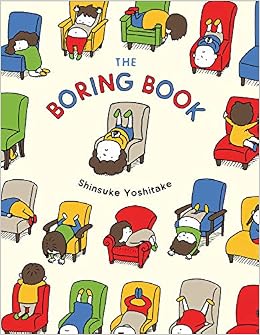
Written by: Shinsuke Yoshitake
Published by: Chronicle Books, 2019
ISBN: 9781452174563
Plot Summary
The Boring Book tells the story of a little boy who finds himself being bored because he has nothing to do. He begins to think more about what it means to be bored and why things are boring. He tries out different activities to see what is or is not boring, and thinks about different situations that are boring. He also realizes there is a state where you are neither bored nor having fun, an in-between. Finally, at the end of the book, he seeks out his dad to ask his advice on being bored.
Critical Analysis
The Boring Book explores the question "What makes something boring?" Since this is such a universal question, the book will hold interest for children as it asks some questions they've likely asked themselves as well as those they haven't. Readers will identify with the main character starting on the first page as he complains that his toys are all boring and there's nothing on TV. Grown-ups will also chuckle at the small jokes included for their benefit, such as when the boy asks tells his mother that he is bored and she responds "What do you want me to do about it?" with a haggard look on her face, obviously at the kitchen sink in the middle of cooking a meal.
The book raises many questions about boredom, some of which are answered but there are others that remain open-ended. This will allow readers to form their own opinions and encourages discussion if the book is shared as a read-aloud. At the end of the book the boy's father explains that boredom can be useful because it makes fun experiences even more fun, but since the boy has heard someone say that before, he deems it boring, thus ending the book on the same note on which it began.
The book was originally written in Yoshitake's native Japanese. Its English translation retains the thought-provoking questions and fun imaginative thoughts. However, the original was published with a hand-written text, which has sadly been replaced in the English translation. There are some cultural markers pointing to the book's Japanese heritage. When the boy asks his grandpa about the most boring thing that has ever happened to him, Grandpa is shown sitting on the floor at a low table with his legs crossed, a position that is common in that culture.
The illustrations are simple, using only black, white, red, blue, green, and yellow. However, they are still very interesting and emotive and contain a lot of detail. There is a recurring theme throughout the illustrations of the main character being drawn in a series of poses that differ only slightly from one another. This can be seen on the opening page when he is shifting around in his chair, as well as several pages in where he tries to see if boredom can be cured by constantly changing the way he sits. This illustration shows him trying different positions, accented by red arrows to demonstrate his progression and the occasional "Rustle" and lines of movement.
The illustrations of the park and the amusement park are anything but boring. The fun park looks like something out of a child's imagination with looping slides, double-decker swings, and a climbing structure that resembles a spaceship. In contrast, the boring park has only a tree and a bench. Even the ground is a gray color, without even green grass to make it interesting.
The pages with the amusement park present a nice contrast between the drawing and the text. The story is talking about the attractions that would be included in the world's most boring amusement park- a slow roller coaster, low Ferris wheel, closed rides, easy games, lukewarm drinks, tired characters, and a haunted house that isn't scary. However, the illustration is anything but boring, with so many detailed things to look at. Certainly, the people at the amusement park are all bored, this is apparent even with their simply drawn faces- the addition of extra lines around their eyes makes a stark difference and clearly communicates their lack of entertainment. In fact, the only people smiling are in the haunted house, definitely out of the norm, but another great detail included in a book that is rich with them.
Although the culture of the book isn't front and center, as previously discussed, there are subtle markers in the illustrations- the Grandpa's posture, as noted, the schoolchildren in uniforms, and the fish that the mother is preparing for dinner. The culture does not override the plot points about boredom, but it is present.
Overall, the book is a simple but not at all boring look at a universal concept that all people experience. It serves as not only a fun read, but also a jumping-off point for conversations about the nature of boredom and tactics that can be used to overcome it.
Awards Won
2019- Cybil's Award Nominee
2019- New York Times/ New York Public Library Best Illustrated Children's Books Award WInner
Review Excerpt
From Publishers Weekly, published May 13, 2019
"Japanese author and illustrator Yoshitake (Still Stuck) zeroes in on a ubiquitous childhood experience and probes it with dry wit. The creator's human figures draw smiles from the get-go as a boy sprawls on the couch, dead bored: My toys are boring. There's nothing to watch on TV. His mind wanders: Why am I bored? What does boring mean, anyway? In vignettes and multistage spreads, the boy considers the many permutations of ennui. I wonder what the worlds most boring amusement part is like, the boy says, as Yoshitake shows children in an advanced state of stupor shuffling through a park (The Ferris wheel is low. The roller coaster is slow. Most of the rides are closed for repairs)."
Connections
Have students create a list of things they like to do when they are bored.
In the book, Yoshitake describes the world's most boring amusement park. Have students create their own "world's most boring" venue or event and describe it.
In the book, Yoshitake describes the world's most boring amusement park. Have students create their own "world's most boring" venue or event and describe it.



No comments:
Post a Comment