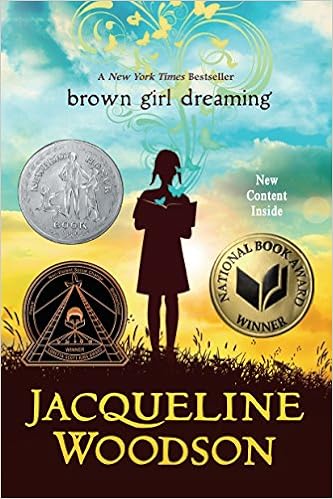
Written by: Jacqueline Woodson
Published by: Nancy Paulsen Books, 2014
ISBN: 978-0-399-25251-8
Plot Summary
Brown Girl Dreaming is the story of Jacqueline Woodson's childhood. Born in Columbus, OH in 1963, Woodson was the youngest of 3 children. After their parents' divorce in 1964, they move with their mother back to her hometown of Greenville, SC to live with her parents. Their contact with their father after that point was non-existent for much of Woodson's childhood, so they begin to call their grandfather "Daddy". Their mother moves to New York City with their Aunt Kay and eventually comes back to Greenville to collect the children to come live with her. She also brings the news that they'll be gaining a baby brother soon.
Woodson and her siblings struggle to find a place to fit in in New York while also missing their grandparents and the familiar way of life in Greenville. At a young age, she discovers her love and talent for writing, which is the only academic pursuit in which she outperforms her older sister. Throughout hardships and celebrations, Woodson and her family support one another and face everything together.
Critical Analysis
Jacqueline Woodson tells the story of her life in verse, which adds a richness to the tale. The majority of the book is not written in rhyme, but there are times when it is used to great effect. While most of the chapters have unique titles, there is a series that are all named "How to Listen" and then numbered in order. In "How to Listen #2", rhyme is used to describe how Jackie and her siblings are followed when they are in stores in downtown Greenville. The short structure of the section along with the rhyme scheme give it almost a sing-song quality. All of the chapters in that series are just 3 lines and can be interpreted as young Jackie's first poetic works. The preceding chapters have discussed the right for equal rights in more detail. This short chapter seems to sum up a young girl's interpretation of what she's seeing around her.
While Jackie's life is at the forefront of the story, national events are constantly running through the background. She tells about their neighbor in Greenville, Miss Bell, who hosts planning meetings for the marchers in her home. Her mother also gets involved in the protests and her grandfather teaches her and her siblings about the importance of the fight. However, her mother has to sneak out when she thinks their Grandma Georgiana isn't looking. It becomes apparent that Grandma Georgiana knows just what is happening when she warns her not to get arrested. This shows that not all Black people in the South agreed with the actions of the protestors. Even in one family, people had differing opinions on the actions being taken. This represents not only the true actions of the author's family, but also exemplifies the fact that cultures are not a monolith- that within cultures and even within families people have their own opinions about important issues.
Jackie's mother eventually moves her children to New York City where their Aunt Kay lives. Before they moved, Jackie described New York City as a fantastical place, where "there is money falling from the sky, diamonds speckling the sidewalks." This imagery gets to the heart of what she expected to find in the city. She imagined her mother in a place ripe with opportunity, where one could find and live their dreams. The reality she finds when she arrives is likely a combination of her heartache at missing her grandparents, losing the only home she remembers, and that disappointment that can come when you build something up too large in your head so that the actual thing has no chance of being as amazing as you thought it would be. The real New York she finds is "only gray rock, cold, and treeless as a bad dream." While local New Yorkers would likely never describe the city that way, someone who was used to green space and a rural community would surely feel that way in such a large city full of buildings and people.
Woodson's strength is in her use of words to create a full picture. This is evident when she describes her uncle when they visit him in prison. She titles the section "Not Robert" because everything about her uncle that made him "him" seems to have been stripped away from him. His signature afro has been shaved, his eyebrows are thicker, and even his smile has faded. These physical manifestations represent the toll that being imprisoned can take on someone. She also talks about how quickly he has turned from a human into just the numbers that are across the chest of his uniform and says that she is "waiting for them to morph into letters that spell out his name." This personal experience reflects the struggle of many Black families in the United States, as events such as the War on Drugs and the school to prison pipeline have resulted in a much higher proportion of incarcerated black men in comparison to their percentage of the population. In comparing this book to Stamped, one is able to put a personal face to the national issues designed to keep Black people enslaved even after the Emancipation Proclamation was issued.
Another running theme through the book is the transformation of Woodson's grandfather, whom they call "Daddy". The first time he is described in the book, it is said that he "seems taller than anyone else in all of Greenville. More handsome too". It becomes clear that he is suffering from lung cancer and as he begins to decline, it is obvious how worried Woodson is. She describes him "moving as if underwater" as he continues to tend to his beloved garden, and, years later, he is too tired to eat and she chooses to spend her summer visit caring for him inside rather than outside with her siblings. Since her grandmother and mother have raised her and her siblings as Jehovah's Witnesses, she worries not only about his health, but also that they may not end up in the same eternity if what she has been taught at church is true. However, her grandfather has a different attitude- believing that God sees the good he has done and will not punish him. This is another example of people in the same culture and family having different beliefs, this time they are spiritual, again representing cultural pluralism.
At its heart, Brown Girl Dreaming is Jacqueline Woodson's memoir. However, it includes so many other important themes in African American literature. Discussions of spirituality, family and friends, and school and community are woven throughout the book. These themes combine to create a work that demonstrates both similarities and differences that people share across all of these themes.
Awards Won
2015- Coretta Scott King Award Winner
2015- Newbery Honor Book
2015- NAACP Image Award Winner- Literary Work- Youth/ Teens
2014- National Book Award Winner
Review Excerpt
From The New York Times, published August 22, 2014
"Jacqueline Woodson’s writing can seem so spare, so effortless, that it is easy to overlook the wonder and magic of her words. The triumph of “Brown Girl Dreaming” is not just in how well Woodson tells us the story of her life, but in how elegantly she writes words that make us want to hold those carefully crafted poems close, apply them to our lives, reach into the mirror she holds up and make the words and the worlds she explores our own."
Connections
Read and discuss some of Langston Hughes' popular works, such as "I, Too, Sing America", "Mother to Son", or "Life is Fine". Re-read the section "Learning with Langston" and discuss why his work was likely such a strong influence on Woodson. Read "Dreams" and have students model their own poems on it, as Woodson did in the book.
Discuss the national events that are mentioned during the book and evaluate how those events mirror the ones in Woodson's own life.




No comments:
Post a Comment