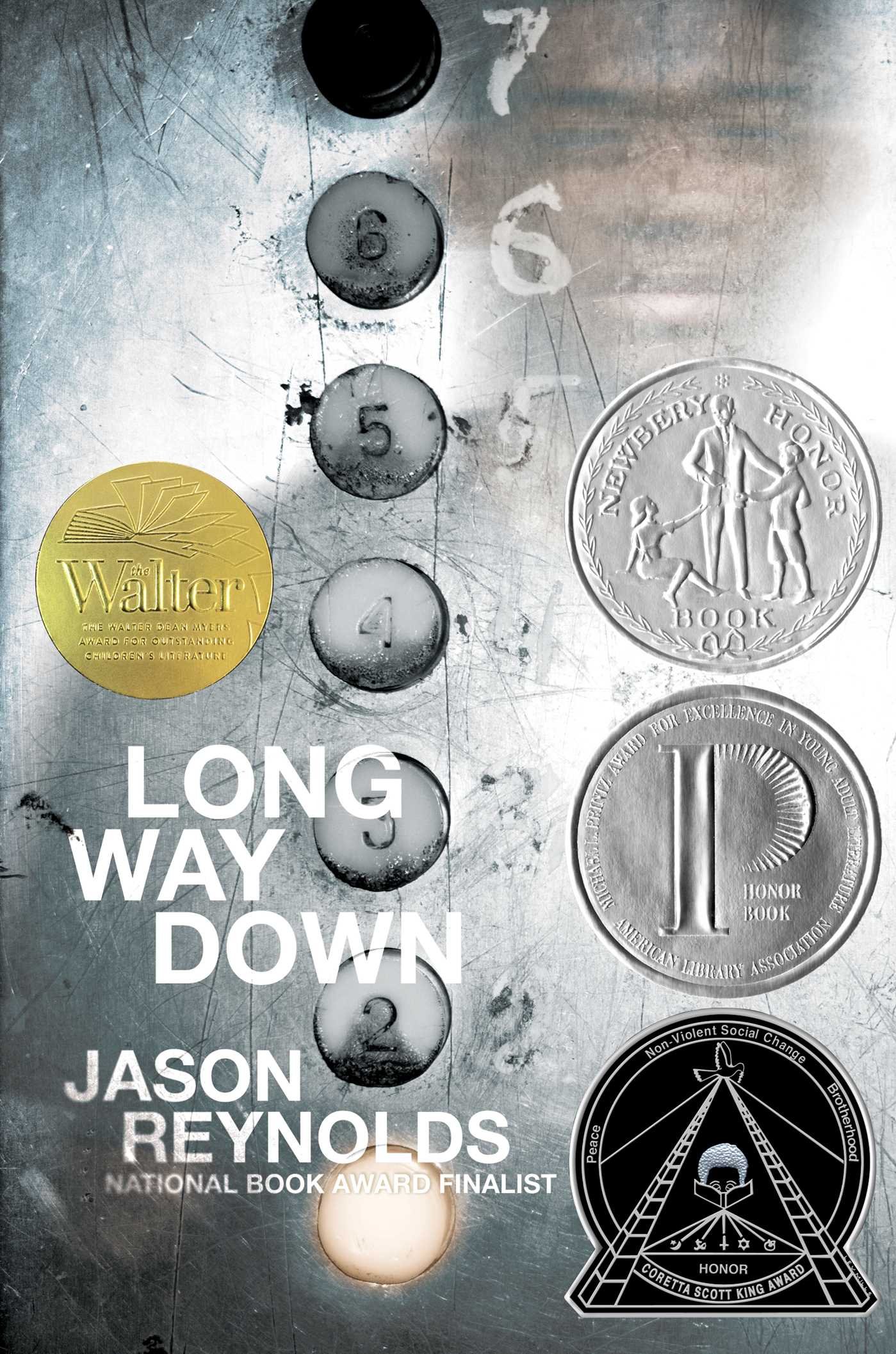
Title: Long Way Down
By: Jason Reynolds
Published by: Atheneum Books for Young Readers, April 2, 2019
ISBN: 978-1481438261
Plot Summary
The story centers on Will, whose older brother, Shawn, is their neighborhood's most recent victim of gun violence. In the aftermath of Shawn's death, Will intends to follow "The Rules" that Shawn taught him and that have been handed down from friend to friend, brother to brother, and father to son over the years. Rule 1: No Crying, Rule 2: No Snitching, Rule 3: Get Revenge. Will finds his brother's gun and is on his way to get revenge against the man he's sure is responsible for his brother's death. But in this modern ghost story, Will is confronted with people from his past that will help him decide if following the rules is really the correct path.
Critical Analysis
Long Way Down is almost a modern-equivalent of A Christmas Carol. The central character, Will, in this case, is visited by several ghosts that help them to see things more clearly. Both Will and Ebenezer Scrooge have chosen to live their lives a certain way and these spirits, who include someone that they have loved and lost (Marley and Shawn) help them to see that the way they previously thought was correct may not be after all.
The short phrasing of the novel in verse makes it a quick read and helps to put the reader in Will's headspace. Some of the chapters are titled with the time of day that they take place, which makes one realize that the entire story spans only 60 seconds, the length of the elevator ride to the ground floor. The short time-frame of the actual elevator ride is jam-packed with 6 ghosts, each of which provides a part of the story that allows Will to discover that what he previously thought was true isn't all that it seems.
Reynolds uses metaphor to great effect throughout the book. This is obvious in The Sadness, where he compares losing a loved one to having a tooth unexpectedly and violently removed. "But the worst part, the absolute worst part, is the constant slipping of your tongue into the new empty space, where you know a tooth supposed to be but ain’t no more." Anyone who has lost someone important in their life knows the feeling of running into that empty space. It happens when you hear something and think you should tell the person or when you find yourself starting to dial their number but remembering that they won't be there to answer.
Metaphor is also present in the section And My Mom. In this chapter, Will describes his mother's reaction to his brother's death. He says that she is "hanging over my brother's body like a dimmed lightpost". This metaphor provides a more detailed description of what his mother looked like in her anguish and allows the reader to picture the scene more accurately than if he had just said that his mother was leaning over his brother. Using the word hanging makes it seem as though she is being held up by another source rather than by her own power. The fact that he describes her as a dimmed lightpost also helps to show the reader how she has "dimmed" as a person after seeing her son die.
Another technique that Reynolds uses throughout the book is creative spacing and formatting. In the chapter I've Never Been he speaks about not ever being in an earthquake but still feeling like the ground has opened up around him and ate him. The lines in this section are divided in the middle, with the left and right sides separated by a large gap. This provides a visual representation of the ground opening up and swallowing him whole, an event that would be physically possibly during an earthquake but has occurred emotionally to the main character, Will, as a manifestation of his grief.
As the elevator travels down throughout the story, each floor it stops on presents Will with another ghost from his past. The chapter Beef discusses how issues or disagreements between individuals in the neighborhood get "inherited like a trunk of fool’s gold or a treasure map leading to nowhere." This becomes apparent as the chain reaction of events that led to Shawn's death becomes apparent with the gathering of ghosts in the elevator. Buck was killed by Frick, who Shawn then killed to avenge his death. Will now thanks that Riggs killed Shawn, but is warned by his father, who he discovers killed the wrong man when trying to get revenge for his own brother's death. It can be assumed that if Will kills Riggs, whether or not he was responsible for killing Shawn, that the cycle will continue, with one of Riggs's friends or family members killing Will in return for his actions.
The ending is left open to interpretation, with the final words being the only ones that Shawn speaks in the entire book, "You coming?" We don't know what Will's response is, so the reader is able to make their own mind up. Did learning the truth about his father's own attempt at revenge and murder convince Will to break the cycle? Did seeing Shawn's ghost cry and thus break rule number 1 help him to realize that the rules don't have to be followed? Or will he follow his family members and friends and become another link in the chain that is binding them together?
Excerpt
MY NAME IS
Will.
William.
William Holloman.
But to my friends
and people who know me
know me,
just Will.
So call me Will,
because after I tell you
what I'm about to tell you
you'll either
want to be my friend
or not
want to be my friend
at all.
Either way,
you'll know me
know me.
Use
My Name Is helps to open the story and introduces us to the main character, Will. It draws readers in by promising them a story that will get to the heart of who he is. After reading this chapter, students can either write or have a discussion about the different names they go by and who in their lives calls them by each name.
Students can choose one of their names and, if they are comfortable doing so, can share why they feel that name in particular is most representative of their real selves. They can choose a name that people actually call them or one that they feel best describes themselves that might not be one that they actually go by.



No comments:
Post a Comment