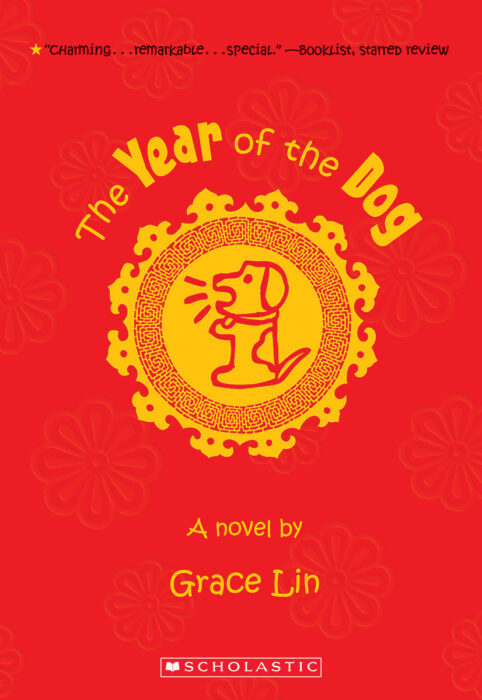
Written by: Grace Lin
Published by: Little, Brown Books for Readers, May 2, 2007
ISBN: 978-0316060028
Plot Summary
The Year of the Dog tells the story of a year in Grace (Pacy) Lin's life. Grace lives in upstate New York with her parents and her two sisters. The book opens with the family preparing for Lunar New Year celebrations. Grace's parents explain that the Year of the Dog is a year to find yourself. This starts Grace off on a journey to do just that. She makes a new best friend in Melody, another Taiwanese girl who is new at her school. Together, Grace and Melody participate in activities at school and try to find themselves.
Critical Analysis
The Year of the Dog weaves together Grace's present-day life with tales of her mother and grandparents as children. This structure helps to show the differences between their lives in Taiwan and her own life in New York. The book starts and ends with a Chinese New Year celebration, which showcases an important holiday in their culture, as well as serving as an opportunity to discuss important foods and traditions.
Lin's story includes the theme of the 1.5 Generation, which is prevalent in Asian American literature. Although her parents are immigrants from Taiwan, she has only known life in the USA. Her two worlds are constantly in competition with one another. This is apparent when she meets Melody at school. Melody asks Grace if she is Pacy and Grace responds that she is. However, Becky, her white friend, says that Pacy is not her name. Grace has to explain that Grace was her name at school but that her mother calls her Pacy. In a vignette at the end of a chapter, she explains how her name changed from Pacy to Grace. A teacher told her she was "too big" to go by Pacy Lin, and called her the name on the roll sheet, Grace. Her older sister, Lissy, explains on the bus that they have both Taiwanese and American names and that she should let the teacher and kids at school call her Grace so that it will be easier and they won't ask so many questions about her name. This is an experience that many people with names that are inspired by other cultures have had. The desire to fit in and go by their American names so that they won't be bombarded with questions is a feeling that many share. The teacher's reaction also shows some ignorance about Grace's culture, assuming that her Chinese name is a nickname when it is her given name, and encouraging her to go by the name on the roll sheet.
Although Grace's family has Chinese names and celebrates the traditions of their culture, they also participate in American traditions as well. She tells about how she and her sisters insist on having turkey at Thanksgiving, even though her parents don't like it. They end up with a table full of traditional Chinese dishes and the smallest turkey her mother can find, a compromise between the culture of their ancestors and her parents original home and the culture of their current home.
There are also times when Grace's acceptance of her life in the US is seen as a detriment by others in the Taiwanese community. She and her family attend a Taiwanese-American Convention with Melody's family. The first week is fun for Grace but after that, Melody leaves to visit her aunt and Grace's mother enrolls her in an art class with other girls. When the girls discover that she's not able to speak Taiwanese or Chinese, they judge her, saying that she's been "Americanized" and call her a Twinkie, a racial slur term that is insensitive.
Earlier in the book, when Grace told a friend at school that she wanted to try out for the part of Dorothy in the school play, the girl told her that she couldn't because Dorothy wasn't Chinese. This upsets her so much that she decides not to try out, even though she'd already signed up. The contrast and similarities of these two experiences accurately portray what the experience of living in America can be like for Asian-Americans. They can be seen as "too foreign" for white Americans and "too American" for other Asian-Americans. This also ties into the recurring theme of physical differences in Asian-American literature. Because of their different facial features, people can immediately tell that a person is Asian, which can lead to stereotyping.
Awards Won
2006- ALA Children's Notable
2006- Asian Pacific American Librarian Association Honor Book
Review Excerpt
From Publishers Weekly, published January 2, 2006
"Lin creates an endearing protagonist, realistically dealing with universal emotions and situations. The well-structured story, divided into 29 brief chapters, introduces traditional customs (e.g., Hong Bao are special red envelopes with money in them, given as New Year's presents), culture and cuisine, and includes several apropos "flashback" anecdotes, mainly from Pacy's mother. The book's inviting design suggests a journal, and features childlike spot illustrations and a typeface with a hand-lettered quality. Girls everywhere, but especially those in the Asian-American community, will find much to embrace here."
Connections
Read The Year of the Rat and Dumpling Days, other books in the Pacy Lin series.
Have students compare a Chinese calendar with a western calendar to discover what year they were born in. They can look up facts about that year.




No comments:
Post a Comment