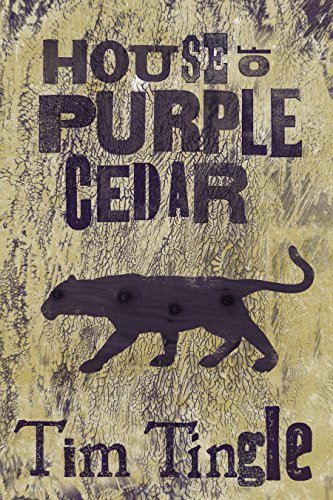
Written by: Tim Tingle
Published by: Cinco Puntos Press, January 14, 2014
ISBN: 978-1-935955-69-6
Plot Summary
Rose is the narrator and one of the main characters of House of Purple Cedar. As an old woman nearing death in 1967, she tells the story of growing up in Skullyville and of the events that occurred there around the turn of the century. Both the Choctaw people as well as the white citizens living in this small Oklahoma town are wary of the local marshall, Hardwicke, who is a known alcoholic. Rose begins with the story of her school, The New Hope Academy, burning down, which resulted in the deaths of 20 Choctaw girls, including her friend, Lillie Chukma, who was deaf and couldn't hear the calls to evacuate. Rose goes on to tell about her grandpa, Amafo's beating by the local marshall, which begins a series of events that effect the lives of many citizens of Skullyville.
Critical Analysis
As the person telling the story, Rose can be seen as the main character. However, the book often focuses on the other characters and Rose covers their stories almost as an omniscient narrator. Amafo's interaction with the marshall and his decision to not only forgive him but also to ensure that he is seen in the town having a positive interaction with him speaks to the type of person he is. His relationship with Pokoni is apparent not only through the way they treat each other while Pokoni is living, but also in the way that he seems to still depend on her even after her death.
Maggie is another strong character in the story who is introduced through her interaction with Amafo. She already does not have a positive opinion of the marshall, but his treatment of Amafo seems to solidify that negative opinion of him in her mind. She is aware of his cruelty, and thus know that even though Terrance poses no actual threat that Marshall Hardwicke will execute him, perhaps our of cruelty more than anything else. This, along with her immediate feelings towards Terrance leads her to act out of character. After being a dependable citizen and employee for many years, she breaks Terrance out of jail by using what she knows about the marshall against him. Although Maggie and Terrance are more minor characters, the inclusion of their stories adds humor and adventure to the book's plot.
The setting of the story takes center stage at times, when Rose describes the woods that surround their community. The woods give predators the perfect place to hide and observe their prey. This is true both of animals, but also of white men, both when they attempt to sneak up on Mingo and the children after Amafo is attacked, and when Marshall Hardwicke pursues Roberta Jean, thinking that she is Rose.
The book contains the language and cultural norms of the Choctaw people. This is apparent when, after Amafo's attack, all the members of the tribe arrive at Rose's house to discuss their next steps as a group. This is indicative of the communal nature of their tribe and how they are acting as a group rather than as individuals. There is also an interesting combination of their culture with the Christian religion to which they have been indoctrinated. The pastor of their church is a member of the Choctaw nation, but preaches Christian messages and baptizes the children. This is an experience that shows that these cultures can be intertwined and that being Choctaw and being Christian are not mutually exclusive. Of course,not all members of the Choctaw nation chose to become Christian and likely either held more traditional religious beliefs or none at all.
The climax of the book combines Rose and her family's trip home from their friends' house with the return of Marshall Hardwicke, who previously faked his own death. One is uncertain if the thing that is following Rose's family home is indeed a panther or Hardwicke himself. This creates a lot of tension and makes the moment of truth very dramatic when the reader discovers that it is actually a panther that has been watching them. An even bigger surprise occurs when the panther traps Rose, but does not harm her. Rose believes that the panther is her Pokoni, who has come back to watch over her. This belief is solidified when she sees her Amafo interact with the panther later that night.
Marshall Hardwicke does return that night, but to his own home rather than to Rose's. His long-suffering wife has finally come into her own and has grown into a stronger person after hearing of his supposed death. The book ends with a satisfying result for her, which is well-deserved after a hard life.
Awards Won
2016- American Indian Library Association Youth Literature Award (Young Adult Category)
Review Excerpt
From Kirkus Reviews, published October 20, 2013
"In quiet, often poetic language drawn from nature’s images and from Choctaw ethos, Tingle sketches Amafo, a marvelous character both wise and loving. Tingle writes of cultures clashing, certainly, but hatred from nahullos (whites) like Hardwicke is counterbalanced by the goodwill of others like John Burleson, railroad stationmaster, and one-legged store clerk Maggie Johnston. Despite assimilating elements of white culture, including Christianity, Tingle’s Choctaws maintain mystical connections to the land and its creatures. The tale is ripe with symbolism and peopled by riveting characters.
A lyrical, touching tale of love and family, compassion and forgiveness."
A lyrical, touching tale of love and family, compassion and forgiveness."
Connections
Read other books by Tim Tingle: How I Became a Ghost, Crossing Bok Chitto, or Stone River Crossing are suggestions.
Define the Choctaw words used throughout the story. Discuss the effect that the use of these words have on the story.



No comments:
Post a Comment